
Ingredients
Equipment
Method
Sift Dry Ingredients Multiple Times (Critical for Smooth Shells)
- Place a fine-mesh sieve over a large mixing bowl. Add 1 cup (100g) super-fine blanched almond flour and 1 3/4 cups (200g) confectioners' sugar. Sift them together, pressing gently with the back of a spoon or silicone spatula to push the fine particles through the mesh. Any large almond pieces or lumps that remain in the sieve should be DISCARDED—these would create bumps and imperfections on the surface of your French Buttercream Macarons. Repeat this sifting process at least ONE more time (sifting 2-3 times total is ideal for the smoothest possible shells). This tedious but essential step is what creates the signature smooth, glossy, professional-quality tops. Set the sifted almond-sugar mixture aside at room temperature.
Make the French Meringue (Building Stable Protein Foam Matrix)
- Ensure your stand mixer bowl and whisk attachment are completely clean, dry, and free of any grease or oil residue (even a tiny amount of fat will prevent egg whites from whipping properly). Place 100g (about 3 large eggs' worth) room-temperature aged egg whites in the bowl of a stand mixer fitted with the whisk attachment. For best results, egg whites should have been separated 2-3 days ahead and stored covered in the refrigerator to "age" (allows moisture to evaporate and proteins to concentrate), then brought to room temperature 30-45 minutes before use. Begin whipping on medium speed until the egg whites turn opaque, frothy, and start to increase in volume, about 1-2 minutes. Once the egg whites are foamy, begin adding 1/4 cup (50g) granulated white sugar very gradually—one tablespoon at a time—while continuing to whip on medium speed. Wait for each addition to be fully incorporated before adding the next. This gradual addition allows the sugar to dissolve properly and stabilize the foam structure. After all sugar is added, increase the mixer speed to medium-high and continue whipping for 4-6 minutes until the meringue reaches STIFF PEAKS: when you lift the whisk, the peaks should stand straight up without drooping or curling over. The meringue should look glossy, smooth, bright white, and thick like shaving cream. If using gel food coloring for tinted macarons, add 2-3 drops during the final minute of whipping and mix until color is evenly distributed. CRITICAL: Do not overwhip. If the meringue starts to look dry, grainy, clumpy, or separated, you have overwhipped and must start over with fresh egg whites. Perfect stiff-peak meringue is the foundation of perfect French Buttercream Macarons.
The Macaronage (Achieving the Critical Lava Stage)
- Add the ENTIRE bowl of sifted almond flour-sugar mixture to the stiff meringue all at once. Using a large, sturdy rubber spatula, begin the folding process called macaronage. Use a deliberate folding motion: cut straight down through the center of the mixture, scrape along the bottom of the bowl, then fold up and over the top, rotating the bowl slightly counterclockwise with each fold. The batter will initially look very dry, thick, broken, and clumpy—this is normal. Continue folding with confidence. As you fold, the meringue will gradually deflate, and the batter will become smoother, shinier, and more fluid. After approximately 25-30 folds, start checking the consistency carefully after every 5 folds. You are looking for the LAVA STAGE: the batter should flow like thick, slow-motion lava when you lift the spatula high above the bowl. It should fall in a thick, continuous, unbroken ribbon (not clumps, not waterfalls). When the ribbon hits the surface of the batter in the bowl, it should slowly melt back and disappear within 10-15 seconds. Perform the FIGURE-EIGHT TEST: lift the spatula and draw a figure-eight pattern in the air with the falling batter—the batter should hold its shape just long enough to complete the figure-eight before the ribbon breaks and melts back into the mass. This precise consistency usually takes 35-55 total folds depending on the initial stiffness of your meringue and your folding technique. CRITICAL: It is better to slightly undermix than overmix. If you undermix, you can always add 3-5 more folds. If you overmix, the batter becomes too runny and the macarons will spread flat with no structure—there is no fixing this. For French Buttercream Macarons, stop immediately when you reach the lava stage.
Pipe Macaron Shells with Precision
- Transfer the finished batter to a large piping bag fitted with a large round piping tip (Ateco or Wilton #10 or #12, about 1/2-inch opening). Line two large baking sheets with Silpat macaron mats (which have pre-printed circles as guides) or parchment paper (if using parchment, draw or print 1.5-inch diameter circles as guides using a template). Hold the piping bag perfectly perpendicular to the surface (straight up and down), with the tip about 1/2 inch above the mat. Pipe straight down with steady, even pressure to create 1.5-inch diameter circles. When each circle is filled, stop squeezing pressure completely, then lift the bag straight up with a quick twist of the wrist to cleanly break the batter and avoid leaving peaks. Space the piped circles at least 1-1.5 inches apart in all directions—they will spread slightly during resting and baking. Once all macarons are piped on both sheets, pick up each baking sheet and firmly RAP/TAP it flat on the counter 5-10 times. This releases any large air bubbles trapped inside the batter (which would create hollow shells or bumps). Use a toothpick to gently pop any visible surface bubbles you can see.
The Critical Resting Period (Skin Formation for Foot Development)
- Leave the piped macarons completely UNCOVERED at room temperature for 30-60 minutes (in high humidity environments above 60%, this may take up to 90 minutes). During this time, a dry skin will form on the surface of each macaron. This skin formation is ABSOLUTELY CRITICAL for proper foot development and crack prevention. To test if the skin has formed properly, very lightly touch the top of one macaron with a clean fingertip—if no batter sticks to your finger and the surface feels completely dry and matte (not tacky or wet), they are ready to bake. If batter sticks, wait longer. This resting step cannot be skipped or rushed. The dry skin prevents the top from rising during baking, which forces steam pressure to push downward and outward, creating the signature ruched foot at the base of French Buttercream Macarons.
Bake at Precise Temperature (Controlled Heat for Perfect Feet)
- While macarons are resting, preheat your oven to 300°F-325°F (150°C-160°C). CRITICAL: Use an oven thermometer to verify the actual internal temperature—many home ovens are off by 25°F or more. The exact temperature depends on your specific oven; 315°F (157°C) is often ideal. Position the oven rack in the center position. Once the macaron shells have formed a complete dry skin, place ONE baking sheet on the center rack (bake one sheet at a time for most even results). Bake for 14-16 minutes total, rotating the pan 180 degrees halfway through (at the 7-8 minute mark) for even browning and foot development. During the first 5-6 minutes of baking, watch through the oven window as the FEET form—you will see the characteristic ruffled, ruched base rise beneath each smooth dome. The tops should remain smooth, glossy, and should NOT brown or change color significantly (if they brown, your oven is too hot—reduce temperature by 10-15°F for the next batch). To test for doneness, gently touch the top of one macaron with your fingertip—it should feel completely firm and should NOT wobble or shift on its foot. If it wobbles at all, bake for an additional 2-3 minutes. Remove the baking sheet from the oven and let the macarons cool COMPLETELY on the pan—at least 15-20 minutes—before attempting to remove them. They should peel cleanly off the Silpat mat or parchment with no sticking and no tearing. If they stick, they are underbaked—next time, add 2-3 minutes to bake time.
Make the French Buttercream (Sabayon-Style Custard Emulsion)
- While macaron shells are cooling, prepare the French buttercream filling. In a small, heavy-bottomed saucepan, combine 2/3 cup (130g) granulated white sugar and 1/4 cup (60ml) water. Stir just until the sugar is moistened, then stop stirring. Place the pan over medium-high heat and insert a candy thermometer (clip it to the side of the pan so the bulb is submerged in the syrup but not touching the bottom). Heat the sugar syrup without stirring until it reaches exactly 235°F-240°F (113°C-116°C) on the candy thermometer—this is the soft-ball stage. While the syrup is heating, place 4 room-temperature egg yolks in the bowl of a stand mixer fitted with the whisk attachment. When the sugar syrup reaches the target temperature, immediately remove it from heat. Turn the stand mixer to medium speed and VERY SLOWLY drizzle the hot sugar syrup into the whipping egg yolks in a thin, steady stream. Aim for the side of the bowl (between the bowl wall and the whisk) rather than pouring directly onto the spinning whisk—this prevents dangerous splattering of boiling syrup. Once all the syrup has been added, increase the mixer speed to medium-high and continue whipping for 8-10 minutes until the egg-syrup mixture (called a sabayon) is thick, pale yellow, fluffy, voluminous, and has cooled completely to room temperature when you touch the outside of the bowl. This extended whipping cools the mixture, thickens it, and creates the base for the buttercream. With the mixer running on medium speed, begin adding the 1 cup (227g) softened room-temperature butter ONE TABLESPOON at a time, waiting for each piece to fully incorporate before adding the next. The mixture may look curdled, separated, or soupy at various points—this is normal. KEEP MIXING. It will come together into a smooth, silky, luxurious emulsion. Once all butter is incorporated, add 1 teaspoon vanilla extract (or other flavoring of choice) and mix on medium-high for 1-2 minutes until the buttercream is smooth, glossy, and custard-like. If the buttercream seems too soft or runny, refrigerate it for 10-15 minutes, then re-whip on medium-high speed until it firms up and becomes fluffy. This is the silky, melt-in-your-mouth French buttercream that makes French Buttercream Macarons legendary.
Assemble and Mature (The 24-48 Hour Secret)
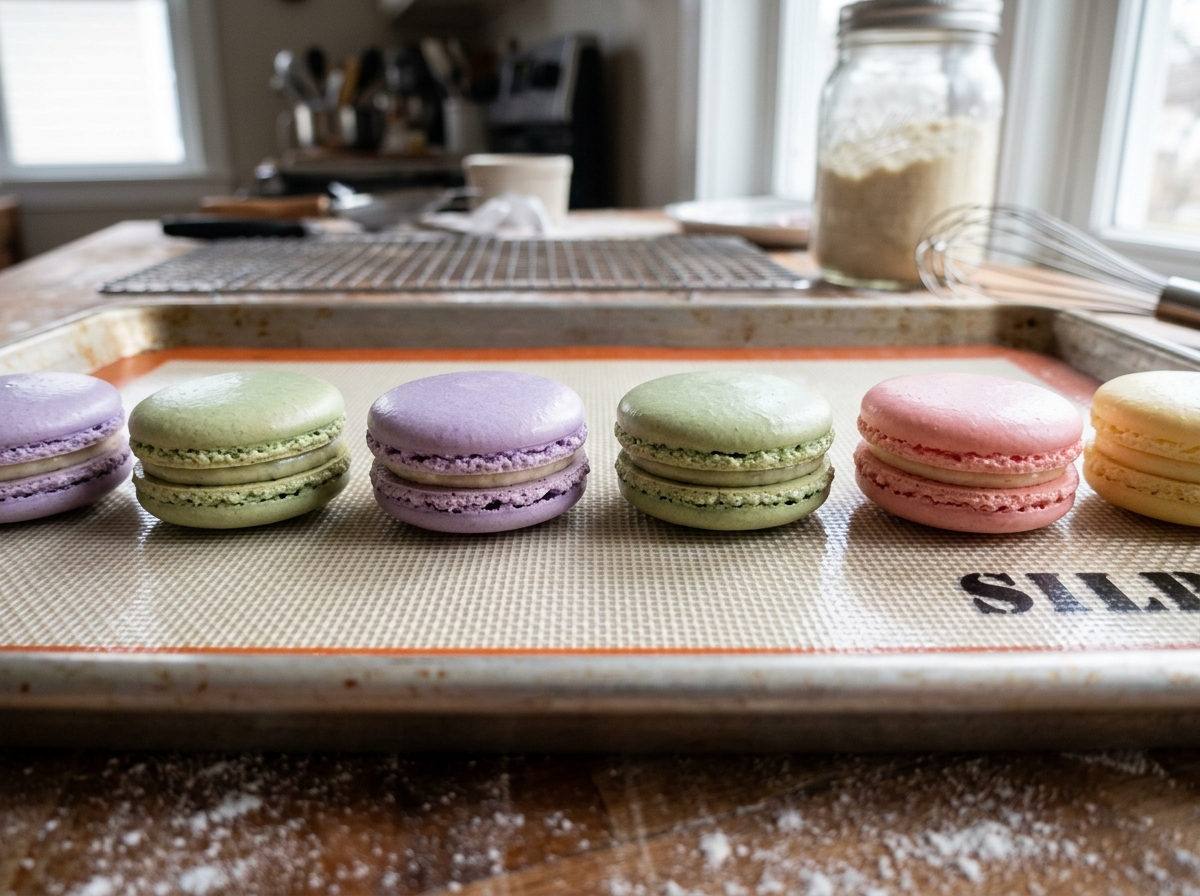
- Once macaron shells are completely cool, match them into pairs of similar size and shape. Transfer the French buttercream to a piping bag fitted with a medium round tip, or simply use a spoon. Pipe or spoon a generous dollop of buttercream (about 1-1.5 tablespoons) onto the flat bottom of one shell from each pair. Gently press the flat bottom of the matching shell on top to create a sandwich, applying just enough pressure to spread the buttercream to the edges without it oozing out excessively. Repeat until all shells are filled. Here is the SECRET that transforms good macarons into extraordinary French Buttercream Macarons: DO NOT EAT THEM IMMEDIATELY. Place the filled macarons in a single layer in an airtight container and refrigerate for 24-48 hours. This maturation period is called "affinage" in French pastry. During this time, moisture from the buttercream slowly migrates into the macaron shells through osmosis, transforming them from crisp and delicate to perfectly chewy with a tender, melt-in-your-mouth texture. The flavors also meld and deepen. This step is not optional—it is what separates homemade macarons from professional French Buttercream Macarons. When ready to serve, remove macarons from the refrigerator and let them sit at room temperature for 20-30 minutes to take the chill off. The buttercream should be soft and the shells should be at room temperature for the best texture and flavor experience.
Notes
Aging Egg Whites is Critical: Separate egg whites 2-3 days before baking and store them covered in the refrigerator. Aging allows moisture to evaporate, concentrating the proteins and creating more stable, stronger meringue. Bring aged whites to room temperature before whipping. Fresh egg whites produce weaker meringue that is more prone to deflating during macaronage.
Humidity is the Enemy: French Buttercream Macarons are extremely sensitive to humidity. Ideal conditions are 40-50% relative humidity. Above 60% humidity, shells may never form a dry skin and will crack during baking. Use a dehumidifier, extend resting time, or wait for a drier day. Some bakers preheat the oven empty at 200°F for 10 minutes to reduce kitchen humidity before baking.
The Lava Stage is Everything: Macaronage is where 90% of home bakers fail. Undermixing results in thick batter that cracks and doesn't develop feet. Overmixing results in runny batter that spreads flat with no structure. Practice the figure-eight test and ribbon test. Count your folds (usually 35-55) and check consistency every 5 folds after fold 30. Stop at lava stage.
Sift Multiple Times: Sifting almond flour and powdered sugar together 2-3 times removes lumps, large almond pieces, and creates the ultra-smooth surface that defines professional French Buttercream Macarons. Do not skip this step.
Resting Forms the Skin: The 30-60 minute uncovered rest at room temperature allows a dry skin to form on the surface. This skin is essential—it prevents cracking and directs steam pressure downward to form the foot. Touch-test: finger should not stick to surface.
Oven Temperature Matters: Use an oven thermometer. Too hot (above 325°F) = cracked tops, hollow shells, browned surfaces. Too cold (below 300°F) = no feet, flat shells, won't release from mat. Ideal range is 300°F-325°F depending on your oven. Most home bakers find 310°F-320°F works best.
Cool Completely Before Removing: Macarons must cool at least 15-20 minutes on the pan. If you try to remove them hot, they will stick, tear, and fall apart. They should peel cleanly when fully cool.
24-48 Hour Maturation is Mandatory: Do NOT eat French Buttercream Macarons fresh out of the oven. Refrigerate filled macarons for 24-48 hours to allow moisture migration from filling into shells. This creates the perfect chewy texture and melds flavors. This is the secret to bakery-quality macarons.
French vs. Italian Meringue: French meringue (this recipe) whips egg whites with granulated sugar—simpler, more delicate, traditional. Italian meringue whips hot sugar syrup into egg whites—more stable, more forgiving for beginners, but requires candy thermometer. Both work for macarons; French is classic.
Weigh Everything: Macarons require gram-level precision. Volume measurements (cups, tablespoons) are too inaccurate. Use a digital kitchen scale and weigh all ingredients in grams.
Gel Food Coloring Only: Liquid food coloring adds water that destabilizes meringue. Always use gel-based food coloring (Americolor, Wilton, Chefmaster). Add 2-3 drops during final minute of whipping meringue.