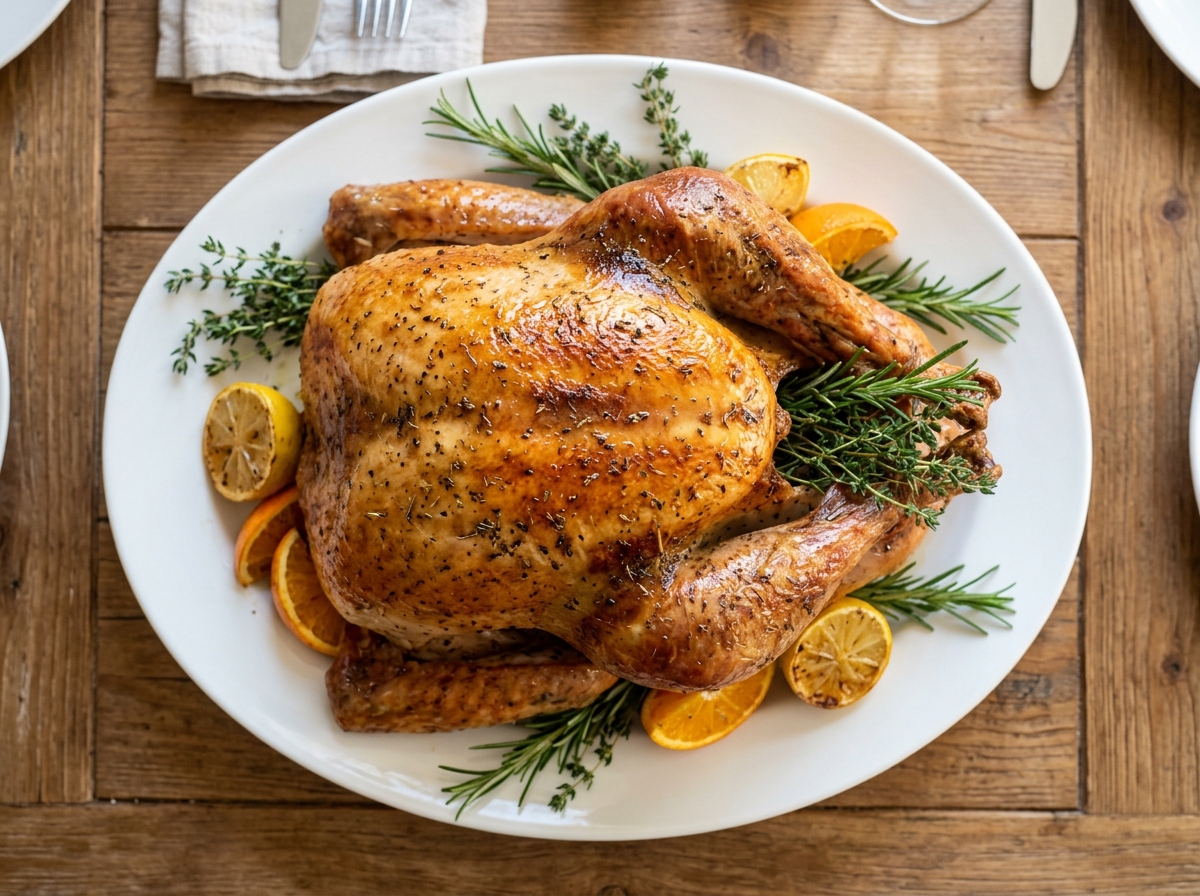

Ingredients
Equipment
Method
Step 1 - Thaw the Turkey Completely
- If starting with frozen turkey, thaw completely in refrigerator at rate of 24 hours per 4-5 pounds. For 16 lb turkey, plan 4 days thawing time. Turkey is fully thawed when cavity is free of ice and breast feels soft when pressed. NEVER thaw at room temperature—this allows bacteria to multiply. Turkey must be completely thawed before brining begins.
Step 2 - The Aromatics Boil (Building Flavor)
- In medium saucepan, combine 2 cups water with all aromatics: thyme, rosemary, sage, bay leaves, garlic, orange quarters, lemon quarters, peppercorns, and brown sugar (if using). Bring to boil over high heat. Once boiling, reduce heat and simmer 5 minutes to extract essential oils from herbs and citrus. Remove from heat and let cool to room temperature. This aromatic concentrate will be added to main brine.
Step 3 - The Ice Bath Chill (Critical for Food Safety)
- In brining container (5-gallon bucket, stockpot, or cooler), combine 2 gallons cold water with kosher salt. Stir vigorously until salt is completely dissolved (2-3 minutes of stirring). Add cooled aromatic concentrate to saltwater. Stir to combine. Add 4-6 pounds ice directly to brine. Stir until most ice has melted. Check temperature with thermometer—brine MUST be below 40°F (4°C) before adding turkey. This is non-negotiable for food safety. Warm brine creates breeding ground for bacteria.
Step 4 - Prepare the Turkey
- Remove turkey from packaging. Reach inside cavity and remove giblet packet (usually contains neck, heart, liver, gizzard). Save for gravy if desired. Rinse turkey briefly under cold water to remove any residual packaging fluids. Pat dry with paper towels. DO NOT BRINE if turkey is labeled 'enhanced,' 'basted,' 'self-basting,' or 'contains solution'—these are already pre-salted.
Step 5 - The Full Submerge (Osmosis Begins)
- Carefully lower turkey into chilled brine, breast-side down. Turkey should be completely submerged. If it floats or parts are exposed, place heavy plate or sealed bag of ice on top to weigh it down. Cover container with lid or plastic wrap. Store in refrigerator OR in cooler with ice. If using cooler, add ice packs or frozen water bottles around turkey to keep temperature below 40°F (4°C). Check and replenish ice every 4-6 hours. Brine temperature must stay between 32°F-40°F at all times.
Step 6 - Brine Time (Osmosis at Work)
- Brine turkey for 12-18 hours. Do NOT exceed 24 hours—over-brining results in mushy, spongy meat. During this time, osmotic pressure drives water and salt into muscle cells. Salt denatures myosin and actin proteins, creating gel matrix that traps moisture during roasting. For 12-14 lb turkey: 12-15 hours. For 14-16 lb turkey: 15-18 hours. Only very large birds (20+ lbs) should brine full 24 hours. Trust the science—let osmosis work.
Step 7 - Rinse and Dry
- After brining, remove turkey from brine. Discard brine—it is NOT reusable and contains bacteria. Rinse turkey thoroughly under cold running water, inside and out. This removes excess salt from surface. If you skip this step, skin will be unbearably salty. Pat turkey completely dry with paper towels, inside and out. Pay special attention to skin.
Step 8 - The Air-Dry Phase (For Crispy Skin)
- This is secret to crispy skin after brining. Place turkey on wire rack set over rimmed baking sheet. Refrigerate UNCOVERED for 8-12 hours (or overnight). Circulating cold air will dry out skin. Dry skin browns and crisps far better than wet skin. Additionally, turkey will come closer to room temperature, which promotes even cooking. Do NOT skip this step if you want golden, crackling skin. This is difference between professional-quality roasted turkey and home-cooked mediocrity.
Step 9 - Roast as Usual
- Once turkey is air-dried, roast using your preferred method. Because turkey is pre-salted from brining, DO NOT add additional salt to outside. You can brush with butter, add herbs, or season with pepper, but skip the salt. Roast at 325°F-350°F (163°C-177°C) until thickest part of breast reaches 160°F (71°C). Remove from oven and let rest 20-30 minutes. Carryover cooking will bring internal temperature to USDA-safe 165°F (74°C). Because you brined correctly, breast meat will retain moisture even at this temperature.
Notes
**Critical Food Safety Guidelines:** - Brine temperature MUST stay below 40°F (4°C) at ALL times - If brine rises above 40°F for more than 2 hours, discard turkey and start over - NEVER thaw turkey at room temperature - Discard brine after use—NOT reusable - Check turkey label: If says 'enhanced,' 'basted,' or 'contains solution,' DO NOT BRINE **Brining Time Guidelines:** - 12-14 lb turkey: 12-15 hours - 14-16 lb turkey: 15-18 hours - 16-20 lb turkey: 18-20 hours - 20-24 lb turkey: 20-24 hours (maximum) - NEVER exceed 24 hours—causes mushy texture **Salt Concentration Guide:** - Ideal salinity: 5-6% by weight - Morton Kosher Salt: 1½ cups (360g) per 2 gallons water - Diamond Crystal Kosher Salt: 2 cups (360g) per 2 gallons water - DO NOT use table salt—too fine, measurements don't match - Always measure by weight for accuracy **Wet Brine vs Dry Brine:** - Wet brine: 8-12% moisture gain, more thorough seasoning, requires space - Dry brine: 3-5% moisture gain, crispier skin, less mess - Wet brine recommended for maximum juiciness - Dry brine recommended for crispy skin priority **Turkey Selection:** - Choose NATURAL, UN-ENHANCED turkeys only - Best brands: Mary's Free-Range, Diestel Turkey Ranch - Avoid: Butterball or any labeled 'basted' or 'enhanced' - Check label carefully for 'contains solution' language - Heritage breeds work beautifully with wet brining **Brining Location Options:** - Refrigerator: Best for food safety (ideal) - Cooler with ice: Check/replenish ice every 4-6 hours - Cold garage/basement: Only if ambient temp below 40°F, monitor closely **The Air-Dry Phase (Non-Negotiable for Crispy Skin):** - After rinsing, refrigerate uncovered 8-12 hours - Dry skin = crispy, golden skin - Wet skin = rubbery, pale skin - This step separates amateur from professional results **Roasting After Brining:** - DO NOT add additional salt before roasting - Turkey is already seasoned internally - Can add: butter, herbs, pepper, aromatics - Roast to 160°F (71°C) breast temp, rest to 165°F (74°C) **Osmosis Science Explained:** - Salt concentration outside cells higher than inside - Water moves from low to high concentration (osmosis) - Turkey absorbs 8-12% weight in water - Salt denatures proteins (myosin, actin) - Result: Moisture retained even after roasting to 165°F **Common Mistakes to Avoid:** - Using pre-brined/enhanced turkey (unbearably salty) - Brining over 24 hours (mushy texture) - Not rinsing after brining (too salty surface) - Using hot water (bacteria growth) - Not fully submerging turkey (uneven seasoning) - Skipping air-dry phase (rubbery skin) - Using table salt (wrong measurements) - Letting brine temp rise above 40°F (food safety risk) **USDA Resources:** - Turkey safety: fsis.usda.gov/food-safety - Danger zone: 40°F-140°F (4°C-60°C) - Safe minimum temp: 165°F (74°C) - Max time at room temp: 2 hours