Blueberry Buttermilk Pancakes: The Science of the Fluff
By Chef Mansoor | The Flavor Bazaar
The Golden Stack Moment
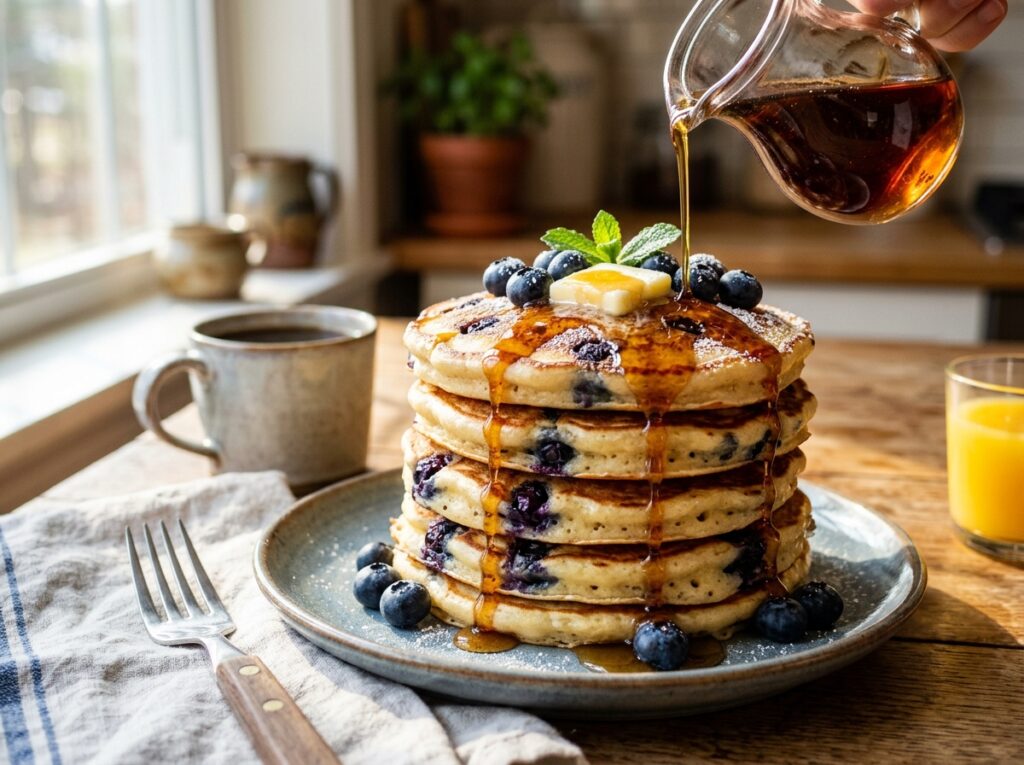
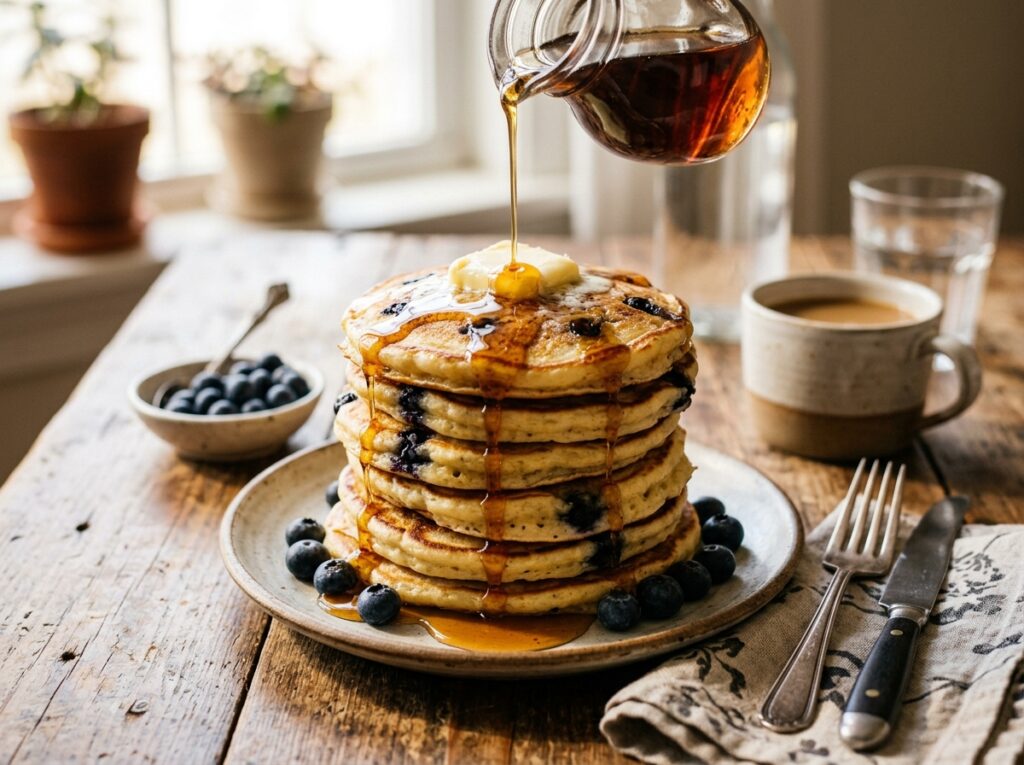
There is something about a tall stack of Blueberry Buttermilk Pancakes that makes everything else in the world pause. The butter cube slowly melting into golden rivers. The blueberries, plump and dark purple, suspended perfectly in each thick, golden layer. The maple syrup catching the morning light as it cascades down the sides. And when you cut through with the edge of your fork, the interior is so tender, so cloud-like, that it almost dissolves on your tongue.
I have measured the bubble-retention rate of various batters to prove that Blueberry Buttermilk Pancakes achieve their maximum height through a specific acid-base interaction that most home cooks overlook. It is not about adding more baking powder or whipping the eggs longer. It is about understanding the instant CO2 reaction between buttermilk’s lactic acid and baking soda’s sodium bicarbonate, and knowing that the moment that reaction happens, you have a narrow window to get those pancakes on the griddle before the gas escapes.
This is not a quick weekday breakfast. These are Sunday morning Blueberry Buttermilk Pancakes—the kind that require actual buttermilk (not milk with vinegar), fresh or properly handled frozen blueberries, and a griddle held at a precise 375°F (190°C) so the interior cooks through before the exterior burns. When you understand the science, you will never settle for flat, rubbery pancakes again.
The Science: Why Buttermilk and Baking Soda Make Blueberry Buttermilk Pancakes Rise
The Acid-Base Lift: Instant CO2 Production
The secret to truly fluffy Blueberry Buttermilk Pancakes is not magic—it is chemistry. When you combine buttermilk (which contains lactic acid, with a pH around 4.5) with baking soda (sodium bicarbonate, a base), you trigger an acid-base neutralization reaction that produces three things: a salt (sodium lactate), water, and most importantly, carbon dioxide gas (CO2).
NaHCO3+HC3H5O3→NaC3H5O3+H2O+CO2↑
In simple terms: when buttermilk and baking soda meet, they fizz and bubble, releasing thousands of tiny CO2 gas bubbles throughout the batter. Those bubbles get trapped in the gluten network formed by the flour proteins. When you pour the batter onto a hot griddle, the heat causes the bubbles to expand rapidly, lifting and aerating the pancakes as they cook. This is why properly made Blueberry Buttermilk Pancakes are thick, fluffy, and almost sponge-like in texture.
But here is the critical detail most recipes skip: this reaction begins immediately. The moment buttermilk touches baking soda, CO2 starts escaping. If you let the mixed batter sit for ten or fifteen minutes before cooking, you lose much of that lift. The bubbles dissipate, and you end up with dense, flat pancakes. For maximum fluff in Blueberry Buttermilk Pancakes, you need to mix the batter quickly, gently, and cook it immediately.
The Lumpy Batter Rule: Why Overmixing Kills Fluff
Flour contains two proteins—glutenin and gliadin—that, when hydrated and agitated, form gluten. Gluten is essential for bread (it creates chew and structure), but it is the enemy of tender Blueberry Buttermilk Pancakes. The more you stir the batter, the more gluten develops, and the tougher and chewier your pancakes become.
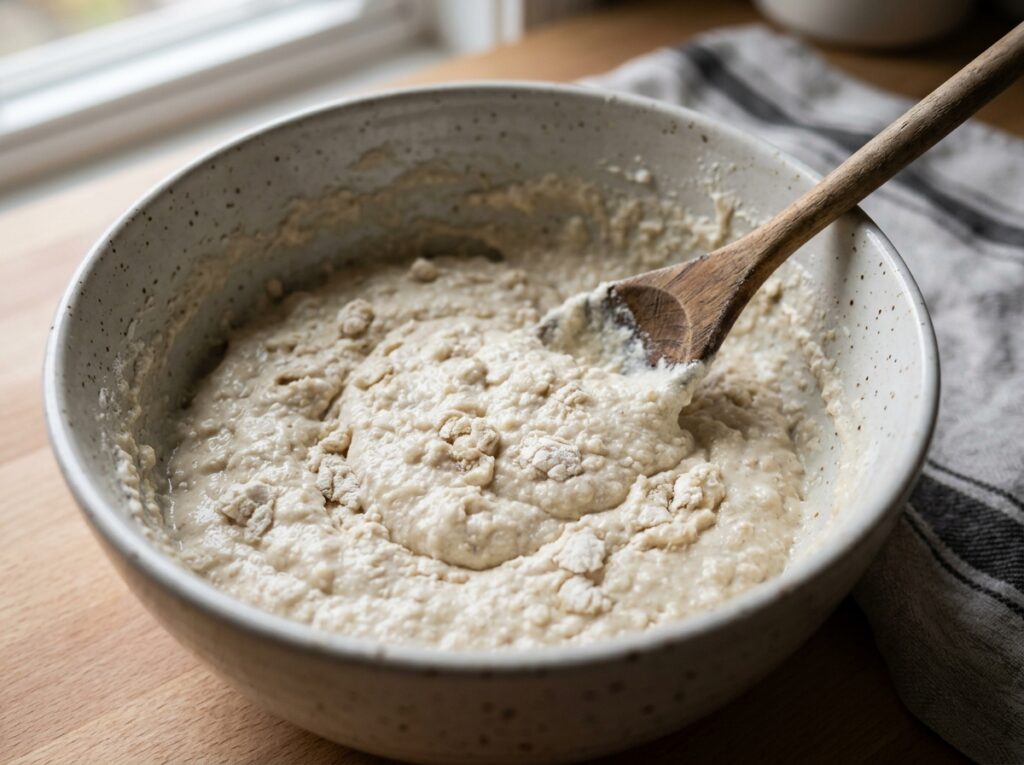
The professional secret: keep the batter lumpy. When you combine wet and dry ingredients, stir just until the flour is barely moistened. The batter should look rough, uneven, and full of small lumps. These lumps are pockets of dry flour that will hydrate gently as the pancakes cook, creating a tender crumb without overdeveloped gluten. If your batter is smooth and silky, you have overmixed, and your Blueberry Buttermilk Pancakes will be tough and rubbery instead of light and fluffy.
Anthocyanins: Why Blueberries Sometimes Turn Green
Blueberries get their deep purple-blue color from anthocyanins—a class of water-soluble pigments that are also powerful antioxidants. Anthocyanins are pH-sensitive. In acidic environments (like buttermilk batter), they stay blue-purple. But if your batter becomes too alkaline (too much baking soda relative to buttermilk, or if you use baking powder instead), the anthocyanins shift to a blue-green or even gray-green color.
This is why some Blueberry Buttermilk Pancakes turn an unappetizing greenish hue. The fix: use the correct ratio of buttermilk to baking soda (about 1 cup buttermilk to 1/2 teaspoon baking soda), and avoid adding extra baking soda “for more rise.” The recipe is already balanced. Trust the chemistry.
🛒 Pro Buying Guide: Ingredients That Make Championship Blueberry Buttermilk Pancakes (USA)
Flour: King Arthur All-Purpose for Tender Structure
King Arthur All-Purpose Flour (available at Walmart, Target, Whole Foods, most supermarkets) has a moderate protein content (11.7%) that creates just enough structure for Blueberry Buttermilk Pancakes without making them tough. Avoid bread flour (too much protein/gluten) and cake flour (too soft, pancakes fall apart). All-purpose is the Goldilocks choice.
Buttermilk: Cultured, Full-Fat, Real
Use real cultured buttermilk (not milk mixed with vinegar or lemon juice—that is a substitute, not the same thing). Buttermilk is a fermented dairy product with live cultures that add tangy flavor and the lactic acid needed for the CO2 reaction with baking soda. Brands like Organic Valley, Horizon Organic, or store-brand cultured buttermilk all work beautifully. Low-fat is acceptable, but full-fat gives richer flavor and more tender Blueberry Buttermilk Pancakes.
Blueberries: Driscoll’s Fresh or Properly Frozen
Fresh Driscoll’s Blueberries (or any high-quality fresh blueberries from farmers’ markets, Whole Foods, Trader Joe’s) are ideal during blueberry season (May–September in the USA). Look for firm, plump berries with a powdery white “bloom” on the skin—that is a sign of freshness, not dirt.
Frozen blueberries work year-round and are often sweeter because they are flash-frozen at peak ripeness. The key: toss frozen blueberries in a tablespoon of flour before folding them into the batter. This prevents them from sinking to the bottom, bleeding excessive juice, and turning the entire batter blue-gray. Do not thaw frozen berries—use them straight from the freezer.
Baking Soda and Baking Powder: Bob’s Red Mill
You need both baking soda (for the instant acid-base CO2 reaction with buttermilk) and a small amount of baking powder (for extended lift during cooking). Bob’s Red Mill (available everywhere) is aluminum-free and reliable. Check expiration dates—old leavening agents lose potency and result in flat Blueberry Buttermilk Pancakes.
Maple Syrup: Pure Vermont Grade A
Pure Vermont Maple Syrup (or any 100% pure maple syrup—not “pancake syrup” or corn syrup blends) is the gold standard. Grade A Amber has a balanced, not-too-assertive maple flavor that complements blueberries without overpowering them. Brands like Anderson’s, Butternut Mountain Farm, or Trader Joe’s Pure Maple Syrup are excellent.
Griddle: Lodge Cast Iron or Electric at 375°F
A Lodge Cast Iron Griddle (available at Walmart, Target, Amazon) holds steady, even heat and creates beautiful golden-brown crusts on Blueberry Buttermilk Pancakes. Preheat it over medium heat for 5–7 minutes before cooking.
Alternatively, a non-stick electric griddle (like Presto or Cuisinart models) with a precise temperature dial set to 375°F (190°C) is foolproof. This is the sweet spot: hot enough to set the exterior quickly and create bubbles, but not so hot that the outside burns before the inside cooks through.
📊 Ingredients Table (US Customary + Metric)
| Ingredient | US Customary | Metric |
|---|---|---|
| All-purpose flour | 2 cups | 240g |
| Granulated sugar | 2 tablespoons | 25g |
| Baking powder | 1 teaspoon | 4g |
| Baking soda | 1/2 teaspoon | 2.5g |
| Fine sea salt | 1/2 teaspoon | 3g |
| Buttermilk, room temperature | 2 cups | 480ml |
| Large eggs, room temperature | 2 | 2 |
| Unsalted butter, melted and slightly cooled | 4 tablespoons | 57g |
| Vanilla extract | 1 teaspoon | 5ml |
| Fresh or frozen blueberries | 1 1/2 cups | 220g |
| All-purpose flour (for tossing frozen berries) | 1 tablespoon | 8g |
For Serving:
- Unsalted butter pats
- Pure maple syrup
- Extra fresh blueberries (optional)
Yield: 12–14 pancakes (4-inch diameter)
Servings: 4–6 people
Prep Time: 10 minutes
Cook Time: 20 minutes
Total Time: 30 minutes
⚠️ Common Mistakes Table (8 Mistakes That Ruin Blueberry Buttermilk Pancakes)
| The Mistake | What Actually Happens | The Fix |
|---|---|---|
| Over-mixing the batter | Gluten develops; pancakes turn tough, chewy, and dense instead of fluffy | Stir just until flour is moistened; batter should be lumpy with visible dry pockets |
| Using cold eggs and buttermilk | Cold ingredients slow CO2 reaction; batter doesn’t rise as much | Bring eggs and buttermilk to room temp 30 min before mixing |
| Flipping too early (before bubbles pop) | Pancakes deflate and stay gummy/undercooked in center | Wait until bubbles form on surface, pop, and edges look set before flipping |
| Pressing down with a spatula after flipping | Squeezes out CO2 gas; pancakes turn flat and dense | Never press! Let pancakes cook undisturbed after flipping |
| Using batter that has sat out too long | CO2 escapes; batter loses lift; pancakes are flat and heavy | Cook batter immediately after mixing; don’t let it sit more than 5 minutes |
| Griddle too hot or too cold | Too hot = burnt outside, raw inside; too cold = pale, dense pancakes | Use 375°F (190°C) exact temp; test with water droplet (should sizzle and dance) |
| Not tossing frozen berries in flour | Berries sink to bottom; bleed juice; batter turns gray-blue throughout | Toss frozen berries in 1 tbsp flour before folding into batter |
| Using fake maple syrup | Corn syrup tastes flat, chemical, and overly sweet; ruins the experience | Always use 100% pure maple syrup for clean, balanced sweetness |
🔪 Step-by-Step Method: Mastering Blueberry Buttermilk Pancakes (Prose Only)
Step 1: The Dry-Wet Separation (Preparing for the CO2 Reaction)
In a large mixing bowl, whisk together two cups all-purpose flour, two tablespoons granulated sugar, one teaspoon baking powder, half a teaspoon baking soda, and half a teaspoon fine sea salt. Whisk thoroughly to distribute the leavening agents evenly—this is critical for uniform rise in your Blueberry Buttermilk Pancakes. Set this dry mixture aside.
In a separate medium bowl, whisk together two cups room-temperature buttermilk, two room-temperature eggs, four tablespoons melted and slightly cooled butter, and one teaspoon vanilla extract. Whisk just until combined and smooth. Room temperature ingredients are essential—cold eggs and buttermilk slow down the acid-base reaction and reduce CO2 production, resulting in less fluffy Blueberry Buttermilk Pancakes.
Step 2: The Lumpy Batter Rule (Minimal Mixing, Maximum Tenderness)
Pour the wet ingredients into the bowl of dry ingredients. Using a wooden spoon, rubber spatula, or whisk, stir gently and quickly just until the flour is mostly moistened. Stop while the batter is still lumpy, uneven, and rough-looking. You should see small pockets of dry flour and the batter should look like it barely came together. This takes only 10–15 gentle stirs. Do not keep stirring to make it smooth—smooth batter means overdeveloped gluten, which means tough, chewy Blueberry Buttermilk Pancakes instead of tender, fluffy ones.
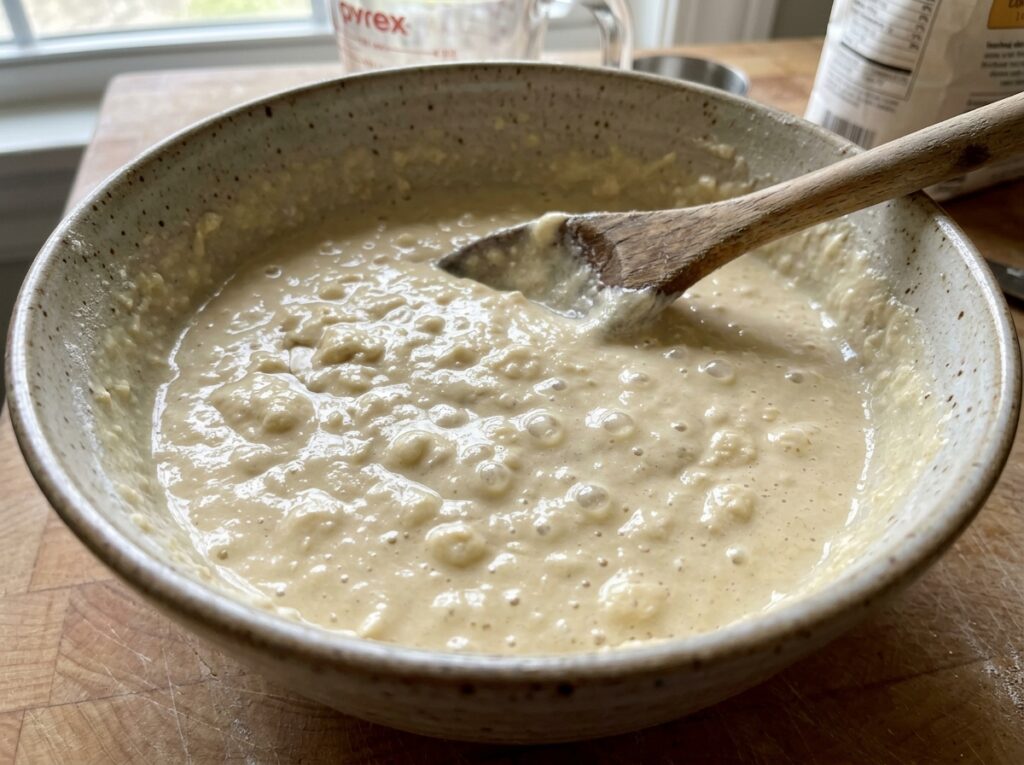
The moment you finish mixing, you will see tiny bubbles forming on the surface as the buttermilk and baking soda react and produce CO2. This is exactly what you want. The clock is ticking—get ready to cook immediately.
Step 3: The Berry Folding Technique (Preventing Sinking and Bleeding)
If you are using fresh blueberries, gently fold them into the batter now using a rubber spatula. Fold carefully to avoid crushing the berries, which would release juice and turn the batter gray-blue.
If you are using frozen blueberries, place them in a small bowl while still frozen and toss them with one tablespoon of all-purpose flour until evenly coated. The flour coating creates a barrier that prevents the berries from sinking to the bottom of the batter and bleeding excessive juice as they thaw during cooking. Gently fold the flour-coated frozen berries into the batter. Do not thaw them first—frozen berries work better in Blueberry Buttermilk Pancakes because they hold their shape and release less moisture.
Step 4: Preheat the Griddle (Achieving the Perfect 375°F Sweet Spot)
Heat your cast iron griddle or non-stick electric griddle over medium heat (or set electric griddle to exactly 375°F / 190°C). Let it preheat for 5–7 minutes until evenly hot. Test the temperature by flicking a few drops of water onto the surface—if they sizzle, dance, and evaporate within 2–3 seconds, the griddle is ready. If the water just sits there, it is too cold. If it evaporates instantly in a violent hiss, it is too hot.
Lightly grease the griddle with a small pat of butter or a light spray of neutral oil (avoid heavy greasing, which makes pancakes greasy instead of fluffy). Wipe off any excess with a paper towel—you just want a thin, even coating.
Step 5: The Pour and the Bubble Watch (Timing the Perfect Flip)
Using a 1/3-cup measuring cup or ladle, pour the batter onto the hot griddle, spacing pancakes about 2 inches apart (they will spread slightly). Do not spread or smooth the batter with the cup—let it settle naturally into a thick, round shape. The thicker the pancake, the fluffier the final Blueberry Buttermilk Pancakes.
Now watch closely. Within 1–2 minutes, you will see small bubbles forming on the surface of the pancakes. These are CO2 gas bubbles rising through the batter. Wait until the bubbles pop and leave small holes, and the edges of the pancakes look set and slightly dry. This usually takes 2–3 minutes on the first side. Do not rush. Flipping too early means the center stays gummy and undercooked.
Step 6: The Perfect Flip (One Smooth Motion, No Pressing)
When the bubbles have popped, the surface looks mostly set with a few moist spots remaining, and the edges are golden-brown, slide a thin spatula under the pancake and flip it in one smooth, confident motion. The second side cooks faster—only about 1–2 minutes. You will see the edges puff up and the pancake rise to its full, fluffy height. Never press down on the pancakes with the spatula. Pressing squeezes out the CO2 gas you worked so hard to create, and your Blueberry Buttermilk Pancakes will turn flat and dense.
When the second side is golden-brown and the pancake feels springy when gently pressed with your finger, transfer it to a plate. Repeat with the remaining batter, adding a tiny bit more butter or oil to the griddle between batches if needed.
Step 7: The Stack and the Pour (The Moment of Glory)
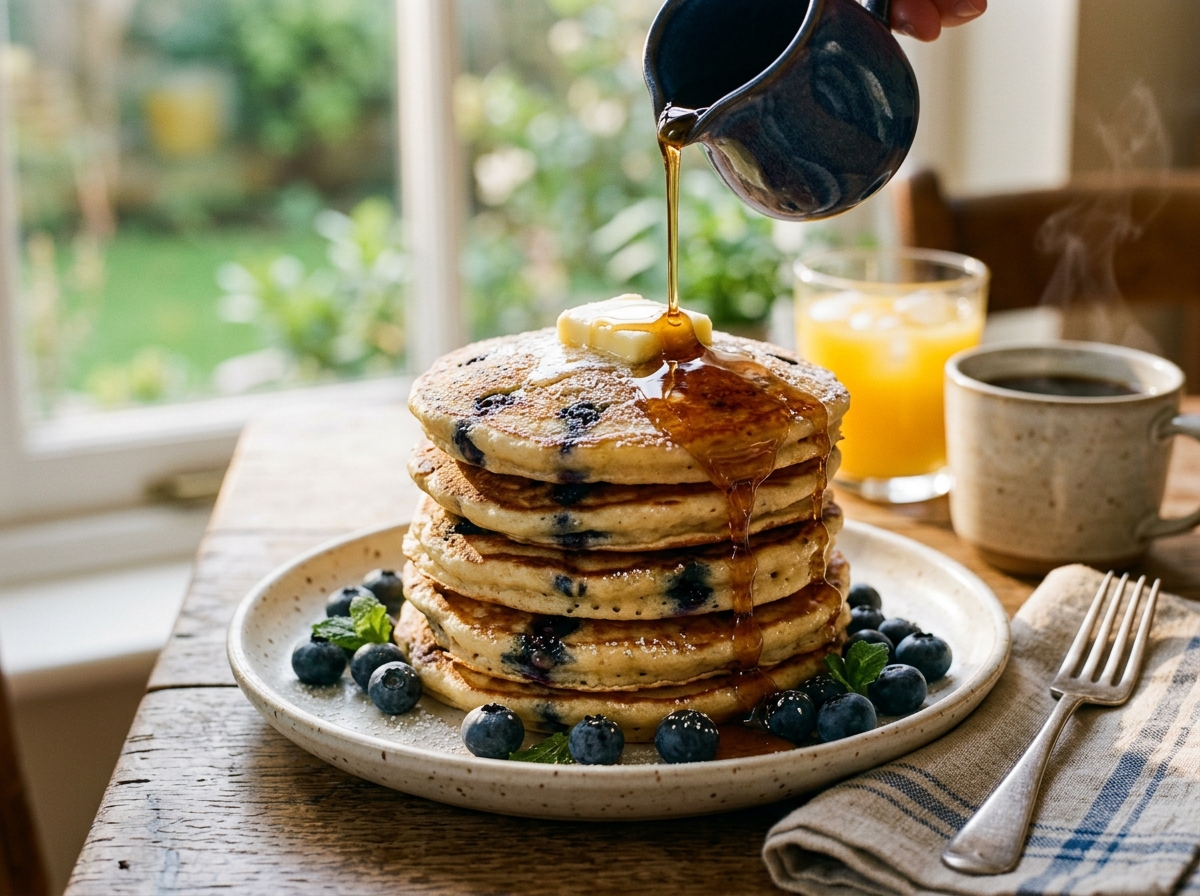
Stack your Blueberry Buttermilk Pancakes tall—three to four per serving. Place a generous pat of butter on top of the stack and let it melt slowly, creating golden rivers down the sides. Pour warm pure maple syrup generously over the stack, letting it pool between the layers and cascade down the edges. Scatter a handful of fresh blueberries around the plate for color and freshness.
Serve immediately while the pancakes are still hot, fluffy, and steaming. The interior should be so tender it almost melts on your tongue, with bursts of sweet-tart blueberry in every bite.

Blueberry Buttermilk Pancakes
Ingredients
Equipment
Method
- In a large mixing bowl, whisk together 2 cups all-purpose flour, 2 tablespoons granulated sugar, 1 teaspoon baking powder, 1/2 teaspoon baking soda, and 1/2 teaspoon fine sea salt. Whisk thoroughly for 20-30 seconds to ensure the leavening agents (baking powder and baking soda) are evenly distributed throughout the flour. This is critical for uniform rise and consistent texture in your Blueberry Buttermilk Pancakes. Set this dry mixture aside while you prepare the wet ingredients.
- In a separate medium mixing bowl, whisk together 2 cups room-temperature buttermilk, 2 room-temperature eggs, 4 tablespoons melted and slightly cooled unsalted butter, and 1 teaspoon vanilla extract. Whisk just until combined and the mixture is smooth and uniform. IMPORTANT: Room temperature ingredients are essential. Cold buttermilk and eggs slow down the acid-base reaction between the buttermilk (lactic acid) and baking soda (sodium bicarbonate), reducing CO2 gas production and resulting in less fluffy pancakes. If your buttermilk and eggs are cold from the refrigerator, let them sit at room temperature for 30 minutes before mixing, or place the eggs (still in shells) in a bowl of warm water for 5 minutes to take the chill off.
- Pour the wet ingredient mixture into the bowl of dry ingredients. Using a wooden spoon, rubber spatula, or whisk, stir gently and briefly—only 10 to 15 gentle strokes—just until the flour is mostly moistened. CRITICAL: Stop while the batter is still lumpy, rough, and uneven-looking. You should see small pockets of dry flour throughout, and the batter should look like it barely came together. This is correct and intentional. Do NOT continue stirring to make the batter smooth. A smooth batter means you have overdeveloped gluten (the protein network formed when flour proteins glutenin and gliadin are hydrated and agitated), which will make your Blueberry Buttermilk Pancakes tough, chewy, and dense instead of tender and fluffy. The lumps are pockets of dry flour that will hydrate gently as the pancakes cook, creating the tender, cloud-like crumb you want. The moment you finish mixing, you will see tiny bubbles forming on the batter surface—this is the buttermilk and baking soda reacting to produce CO2 gas. The clock is now ticking. You need to cook the batter immediately to capture that lift.
- If using FRESH blueberries: Gently fold 1 1/2 cups fresh blueberries into the batter using a rubber spatula. Fold carefully with just 3-4 strokes to avoid crushing the berries, which would release juice and turn the batter gray-blue. If using FROZEN blueberries: Place 1 1/2 cups frozen blueberries (do NOT thaw) in a small bowl and toss them with 1 tablespoon all-purpose flour until each berry is lightly coated. The flour coating creates a barrier that prevents the berries from sinking to the bottom during cooking and stops them from bleeding excessive juice as they thaw in the hot batter. This keeps your pancakes looking appetizing with distinct purple-blue berries instead of turning the entire batter a muddy gray-blue color. Gently fold the flour-coated frozen berries into the batter with just 3-4 strokes.
- Heat a cast iron griddle or non-stick electric griddle over medium heat. If using an electric griddle, set the temperature dial to exactly 375°F (190°C). If using a stovetop griddle or large skillet, let it preheat over medium heat for 5-7 minutes to ensure even heat distribution. Test the temperature by flicking a few drops of water onto the surface. The water should sizzle immediately, form dancing droplets that skitter across the surface, and evaporate completely within 2-3 seconds. If the water just sits and slowly steams, the griddle is too cold (pancakes will be pale and dense). If the water evaporates instantly in a violent hiss with no dancing, the griddle is too hot (pancakes will burn on the outside and stay raw inside). 375°F is the precise temperature that cooks the interior through while creating a golden-brown, slightly crisp exterior. Once at the correct temperature, lightly grease the griddle with a small pat of butter or a light spray of neutral oil (canola or vegetable oil). Wipe off any excess with a paper towel—you want just a thin, invisible coating. Too much grease makes the pancakes greasy instead of fluffy.
- Using a 1/3-cup measuring cup or ladle, pour the batter onto the hot greased griddle, spacing pancakes about 2 inches apart to allow for slight spreading. Do NOT spread, smooth, or manipulate the batter with the cup—let it settle naturally into a thick, round shape. Thicker pancakes = fluffier final texture. Pour as many pancakes as will comfortably fit without crowding (usually 3-4 on a standard griddle). Now watch the surface carefully. Within 1-2 minutes, you will see small bubbles forming on the top surface of the pancakes as CO2 gas rises through the batter. Wait patiently until the bubbles POP and leave small holes, and the edges of the pancakes look set, dry, and slightly matte instead of wet and glossy. This usually takes 2-3 minutes on the first side. Resist the urge to flip early. Flipping before the bubbles pop means the center will stay gummy, wet, and undercooked. Be patient and wait for the visual cues.
- When the bubbles have popped, the surface looks mostly set with just a few small moist spots remaining in the center, and the edges are golden-brown, slide a thin, wide spatula under each pancake and flip it in one smooth, confident motion. The second side cooks much faster than the first—only 1-2 minutes. You will see the pancake puff up dramatically as the heat causes the CO2 bubbles to expand to their maximum size. CRITICAL: Never press down on the pancakes with the spatula after flipping. Pressing squeezes out the CO2 gas you worked so hard to create through the buttermilk-baking soda reaction, and your Blueberry Buttermilk Pancakes will deflate and turn flat and dense. Let them cook completely undisturbed. When the second side is golden-brown and the pancake feels springy and firm (not squishy or wet) when gently pressed with your fingertip, transfer it to a serving plate or wire rack.
- Repeat the pouring, watching, and flipping process with the remaining batter. Add a tiny bit more butter or oil to the griddle between batches if needed, wiping off any excess. If you notice the griddle getting too hot (pancakes browning too quickly), reduce the heat slightly. If using an electric griddle, the temperature should stay consistent. If the batter thickens as it sits (which can happen as the flour continues to hydrate), you can gently stir in 1-2 tablespoons of buttermilk to loosen it slightly, but work quickly—the CO2 is escaping with every passing minute.
- Stack the Blueberry Buttermilk Pancakes 3-4 high on individual serving plates. Place a generous pat of unsalted butter on top of each stack and let it melt slowly, creating glossy golden rivers that run down the sides. Pour warm pure maple syrup generously over the stack, letting it pool between the layers and cascade down the edges. Scatter a handful of fresh blueberries around the plate for color, freshness, and visual appeal. Serve immediately while the pancakes are still hot, steaming, and at peak fluffiness. The interior should be so tender and cloud-like that it almost melts on your tongue, with bursts of sweet-tart blueberry throughout and a lightly crisp, golden-brown exterior.
- If you want to serve everyone at the same time instead of in batches, preheat your oven to 200°F (93°C). As pancakes finish cooking, transfer them to a wire rack set over a baking sheet (do NOT stack them directly or they will steam and become soggy). Keep warm in the oven for up to 20 minutes while you finish cooking the remaining batter.
Notes
🧘♂️ Chef Mansoor’s Insight
Breakfast is the only meal that feels like a hug. Dinner can be impressive. Lunch can be efficient. But breakfast, especially a Sunday morning stack of Blueberry Buttermilk Pancakes, is pure comfort.
It is not about speed or convenience or squeezing it in between tasks. It is about taking time when you have it, making something from scratch when you could just as easily pour cereal, and sitting down with people you love while the world is still quiet.
The science matters—the CO2 reaction, the gluten control, the precise temperature—but it only matters because it serves something bigger. These pancakes are not just food. They are the pause button. They are the reset. They are the quiet Sunday ritual that makes Monday feel possible.
📊 Nutrition Table (Per Serving, 3 Pancakes)
| Nutrient | Amount |
|---|---|
| Calories | 380 kcal |
| Total Carbohydrates | 54g |
| Total Sugars | 14g |
| Dietary Fiber | 3g |
| Protein | 11g |
| Total Fat | 13g |
| Saturated Fat | 7g |
| Cholesterol | 95mg |
| Sodium | 520mg |
| Vitamin C | 15% DV |
| Calcium | 20% DV |
| Iron | 12% DV |
| Antioxidants (Anthocyanins) | ~80mg |
Estimates based on USDA data for homemade pancakes with buttermilk, eggs, butter, and fresh blueberries. Values do not include butter and syrup for serving.
🌡️ Food Safety & Griddle Temperature Guide
Safe minimum internal temperature for eggs (fully cooked pancakes): 160°F (71°C) — pancakes should be cooked through with no raw batter
Ideal griddle temperature for Blueberry Buttermilk Pancakes: 375°F (190°C)
Water droplet test: Droplets should sizzle and evaporate in 2–3 seconds
Danger zone (do not hold): 40°F–140°F (4°C–60°C)
Holding cooked pancakes: Keep warm in a 200°F (93°C) oven on a wire rack (not stacked—they steam and get soggy)
Leftover storage: Refrigerate within 2 hours; consume within 3–4 days
🧊 Storage & Reheating Guide
| Storage Method | Duration | Best Reheating Practice |
|---|---|---|
| Refrigerator (cooled, stacked with parchment between) | 3–4 days | Reheat in toaster or 350°F oven for 5–7 min until warmed through and crisp |
| Freezer (individually wrapped, then bagged) | 2 months | Reheat from frozen in toaster or 350°F oven 8–10 min; microwave makes them rubbery |
| Room temperature | Not recommended | Pancakes with dairy and eggs enter danger zone after 2 hours |
| Microwave reheating | Not recommended | Makes pancakes soggy, rubbery, and deflated; always use oven or toaster |
Pro Tip: To freeze Blueberry Buttermilk Pancakes, let them cool completely, place parchment paper between each pancake, stack, wrap tightly in plastic wrap and foil, and freeze. Reheat straight from frozen for quick weekday breakfasts that taste freshly made.
❓ Frequently Asked Questions
Can I make Blueberry Buttermilk Pancakes without buttermilk?
You can make a substitute by adding 2 tablespoons lemon juice or white vinegar to 2 cups whole milk and letting it sit for 5 minutes to curdle. It provides the acid needed for the baking soda reaction, but it won’t have the same depth of tangy flavor as real cultured buttermilk.
Why are my pancakes flat and dense instead of fluffy?
Most common causes: (1) Overmixing the batter (develops too much gluten), (2) Old/expired baking soda or baking powder (no CO2 production), (3) Letting the batter sit too long before cooking (CO2 escapes), or (4) Cold ingredients (slows the acid-base reaction).
Should I use fresh or frozen blueberries in Blueberry Buttermilk Pancakes?
Both work. Fresh blueberries (in season May–September) have firmer texture and brighter flavor. Frozen blueberries work year-round and are often sweeter. If using frozen, toss them in 1 tablespoon flour while still frozen to prevent sinking and excessive bleeding.
Why do my blueberries turn green in the pancakes?
Blueberries contain anthocyanins (pH-sensitive pigments). If your batter is too alkaline (too much baking soda, not enough buttermilk), the anthocyanins shift from blue-purple to blue-green. Use the exact recipe ratios—don’t add extra baking soda.
What temperature should my griddle be?
Exactly 375°F (190°C). Too hot and the outside burns before the inside cooks; too cold and the pancakes stay pale and dense. Use an electric griddle with a dial, or test with water droplets (should sizzle and dance).
When should I flip the pancakes?
Wait until bubbles form on the surface, pop, and leave small holes, and the edges look set and dry. This takes about 2–3 minutes on the first side. Flipping too early results in gummy, undercooked centers.
Can I make the batter ahead of time?
No. The buttermilk-baking soda reaction produces CO2 immediately. If the batter sits for more than 5 minutes, the gas escapes and you lose the lift. Always cook Blueberry Buttermilk Pancakes immediately after mixing for maximum fluff.
How do I keep pancakes warm while cooking the rest of the batch?
Preheat your oven to 200°F (93°C). Place cooked pancakes on a wire rack set over a baking sheet (not stacked directly—they steam and get soggy). Keep warm in the oven for up to 20 minutes.
🔗 More from The Flavor Bazaar
If these Blueberry Buttermilk Pancakes made your morning, explore these other science-backed breakfast and berry recipes:
Strawberry Shortcake: The Science of the Perfect Crumb
More berry science and acid-base chemistry
The BEST BBQ Chicken Pizza: The Science of the Smoky Slice
Master another batter (pizza dough) with fermentation
Watermelon Mint Cooler: The Science of Summer Hydration
Refreshing pairing for a rich breakfast
Buttermilk Biscuits: The Science of Flaky Layers
Deep dive into buttermilk chemistry and fat lamination
Outbound Link (Authority Building):
🔬 Antioxidant Benefits of Cooked Blueberries (USDA Study) — Scientific research on how cooking increases anthocyanin bioavailability
For More Healthy Recipes Visit: flavourbazar.com