Mexican Street Corn (Elote): The Science of the Perfect Char
By Chef Mansoor | The Flavor Bazaar
The Sound, The Smoke, The Snap
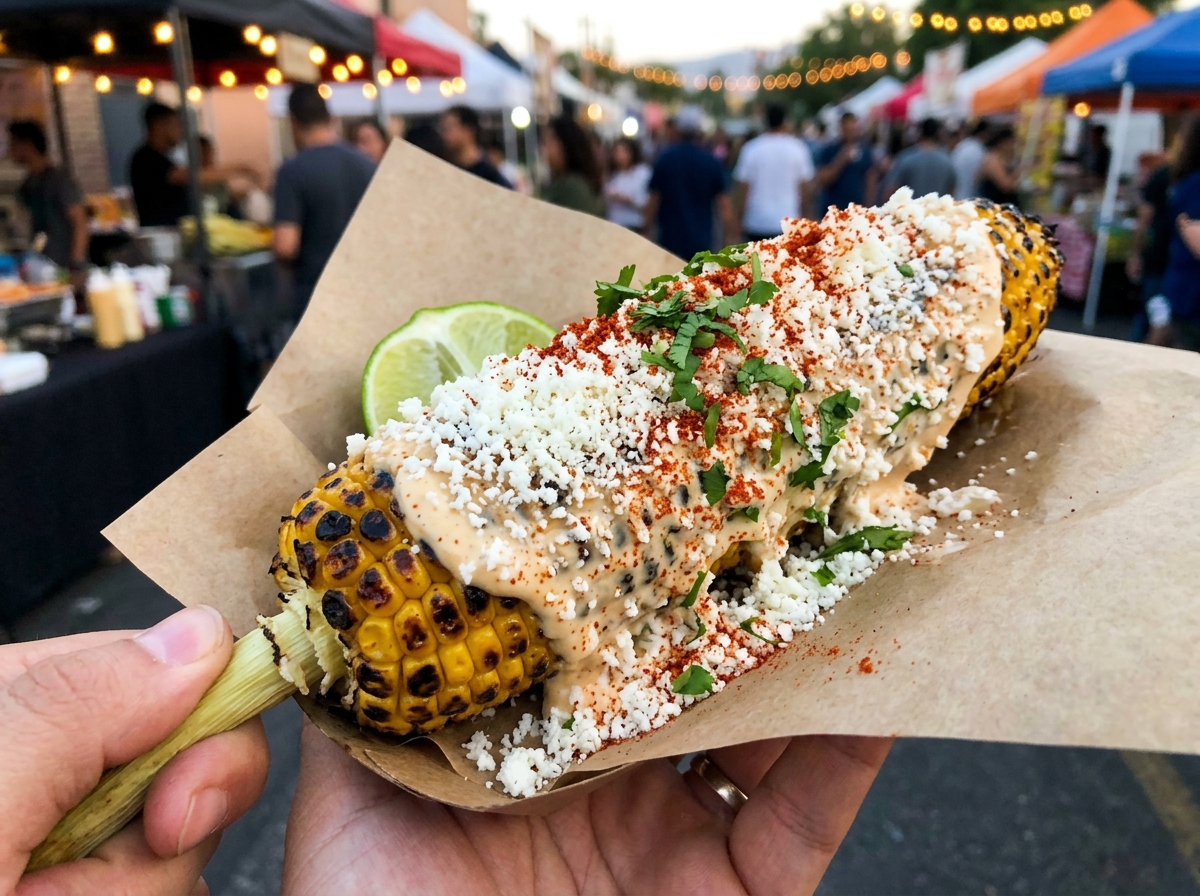
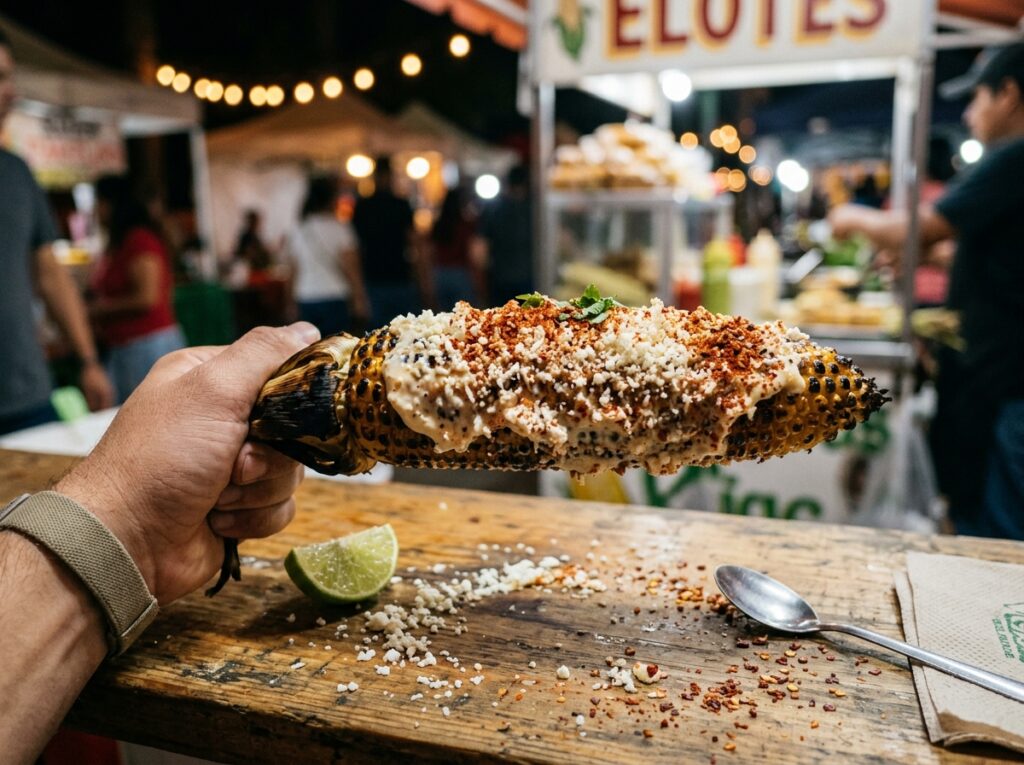
There is a moment on a city sidewalk or at a summer festival when you hear it before you see it—the sharp, rhythmic pop-pop-pop of corn kernels snapping under high heat, the hiss of fat hitting fire, the smell of caramelizing sugar mixing with char smoke. Then you see it: golden-yellow cobs turning slowly on a makeshift grill, blistering and blackening in spots, steam rising as the vendor slathers on a thick, creamy sauce and rolls the whole thing in crumbled white cheese and bright red chili powder. This is elote—Mexican Street Corn in its purest, most irresistible form.
I have analyzed the sugar-to-starch conversion in sweet corn at various grill temperatures to ensure that this Mexican Street Corn achieves the perfect caramelized “snap” without losing its juicy interior. What I learned is that great elote is not about piling on toppings—it is about understanding how the Maillard reaction transforms corn sugars into complex, nutty flavors, why fat is essential for carrying the volatile oils of lime and chili to your taste buds, which cheese holds its shape under heat instead of melting into a mess, and when to apply the sauce so it adheres instead of sliding off.
This is not corn on the cob with butter. This is Mexican Street Corn—a layered, balanced, intensely flavorful experience that has transformed from a humble street snack into a global gourmet phenomenon. And once you understand the science, you will never go back to plain corn again.
The Science: Maillard Magic and Fat as a Flavor Carrier
The Maillard Reaction: How Heat Creates Complexity
Fresh sweet corn is delicious raw—crisp, sweet, slightly starchy. But when you char it over high heat to make Mexican Street Corn, you unlock an entirely different flavor dimension. This is the Maillard reaction—a chemical reaction between amino acids (proteins) and reducing sugars that occurs at temperatures above 285°F (140°C). It is the same reaction that creates the brown crust on seared steak, the golden exterior of bread, and the deep color of roasted coffee.
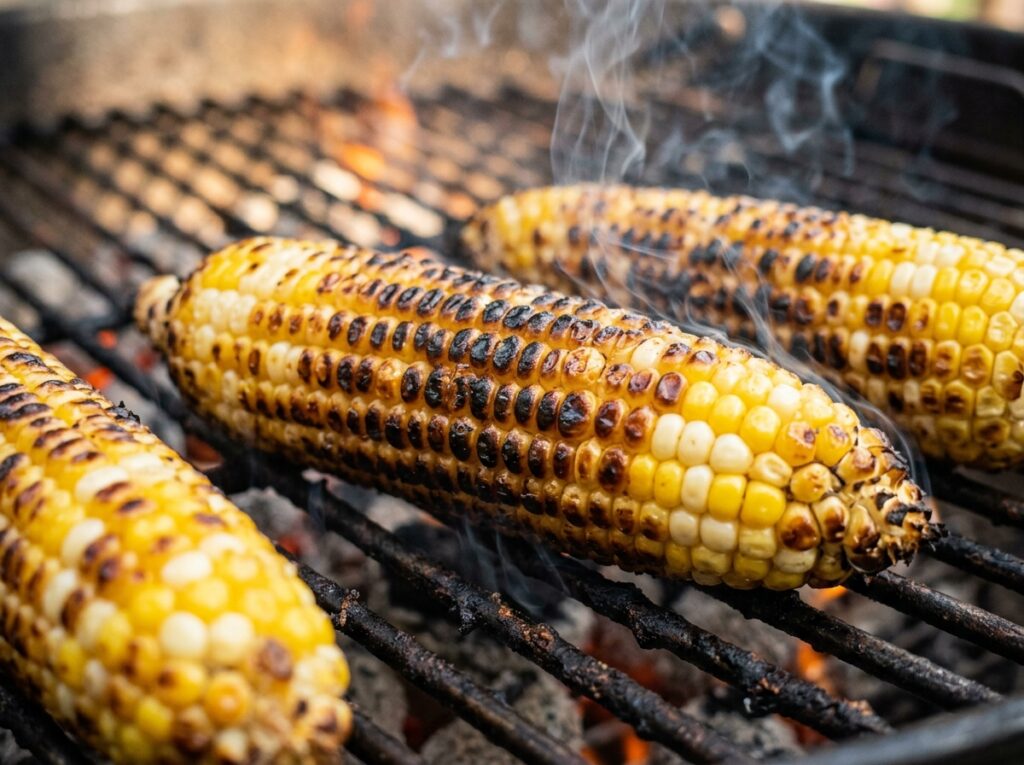
When you grill corn directly over flames or very hot coals, the surface temperature can exceed 400°F (204°C) in spots. At this temperature, the natural sugars in sweet corn (primarily glucose and fructose) react with amino acids to form hundreds of new flavor compounds called melanoidins. These compounds create the toasted, nutty, caramelized, slightly bitter complexity that makes Mexican Street Corn so much more interesting than boiled or steamed corn.
Heat+Sugars+Amino Acids→Melanoidins (Brown Color/Flavor)
In simple terms: high heat + corn’s natural sugars + corn’s proteins = deep, complex, caramelized flavor and brown char. The black-brown spots on perfectly charred Mexican Street Corn are not burnt—they are flavor bombs created by the Maillard reaction.
Fat as a Flavor Carrier: Why Crema and Mayo Matter
The sauce that coats traditional Mexican Street Corn is a mixture of Mexican crema (or sour cream), mayonnaise, lime juice, and sometimes garlic. This is not just for richness—it is science. Many of the most intense flavor compounds in chili powder, lime zest, and garlic are fat-soluble, meaning they dissolve in fat but not water. The creamy, fatty base acts as a flavor carrier, binding these aromatic compounds and delivering them to your taste buds in a smooth, cohesive layer.
If you tried to apply just lime juice and chili powder to grilled corn, the flavors would taste sharp, isolated, and one-dimensional. The fat in the crema-mayo mixture emulsifies everything together, mellows the acidity, and creates a velvety coating that adheres to the hot corn and makes every bite rich and balanced.
Cotija Cheese: The Shape-Holder
Most cheeses melt when heated. Cotija cheese (the crumbly, salty Mexican cheese traditionally used on elote) does not melt—it holds its shape and texture even when sprinkled on hot Mexican Street Corn. This is because Cotija is a hard, aged cheese with low moisture content and tightly bound protein structures. When you crumble it over hot corn, it warms, softens slightly, and releases its salty, tangy flavor, but it does not turn into a gooey puddle like mozzarella or cheddar would. This textural contrast—creamy sauce, crumbly cheese, crunchy charred corn—is what makes Mexican Street Corn so texturally satisfying.
🛒 Pro Buying Guide: Ingredients for Authentic Mexican Street Corn (USA)
Sweet Corn: Fresh, Local, Peak Season
The best Mexican Street Corn starts with the best corn. Look for fresh sweet corn (yellow or bi-color varieties) at local farmers’ markets (May–September in most of the USA), Whole Foods, Trader Joe’s, or supermarket produce sections. Choose ears with bright green, tight husks, moist silk, and plump, tightly packed kernels. Press a kernel with your thumbnail—it should release milky juice (not watery or dry).
Avoid: Pre-husked corn in plastic wrap (it dries out quickly) or corn that has been sitting for days (sugars convert to starch and sweetness declines).
Cotija Cheese: The Authentic Choice
Cotija cheese is sold in blocks or pre-crumbled in the refrigerated Hispanic/Latin dairy section of most supermarkets (look near the Mexican crema and queso fresco). Cacique brand is widely available and excellent quality. Cotija is salty, crumbly, tangy, and does not melt—essential for authentic Mexican Street Corn.
Substitutes if you cannot find Cotija: Crumbled feta (saltier, tangier), grated Parmesan (harder texture, less authentic), or queso fresco (milder, softer). Do NOT use pre-shredded Parmesan in a bag—it is coated in cellulose and tastes like cardboard.
Mexican Crema and Mayo
Mexican crema (Cacique, Supremo brands) is thinner and tangier than American sour cream. It is sold in squeeze bottles in the Hispanic dairy aisle. If you cannot find it, substitute with regular sour cream thinned with a tablespoon of milk, or use crème fraîche.
Mayonnaise: Use real mayo (Hellmann’s/Best Foods, Duke’s, or Kewpie Japanese mayo for extra richness). Do NOT use Miracle Whip or low-fat mayo—they taste sweet and artificial and will ruin your Mexican Street Corn.
Tajín Clásico Seasoning
Tajín is a Mexican chili-lime seasoning blend made from dried chili peppers, lime, and salt. It is the easiest way to add authentic flavor to Mexican Street Corn. Widely available at Walmart, Target, most supermarkets, and Mexican grocery stores. One small bottle lasts for months.
Alternative: Make your own blend—1 teaspoon chili powder + 1/2 teaspoon smoked paprika + 1/4 teaspoon cayenne + 1/4 teaspoon lime zest + pinch of salt.
Fresh Limes and Cilantro
Use fresh limes (not bottled lime juice) for squeezing over the finished Mexican Street Corn. The aromatic oils in fresh lime zest are essential. Fresh cilantro adds bright, herbaceous contrast (optional but traditional). Both are available in every supermarket produce section.
📊 Ingredients Table (US Customary + Metric)
| Ingredient | US Customary | Metric |
|---|---|---|
| Fresh sweet corn ears, in husks | 4-6 ears | 4-6 ears |
| Mayonnaise | 1/3 cup | 80g |
| Mexican crema or sour cream | 1/3 cup | 80g |
| Fresh lime juice | 2 tablespoons | 30ml |
| Garlic, minced | 1-2 cloves | 1-2 cloves |
| Cotija cheese, crumbled or finely grated | 1/2 cup | 60g |
| Tajín seasoning or chili powder | 2-3 teaspoons | 5-7g |
| Fresh cilantro, chopped (optional) | 2 tablespoons | 10g |
| Fresh limes, cut into wedges | 2 limes | 2 limes |
Optional Add-Ons:
- Smoked paprika (for extra smokiness)
- Hot sauce (for extra heat)
- Extra lime zest
Yield: 4-6 servings
Prep Time: 10 minutes
Cook Time: 12-15 minutes
Total Time: 25 minutes
⚠️ Common Mistakes Table (8 Mistakes That Ruin Mexican Street Corn)
| The Mistake | What Actually Happens | The Fix |
|---|---|---|
| Overcooking the corn until it’s mushy | Kernels turn soft and mealy; lose their juicy snap | Grill 10-12 min total; kernels should still have slight crisp when bitten |
| Using pre-shredded Parmesan instead of Cotija | Tastes wrong; cellulose coating prevents proper adhesion and flavor | Use authentic Cotija cheese; crumble or grate it yourself |
| Applying sauce to cold corn | Sauce slides off; doesn’t adhere or absorb into kernels | Sauce must be applied immediately to hot corn straight off the grill |
| Not rotating the corn frequently | Uneven char; some sides burn while others stay pale | Rotate every 2-3 min for even charring on all sides |
| Using sweet salad dressing instead of mayo | Tastes artificial and too sweet; wrong texture | Use real mayonnaise (Hellmann’s, Duke’s, or Kewpie) |
| Boiling corn instead of grilling | No char, no Maillard reaction, no caramelized flavor | Must grill over direct high heat for authentic Mexican Street Corn |
| Adding lime juice to the sauce | Acid thins sauce and makes it slide off corn | Mix lime into sauce sparingly; squeeze fresh lime over corn at the end |
| Leaving husks on during grilling | Corn steams instead of chars; no caramelization | Remove husks completely before grilling for direct-heat char |
🔪 Step-by-Step Method: Mastering Mexican Street Corn (Prose Only)
Step 1: The Husk Removal (Exposing Kernels to Heat)
Peel back the husks on each ear of corn but do NOT remove them completely—leave them attached at the base to create a natural “handle” for holding the hot corn. Pull off and discard all the silk (the stringy fibers between the kernels and husk). If you want a cleaner presentation, you can remove the husks entirely and skewer the corn through the core with wooden skewers or metal corn holders. For traditional Mexican Street Corn, the husk handle is iconic and functional—it keeps your hands clean and cool while you eat.
Step 2: The Direct-Heat Sear (Maillard Reaction Activation)
Preheat your outdoor grill (charcoal or gas) to high heat—about 450°F-500°F (230°C-260°C). If using charcoal, wait until the coals are glowing red-orange with white ash. If using gas, preheat all burners on high for 10 minutes with the lid closed. Place the husked corn directly on the grill grates over direct, high heat.
Do NOT wrap in foil—you want direct contact between corn and heat for char and caramelization. Grill the corn, rotating every 2-3 minutes using tongs, for a total of 10-12 minutes. You want deep golden-brown char marks and some blackened spots on about 50-60% of the kernels.
The char is not burnt—it is caramelized sugars and melanoidins from the Maillard reaction. The kernels should blister slightly and make popping sounds as their moisture turns to steam.
Do not overcook—the kernels should still have a slight snap when bitten, not turn soft and mushy. When the Mexican Street Corn is evenly charred on all sides, remove it from the grill and work quickly while it is still very hot.
Step 3: The Crema Slather (Fat-Based Flavor Delivery)
While the corn is grilling, prepare the sauce. In a small bowl, whisk together one-third cup mayonnaise, one-third cup Mexican crema (or sour cream), two tablespoons fresh lime juice, and one to two cloves of minced garlic.
The mixture should be thick, creamy, and smooth. Taste and adjust—if it is too thick, thin with a splash of milk; if too thin, add more mayo.
The moment the corn comes off the grill (while still piping hot), use a silicone brush or spoon to generously slather the creamy sauce all over each ear of Mexican Street Corn, coating every kernel.
The heat from the corn will warm the sauce slightly, causing it to melt into the crevices between kernels and adhere beautifully. If the corn cools too much, the sauce will slide off instead of sticking. Work quickly.
Step 4: The Cotija Crust (Texture and Salt Contrast)
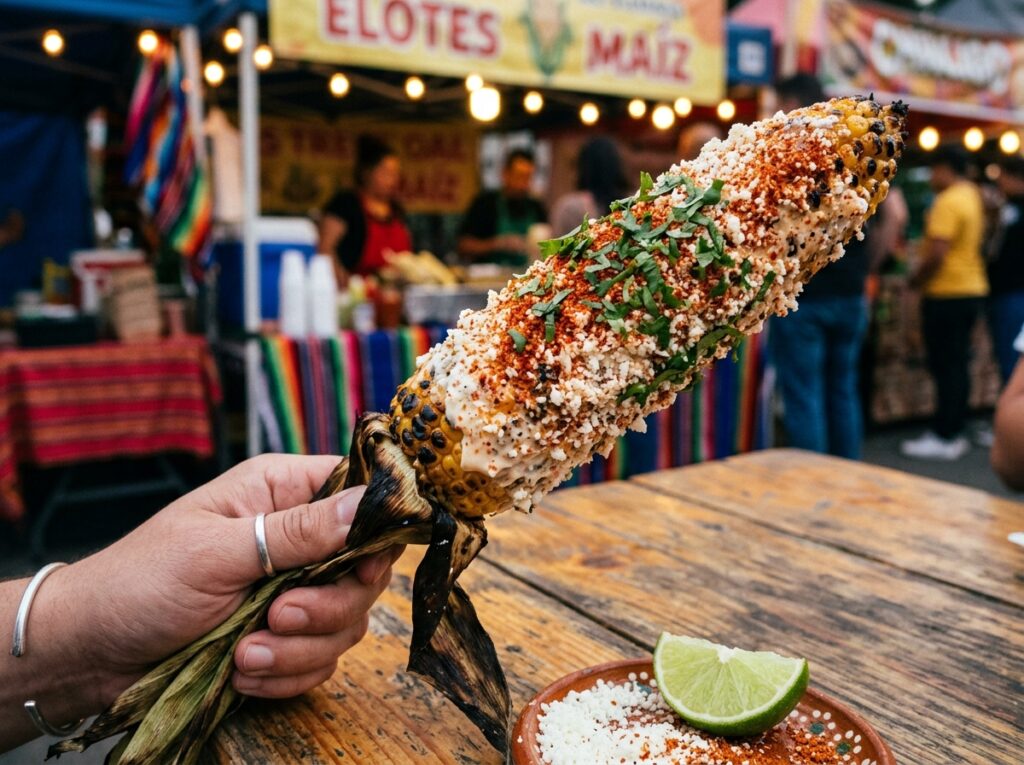
Immediately after saucing, while the Mexican Street Corn is still hot and the sauce is wet and sticky, hold each ear over a plate or shallow dish filled with crumbled Cotija cheese and roll it generously, pressing gently so the cheese adheres to the sauce.
Alternatively, use your hands or a spoon to sprinkle and press the Cotija all over the corn. You want a thick, uneven crust of crumbly white cheese covering most of the surface.
The heat from the corn will warm the Cotija, releasing its salty, tangy aroma, but it will NOT melt—Cotija holds its shape and provides crucial textural contrast against the creamy sauce and crunchy charred kernels.
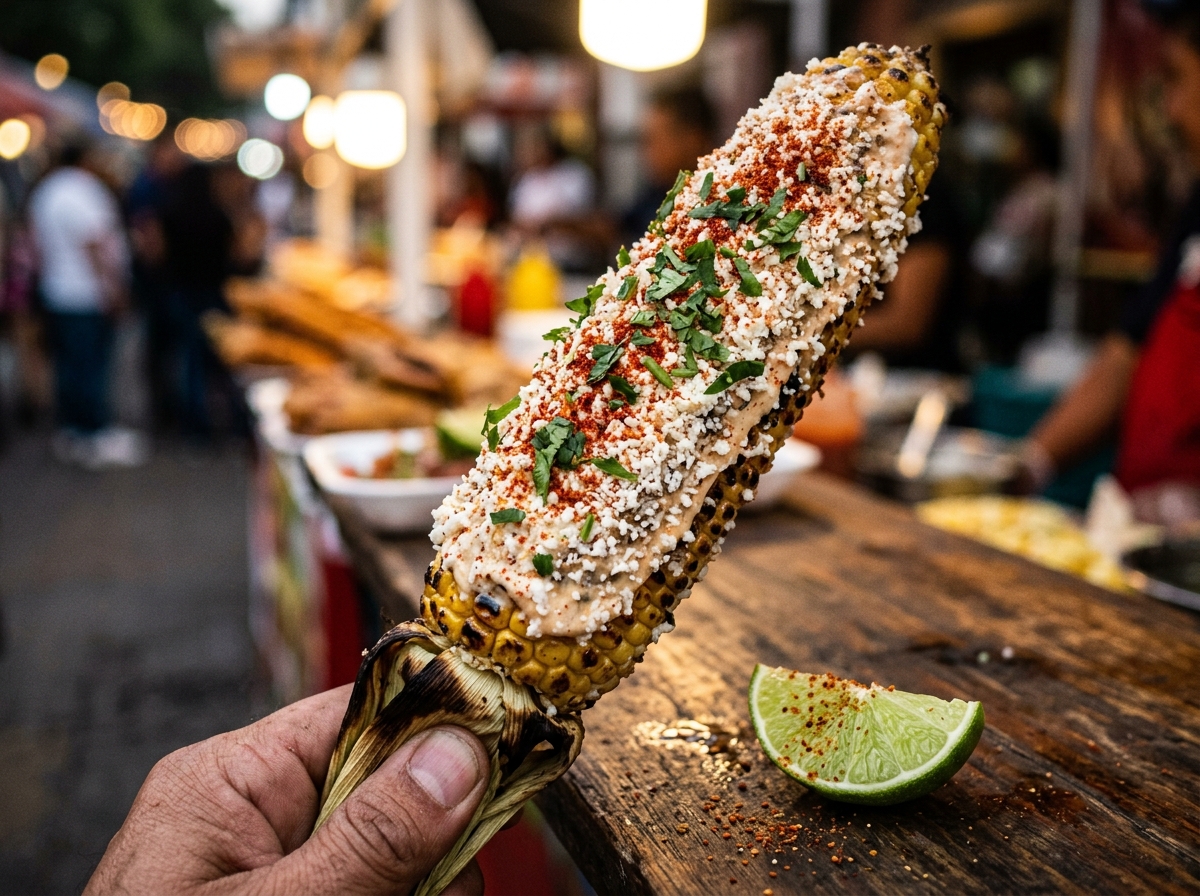
Next, sprinkle Tajín seasoning or chili powder generously over the cheese-coated corn. The bright red chili powder should create a vibrant contrast against the white cheese. Finally, sprinkle chopped fresh cilantro if using.
Serve immediately with fresh lime wedges on the side for squeezing over the top. The acid from the fresh lime “cuts” through the richness of the sauce and makes all the flavors pop.

Mexican Street Corn (Elote)
Ingredients
Equipment
Method
- Peel back the husks on each ear of corn but DO NOT remove them completely—leave the husks attached at the base to create a natural “handle” for holding the hot corn later. This is the traditional street vendor presentation. Pull off and discard all the silk (the stringy fibers between the kernels and husks). If you prefer a cleaner presentation or easier eating, you can remove the husks entirely and insert wooden skewers or metal corn holders through the core. While preparing corn, preheat your outdoor grill (charcoal or gas) to HIGH heat—about 450°F-500°F (230°C-260°C). For charcoal grills, wait until the coals are glowing red-orange with white ash covering them. For gas grills, preheat all burners on high for 10 minutes with the lid closed. The grill grates should be very hot—if you hold your hand 6 inches above the grates, you should only be able to hold it there for 2-3 seconds before the heat becomes uncomfortable. This high heat is essential for proper char and Maillard reaction in Mexican Street Corn.
- Place the husked corn ears directly on the hot grill grates over DIRECT high heat. DO NOT wrap the corn in aluminum foil—you need direct contact between corn kernels and heat source to develop char marks and caramelized flavor through the Maillard reaction. Grill the corn, rotating every 2-3 minutes using long-handled tongs, for a total of 10-12 minutes (up to 15 minutes if your corn ears are very large). You want deep golden-brown char marks and some blackened spots covering approximately 50-60% of the kernel surface. The charred spots are not burnt—they are caramelized natural sugars and melanoidins (flavor compounds created by the Maillard reaction between sugars and amino acids). The kernels should blister slightly and you will hear popping sounds as internal moisture turns to steam and escapes. Rotate the corn frequently to achieve even charring on all sides—uneven charring results in some bites tasting plain while others are intensely flavored. Do NOT overcook the corn—the kernels should still have a slight crisp, juicy snap when bitten into, not turn soft, mushy, or mealy. When the Mexican Street Corn is evenly charred on all sides with beautiful brown-black grill marks, remove it from the grill. Work QUICKLY while the corn is still very hot—the next steps are time-sensitive.
- While the corn is grilling, prepare the creamy sauce base. In a small mixing bowl, whisk together 1/3 cup mayonnaise, 1/3 cup Mexican crema (or regular sour cream), 2 tablespoons fresh lime juice, and 1-2 cloves of minced garlic until the mixture is smooth, creamy, and completely homogeneous with no lumps. The consistency should be thick and spreadable but not so thick it won’t coat the corn—similar to thick pancake batter. If the sauce is too thick and pasty, thin it with a splash of milk (1-2 teaspoons at a time). If it’s too thin and runny, add a bit more mayonnaise. Taste and adjust seasoning—add a pinch of salt if needed. The sauce should taste tangy, creamy, and slightly garlicky. Set aside until the corn is ready. The fat in this sauce (from mayo and crema) is essential—it acts as a carrier for the fat-soluble flavor compounds in the chili powder, lime zest, and garlic, creating a cohesive flavor delivery system that water-based sauces cannot achieve.
- The MOMENT the corn comes off the grill (while still piping hot and steaming), use a silicone pastry brush, basting brush, or the back of a spoon to generously slather the creamy sauce all over each ear, coating every visible kernel. Work quickly and coat the corn while it’s still very hot—this is critical. The heat from the corn slightly warms and thins the sauce, causing it to melt into the crevices between kernels and adhere tightly to the surface. If the corn cools too much before you apply the sauce (below about 150°F / 65°C), the cold surface will repel the fatty sauce and it will slide off in clumps instead of coating evenly. For best results, sauce one ear at a time immediately after removing it from the grill, rather than letting all the corn cool while you finish grilling. Apply a thick, generous layer—don’t be shy. The sauce layer should be visible and creamy-white covering most of the charred kernels. This is authentic Mexican Street Corn technique.
- Immediately after coating with sauce (while the Mexican Street Corn is still hot and the sauce is wet and sticky), hold each ear over a shallow plate or wide bowl filled with crumbled Cotija cheese. Roll the sauced corn in the cheese, rotating and pressing gently so the cheese adheres to the sauce all over the surface. Alternatively, use your hands or a spoon to sprinkle and press generous amounts of crumbled Cotija cheese all over the corn, coating it as heavily as possible. You want a thick, uneven, rustic crust of crumbly white cheese covering most of the creamy sauce layer. The residual heat from the corn will warm the Cotija cheese, releasing its salty, tangy aroma and softening it slightly, but it will NOT melt into a gooey mess—Cotija is a hard, aged cheese with low moisture content and tightly bound protein structures that hold their shape even when heated. This textural contrast (crunchy charred kernels + creamy sauce + crumbly cheese) is what makes Mexican Street Corn so texturally satisfying. Next, sprinkle Tajín Clásico seasoning or chili powder generously over the cheese-coated corn—about 1/2 teaspoon per ear, adjusting to your heat preference. The bright red-orange chili powder should create vibrant visual contrast against the white Cotija cheese. If using fresh cilantro, sprinkle chopped cilantro over the top now. Finally, serve the Mexican Street Corn immediately while still hot, with fresh lime wedges on the side. Instruct diners to squeeze fresh lime juice over their corn just before eating—the fresh lime acid “cuts” through the richness of the creamy sauce and makes all the flavors pop and sing.
- Mexican Street Corn is best eaten immediately while hot—the contrast between hot charred corn, warm creamy sauce, and cool fresh lime juice is part of the magic. Serve with plenty of napkins (this is messy, hands-on eating—embrace it). If holding for a short time before serving, keep the corn in a warm (not hot) place loosely covered for no more than 15-20 minutes. Do NOT refrigerate and reheat—the texture suffers significantly. If you have leftovers, cut the kernels off the cob and transform them into Esquites (Mexican street corn salad served in bowls)—same flavors, easier to reheat.
Notes
🧘♂️ Chef Mansoor’s Insight
Elote started as fuel for field workers—sweet corn grilled roadside and rubbed with whatever was available. Lime for brightness. Chile for heat. Cheese for salt and protein.
Somewhere along the way, it crossed borders, showed up on restaurant menus, became “Mexican Street Corn” on Instagram, and turned into a gourmet side dish at fifteen dollars a cob.
But the magic never changed. It is still about char meeting cream, heat meeting acid, smoke meeting salt. The humble becomes extraordinary not through complication but through understanding what each element does and respecting the balance.
That is the lesson of elote. You do not need exotic ingredients or fancy techniques. You need good corn, high heat, fat to carry flavor, and the confidence to let char develop without fear. The best food is often the simplest—executed with precision and respect.
📊 Nutrition Table (Per Ear of Corn, Fully Loaded)
| Nutrient | Amount |
|---|---|
| Calories | 280 kcal |
| Total Carbohydrates | 28g |
| Dietary Fiber | 3g |
| Total Sugars | 6g |
| Protein | 7g |
| Total Fat | 17g |
| Saturated Fat | 5g |
| Cholesterol | 20mg |
| Sodium | 420mg |
| Vitamin C | 15% DV |
| Calcium | 12% DV |
| Iron | 4% DV |
Estimates based on USDA data for sweet corn, mayonnaise, sour cream, and Cotija cheese. Values vary with topping amounts.
🌡️ Food Safety Guide
Safe grilling temperature for vegetables: No minimum internal temp required (corn is safe when cooked through)
Ideal grill surface temp for char: 450°F-500°F (230°C-260°C)
Danger zone (do not hold): 40°F–140°F (4°C–60°C)
Serving buffer: Serve Mexican Street Corn immediately off the grill while hot
Leftover storage: Refrigerate cooked corn (with or without toppings) within 2 hours; consume within 2 days
Reheating: Not recommended—texture suffers; better to make fresh or use leftovers for Esquites (off-the-cob salad)
🧊 Storage & Leftover Ideas
| Storage Method | Duration | Best Use / Notes |
|---|---|---|
| Refrigerator (cooked corn with toppings) | 1-2 days | Texture suffers; sauce gets watery; better to eat fresh |
| Refrigerator (plain grilled corn, no sauce) | 3 days | Cut kernels off and make Esquites (Mexican corn salad) |
| Freezer | Not recommended | Corn becomes mushy and watery when thawed |
| Esquites (leftover transformation) | Make fresh same day | Cut kernels off cob, mix with sauce, serve in bowl with spoon |
Pro Tip: Esquites (Off-the-Cob Mexican Street Corn): If you have leftover grilled corn or want a less messy version, cut the charred kernels off the cobs into a bowl. Mix with the creamy sauce, Cotija, chili powder, lime juice, and cilantro. Serve in bowls with spoons. Same flavors, easier to eat, perfect for parties.
❓ Frequently Asked Questions
Can I make Mexican Street Corn in the oven or on the stovetop?
You can, but it won’t be the same. The high direct heat of a grill is essential for proper char and Maillard reaction. Oven: Broil corn 6 inches from heat, rotating every 3 min until charred (10-12 min total). Stovetop: Use a cast iron grill pan over high heat. Results will be good but not as smoky or intensely charred as outdoor grilling.
What is the best substitute for Cotija cheese?
Crumbled feta is the closest substitute (salty, crumbly, tangy, doesn’t melt). Grated Parmesan works but has a harder texture and different flavor. Queso fresco is milder and softer. Do NOT use pre-shredded Parmesan in a bag—it has cellulose coating and poor flavor. For authentic Mexican Street Corn, seek out real Cotija.
Should I grill corn in the husks or remove them?
Remove the husks completely or pull them back to create a handle. Grilling with husks ON causes the corn to steam instead of char—you won’t get Maillard reaction or caramelization. For authentic Mexican Street Corn with char marks, husks must be removed or pulled back so kernels have direct contact with heat.
Can I use frozen or canned corn?
Fresh corn is essential for authentic texture and flavor. Frozen corn is too watery and soft. Canned corn is mushy and lacks sweetness. For true Mexican Street Corn, use fresh sweet corn ears during peak season (May-September in most of USA).
Why does my sauce slide off the corn?
The corn must be HOT when you apply the sauce. The heat slightly melts the fat in the sauce, causing it to adhere and seep into the crevices between kernels. If the corn cools too much before saucing, the cold surface repels the sauce and it slides off. Sauce immediately after grilling.
Can I mix the lime juice into the creamy sauce?
You can add a little (1-2 tablespoons) for tanginess, but too much acid thins the sauce and makes it watery and more likely to slide off the corn. Traditional Mexican Street Corn vendors apply creamy sauce first, then squeeze fresh lime over the top at the end. The fresh lime “pop” at the end is part of the flavor experience.
How do I prevent the corn from tasting burnt?
Deep char marks and some black spots are GOOD—that’s caramelized sugars and Maillard reaction, not burning. But if the entire ear turns black, you’ve overcooked it. Grill at 450°F-500°F and rotate every 2-3 minutes for even charring. Total time is 10-12 minutes. The kernels should still have a slight snap, not turn soft.
What is Tajín and where do I buy it?
Tajín Clásico is a Mexican chili-lime seasoning made from dried chili peppers, lime, and salt. It’s the red powder you see on authentic Mexican Street Corn. Widely available at Walmart, Target, most supermarkets (Hispanic foods aisle or spice section), and Mexican grocery stores. One small bottle lasts months.
🔗 More from The Flavor Bazaar
If Mexican Street Corn ignited your love for Mexican flavors, explore these other science-backed recipes:
Zesty Cilantro Lime Rice
Perfect pairing for a complete Mexican fiesta menu
Smoky Chipotle Burger Patties
Perfect Mexican-themed dinner pairing
Slow-Smoked Beef Brisket: The Physics of the Texas Bark
Another side-dish-worthy main
The BEST BBQ Chicken Pizza: The Science of the Smoky Slice
Tex-Mex flavor mastery
Probiotic Chickpea Salad: Gut-Friendly Fuel
Fresh, bright side to balance rich mains
Outbound Link:
Botanical Guide to Corn Varieties in North America
Learn about sweet corn vs. field corn genetics and breeding
For More Healthy Recipes Visit: flavourbazar.com