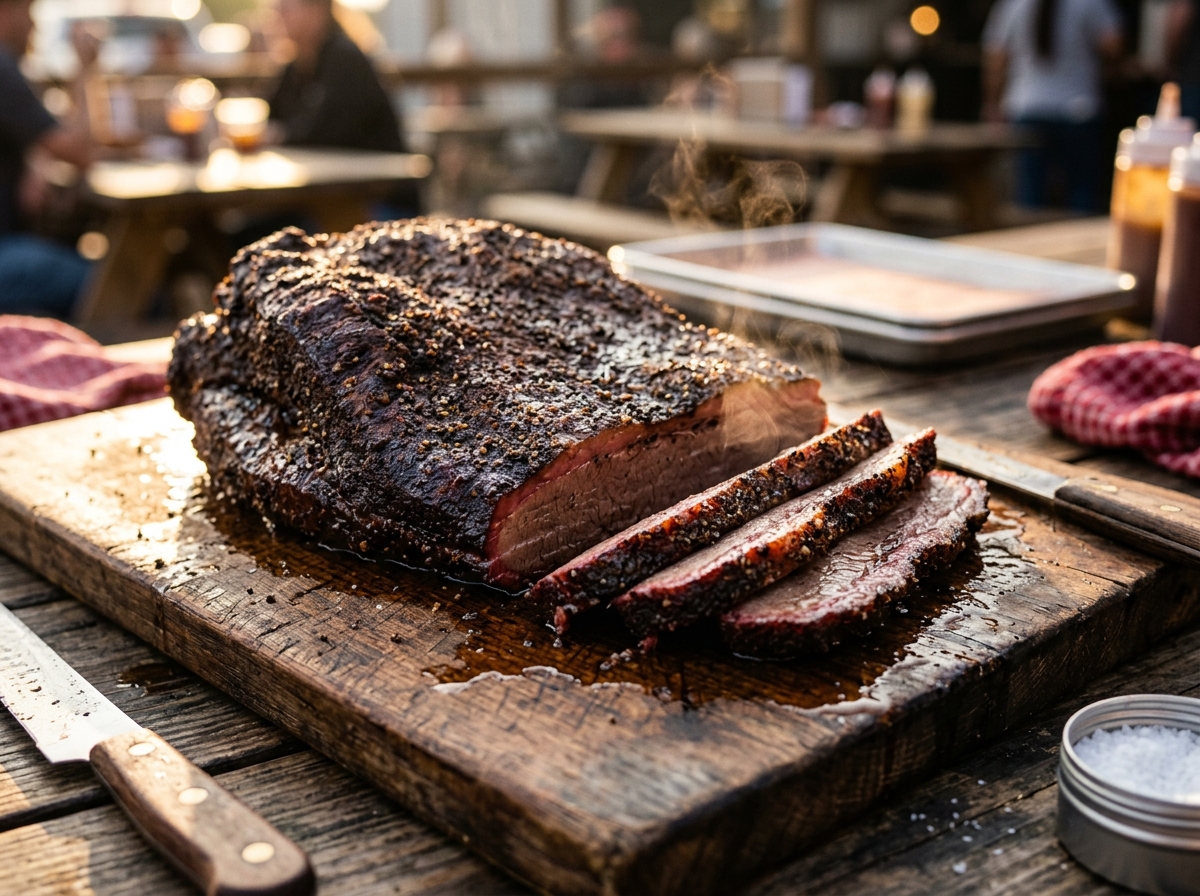
Slow-Smoked Beef Brisket: The Physics of the Texas Bark
By Chef Mansoor | Flavour Bazar
The Midnight Ritual
There is something primal about waking up at three in the morning, pulling on jeans still smelling faintly of smoke, and walking out into the cold to start a fire. The rest of the world is asleep. The smoker is waiting.
And somewhere in your refrigerator, a twelve-pound slab of brisket is about to begin a transformation that will take all day, demand your patience, and reward you with bark so dark and flavorful it cracks like autumn leaves when you press it.
I have monitored the internal enthalpy of hundreds of briskets to decode “The Stall”—the exact moment where evaporative cooling defies the laws of the smoker, where the temperature plateaus at 160°F (71°C) for hours, and inexperienced pitmasters panic and crank the heat.
That is the moment where real BBQ is born. Not in the rub. Not in the wood. But in the physics of water evaporating from the surface of the meat, cooling it faster than the fire can heat it, while deep inside, collagen slowly unravels into gelatin.
A proper Slow-Smoked Beef Brisket is not a recipe—it is a twelve-hour meditation on heat, time, and patience. It is the rebellion against instant gratification, the refusal to rush what cannot be rushed. And if you understand the science behind the bark, the stall, and the rest, you will never buy BBQ again.
The Science: Why the Stall Happens and Why You Should Never Fear It
Evaporative Cooling: The Physics That Stops Time
When you place a well-trimmed Slow-Smoked Beef Brisket in a smoker at 225°F–250°F (107°C–121°C), the internal temperature rises steadily for the first few hours.
Then, somewhere around 150°F–160°F (65°C–71°C) internal temp, something strange happens: the temperature stops rising. For two, three, sometimes four hours, the brisket sits stubbornly at the same temperature, no matter how consistent your fire.
This is The Stall, and it is not your smoker’s fault. It is evaporative cooling in action. As the brisket heats, moisture is drawn to the surface. That moisture evaporates into the smoky air, and evaporation is an endothermic process—it absorbs heat energy.
The cooling effect from evaporation exactly matches the heat being applied by your smoker, creating thermal equilibrium. The brisket is sweating, and that sweat is keeping it cool.
Most backyard cooks see the stall as a problem to solve. They wrap the meat in foil (the “Texas Crutch”), which traps moisture and pushes through the stall faster. But here is what they lose: bark development.
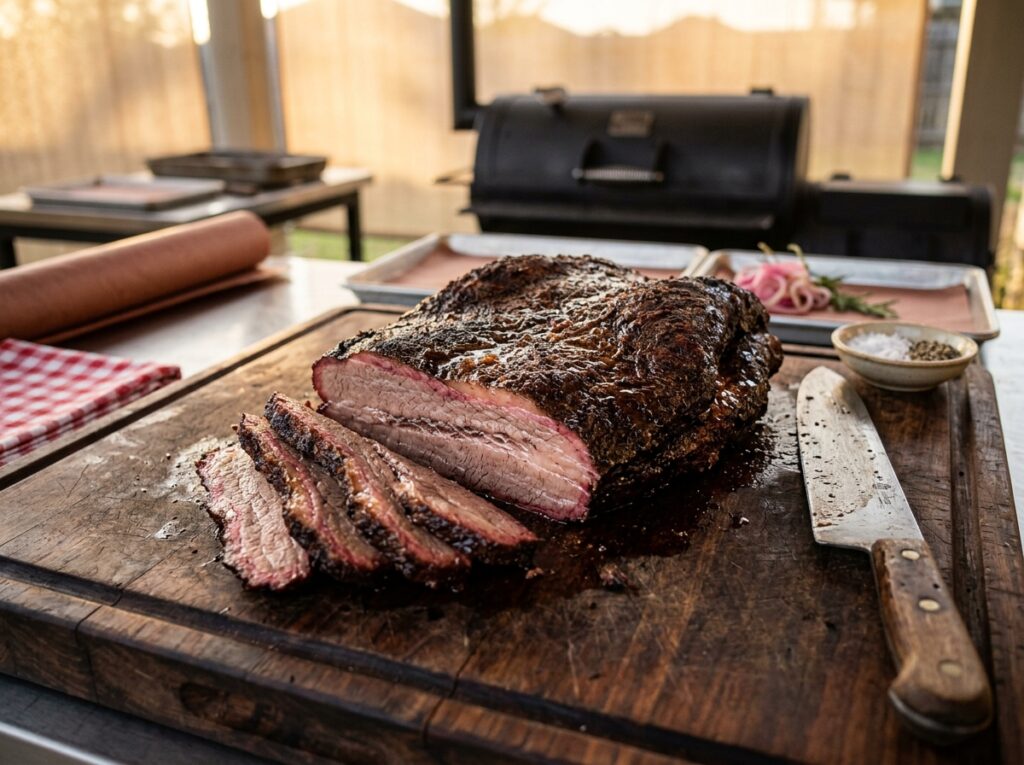
That dark, crunchy, spice-crusted exterior that defines a championship Slow-Smoked Beef Brisket forms during the stall. The Maillard reaction and caramelization continue on the dry surface while the interior stays moist. If you wrap too early, you steam the bark and turn it soft.
Professional pitmasters let the stall happen. They ride it out. They trust the process.
Collagen to Gelatin: The Long, Slow Melt
Brisket comes from the chest of the cow—a heavily worked muscle group responsible for supporting about sixty percent of the animal’s body weight. T
hat means it is loaded with collagen, the tough connective tissue that makes cheap cuts chewy and unpleasant when cooked fast.
But collagen has a secret: when held at temperatures between 160°F–205°F (71°C–96°C) for extended periods, it denatures and converts into gelatin. Gelatin is what gives a perfectly cooked Slow-Smoked Beef Brisket that glossy, jiggly, melt-in-your-mouth texture.
It is the fat rendering. It is the moisture that drips down your chin. It is the reason brisket exists.
Collagen+Heat+Time→Gelatin (The Jiggle)
This conversion cannot be rushed. You cannot crank your smoker to 350°F and finish in six hours. You will render the fat, but the collagen will not have time to break down. You will end up with dry, stringy, flavorless meat.
A proper Slow-Smoked Beef Brisket takes ten to fourteen hours at low, steady heat. The collagen needs time to unwind, to dissolve, to become the magic that makes tough meat tender.
🛒 Pro Buying Guide: Sourcing and Gear for Championship Slow-Smoked Beef Brisket (USA)
The Meat: USDA Prime or Choice, Full Packer
You want a full packer brisket—that means the whole muscle, untrimmed, with both the flat (the lean side) and the point (the fatty, marbled side) still attached. A full packer will weigh anywhere from 10 to 16 pounds before trimming. After you trim the fat, expect to lose about 2–3 pounds.
USDA Prime is the best grade—more intramuscular fat (marbling), more forgiveness, more flavor. You will find Prime briskets at Costco (often labeled “USDA Prime Whole Packer Brisket”), Wild Fork Foods (online or retail locations), and high-end butcher shops. Expect to pay $5–7 per pound.
USDA Choice is more budget-friendly and still excellent for Slow-Smoked Beef Brisket if you manage your temps carefully. Available at most supermarkets, Sam’s Club, and Costco. Expect $3.50–5 per pound.
Avoid Select grade—it is too lean and will dry out during the long smoke. Brisket needs fat to stay moist.
The Wood: Post Oak, Hickory, or Oak
In Texas, Post Oak is king. It burns slow, produces clean smoke, and has a mild, slightly sweet flavor that does not overpower the beef. If you cannot find Post Oak, Red Oak or White Oak work beautifully.
Hickory is stronger, more assertive—common in the Midwest and Southern BBQ. It pairs well with beef but can turn bitter if you over-smoke. Use it sparingly or mix it with oak.
Avoid mesquite for a full Slow-Smoked Beef Brisket—it burns too hot and the smoke is too intense. A little mesquite for the first hour is fine, but twelve hours of mesquite will make your brisket taste like an ashtray.
Where to buy: Lowe’s, Home Depot, and BBQ specialty stores sell smoking wood. Online options include BBQGuys.com and Amazon (search “Post Oak chunks” or “Hickory logs”).
The Smoker: Offset or Pellet
Offset Smokers (like the Oklahoma Joe’s Highland or Lone Star Grillz models) are the traditional choice. They require more attention—you are managing fire, airflow, and temperature manually—but they produce the cleanest smoke and the best bark on a Slow-Smoked Beef Brisket.
Pellet Grills (like Traeger, Camp Chef, or Pit Boss) are more forgiving. They hold steady temps with digital controllers and burn compressed wood pellets.
The smoke flavor is milder, but the convenience is unmatched for beginners. I have cooked championship-level Slow-Smoked Beef Brisket on both. The smoker does not make the pitmaster—the understanding does.
Butcher Paper vs. Foil: The Bark Saver
When you hit the stall, many pitmasters wrap their Slow-Smoked Beef Brisket to push through faster. Aluminum foil works, but it traps moisture and steam, which softens the bark and makes the exterior mushy—a texture some call “pot roast bark.”
Pink butcher paper (also called peach paper) is the Texas secret. It is breathable—allows some moisture to escape while still speeding up the cook.
The bark stays firm, dry, and crunchy. Brands like ChefsTemp Pink Butcher Paper or Camerons Peach Butcher Paper are available on Amazon, at BBQ specialty stores, and even at some Costco locations.
Wrap at 165°F–170°F (74°C–77°C) internal temp, and your Slow-Smoked Beef Brisket will thank you.
📊 Ingredients Table (US Customary + Metric)
| Ingredient | US Customary | Metric |
|---|---|---|
| Whole packer beef brisket (USDA Choice or Prime) | 12–14 lb (before trimming) | 5.4–6.4 kg |
| Coarse kosher salt | 1/4 cup | 60g |
| Coarse black pepper (16-mesh grind) | 1/4 cup | 30g |
| Garlic powder (optional) | 2 tablespoons | 15g |
| Onion powder (optional) | 1 tablespoon | 8g |
| Smoked paprika (optional) | 1 tablespoon | 7g |
Optional Binder (for rub adhesion):
- Yellow mustard or Worcestershire sauce (does not affect flavor after smoking)
Wood:
- Post Oak, Hickory, or Oak chunks/logs (enough for 10–12 hours of steady smoke)
Yield: 16–20 servings (depending on trim and shrinkage)
Prep Time: 30 minutes (trimming + rub)
Smoke Time: 10–14 hours
Rest Time: 2–4 hours
Total Time: 12–18 hours
⚠️ Common Mistakes Table (8 Mistakes That Ruin Slow-Smoked Beef Brisket)
| The Mistake | What Actually Happens | The Fix |
|---|---|---|
| Trimming too much fat | Brisket dries out; no protective moisture barrier during long smoke | Leave 1/4-inch fat cap on top; trim silver skin and hard fat only |
| Ignoring the grain direction when slicing | Meat is tough and chewy even when properly cooked | Always slice against the grain; flat and point have different grain directions |
| Opening the lid too often | “If you’re lookin’, you ain’t cookin'”—heat/smoke escapes, cook time extends | Trust your thermometer; only open to spritz, wrap, or check internal temp |
| Not resting the meat for at least 2 hours | Juices pour out when sliced; meat tastes dry | Wrap in butcher paper + towels; rest in a cooler 2–4 hours before slicing |
| Using a sugary rub that burns | Sugar caramelizes, then burns black during 12+ hour cook; bitter bark | Use salt + pepper (Dalmatian rub) or low-sugar rubs; save sweet BBQ sauce for serving |
| Wrapping too early (before bark sets) | Bark stays soft and steamed instead of crunchy | Wait until internal temp hits 165°F–170°F and bark is dark/set before wrapping |
| Cooking too hot (above 275°F) | Fat renders too fast; collagen doesn’t break down; meat is dry and stringy | Keep smoker between 225°F–250°F; low and slow is the only way |
| Not using a reliable meat thermometer | Guessing doneness by time alone; brisket is underdone or overcooked | Use a digital probe thermometer; pull brisket at 200°F–205°F internal temp |
🔪 Step-by-Step Method: Mastering the Slow-Smoked Beef Brisket (Prose Only)
Step 1: The Aerodynamic Trim (Fat Cap Strategy)
Place your cold, whole packer brisket on a large cutting board, fat side up. You will see a thick, uneven layer of white fat covering the top—this is the fat cap. Your goal is to trim this down to about one-quarter inch thickness across the entire surface.
Any thicker and it will not render fully during the smoke, leaving you with rubbery, inedible fat. Any thinner and you lose the protective moisture barrier that keeps the lean flat from drying out.
Use a sharp boning knife or fillet knife. Work in long, smooth strokes, peeling away the excess fat in sheets. Flip the brisket over. On the bottom (the lean side), you will see a thick membrane called silver skin.
This does not render and will stay chewy—remove it completely. Also trim away any hard, waxy fat pockets between the point and the flat.
The goal is an aerodynamic shape: smooth, even thickness, no sharp edges that will dry out or burn.
A well-trimmed Slow-Smoked Beef Brisket cooks more evenly and develops better bark. Save the trimmings—you can render them into beef tallow for cooking.
Step 2: The Dalmatian Rub (Salt and Pepper Perfection)
Traditional Texas-style Slow-Smoked Beef Brisket uses a simple Dalmatian rub: equal parts coarse kosher salt and coarse cracked black pepper (16-mesh grind, the size of cracked peppercorns). This is not about complexity—it is about letting the beef and smoke do the talking.
Mix your salt and pepper in a bowl. If you want to add garlic powder, onion powder, or smoked paprika, go ahead—but keep it minimal.
Some pitmasters apply a thin layer of yellow mustard or Worcestershire sauce as a binder first. This helps the rub stick and adds no flavor after twelve hours of smoke.
Coat the entire brisket liberally with the rub, pressing it into the meat so it adheres. Do not be shy—this is a big piece of meat, and the bark will concentrate all that seasoning into a flavorful crust.
Let the rubbed brisket sit at room temperature for 30–60 minutes while you prepare your smoker. This takes the chill off and helps it cook more evenly.
Step 3: The Blue Smoke Phase (The First Four Hours)
Preheat your smoker to 225°F–250°F (107°C–121°C). You want thin, blue smoke—nearly invisible wisps that smell sweet and clean, not thick white billows that taste acrid and bitter.
Thick white smoke means your wood is smoldering, not burning cleanly. Adjust your airflow until the smoke clears to a faint blue haze.
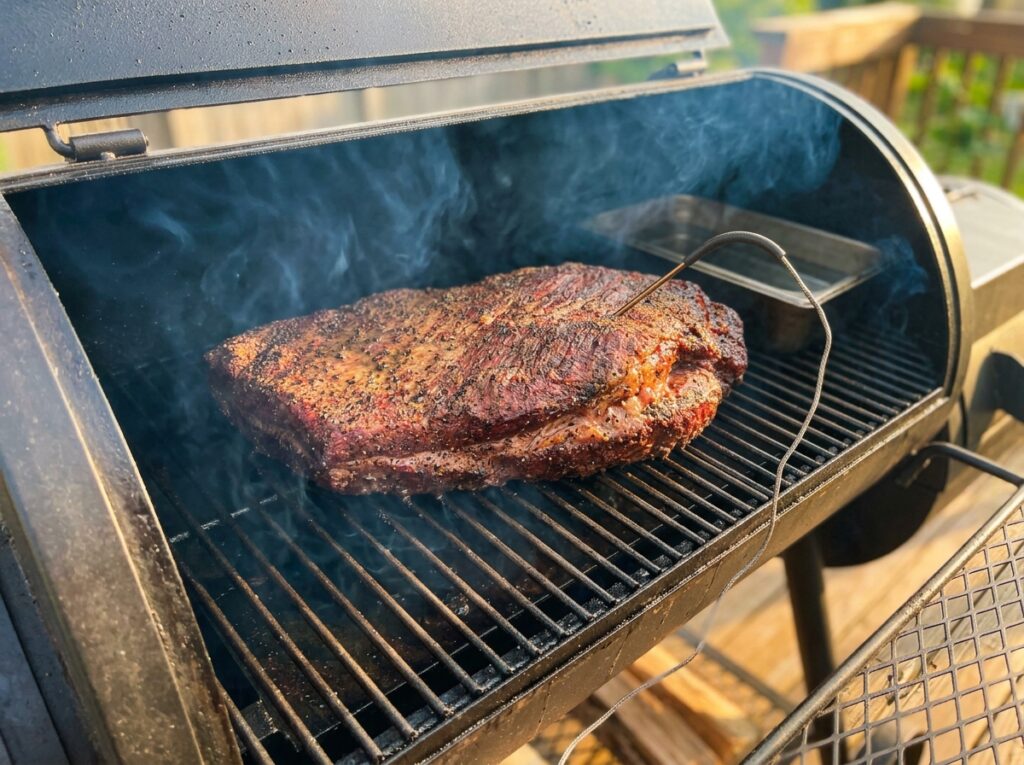
Place the Slow-Smoked Beef Brisket on the grate fat side up (this is debated, but fat-side-up allows the rendering fat to baste the meat as it melts). Insert a leave-in probe thermometer into the thickest part of the flat, making sure the probe does not touch fat or bone.
Close the lid. Do not open it for at least two hours. This is the most important phase for smoke absorption—the meat is cold, the surface is tacky, and it will pull in smoke flavor aggressively. After two hours, you can spritz the surface lightly with apple cider vinegar, water, or beef broth every 60–90 minutes to keep it moist and help build bark. But do not overdo it—every time you open the lid, you lose heat and extend the cook.
Step 4: The Stall and the Texas Crutch (Wrapping at 165°F)
Around hour five or six, your Slow-Smoked Beef Brisket will hit The Stall—the internal temperature will plateau around 150°F–165°F (65°C–74°C) and refuse to climb. This can last for hours. Do not panic. Do not raise the heat. This is where bark develops and collagen begins breaking down.
You have two choices:
Option 1: Ride it out (unwrapped). Let the brisket push through the stall naturally. This takes longer (sometimes 3–4 extra hours), but you get the darkest, crunchiest bark. This is the purist method.
Option 2: The Texas Crutch (wrap in butcher paper). When the internal temp hits 165°F–170°F (74°C–77°C) and the bark is set (dark, firm to the touch), remove the brisket and wrap it tightly in pink butcher paper. Return it to the smoker. The paper traps some moisture and heat, pushing through the stall faster while still allowing the bark to breathe. This is the method most championship pitmasters use.
Never wrap in foil unless you want soft, steamed bark. Foil is for ribs, not brisket.
Continue smoking until the internal temperature reaches 200°F–205°F (93°C–96°C) in the thickest part of the flat. But temperature is not the only indicator—you also want probe tenderness.
When you insert the probe thermometer, it should slide in and out like soft butter, with almost no resistance. If it feels firm or catches on fibers, let it cook longer, even if the temp is already at 205°F.
Step 5: The Long Rest (The Secret Most People Skip)
This is the step that separates backyard brisket from competition-level Slow-Smoked Beef Brisket. When the brisket hits 200°F–205°F and is probe-tender, do not slice it immediately. Remove it from the smoker, still wrapped in butcher paper.
Wrap the entire bundle in old beach towels or a thick blanket. Place it in an insulated cooler (like an Igloo or Yeti) and let it rest for 2 to 4 hours.
During this rest, the internal temperature will slowly drop, but the residual heat will continue breaking down collagen. More importantly, the juices redistribute. When meat is hot, the muscle fibers are contracted and squeezed tight.
As it cools slightly, the fibers relax and reabsorb moisture. If you slice a brisket right off the smoker, all those juices will pour out onto the cutting board and your slices will taste dry. A rested Slow-Smoked Beef Brisket stays juicy, slices cleanly, and tastes exponentially better.
I have held briskets in a cooler for up to six hours with no loss in quality. This also makes timing flexible—you can finish the cook early and hold it hot until your guests arrive.
Step 6: The Slice (Against the Grain, Always)
Unwrap the Slow-Smoked Beef Brisket and place it on a large cutting board. You will notice the flat (lean side) and the point (fatty, marbled side) have different grain directions. The flat usually runs lengthwise, and the point runs at about a 90-degree angle.
Separate the point from the flat by cutting along the fat seam. Slice the flat against the grain into pencil-thick slices (about 1/4 inch). Slice the point against its grain into thicker slices or chunks—this is the juicier, fattier part, often called “burnt ends” when cubed and sauced.
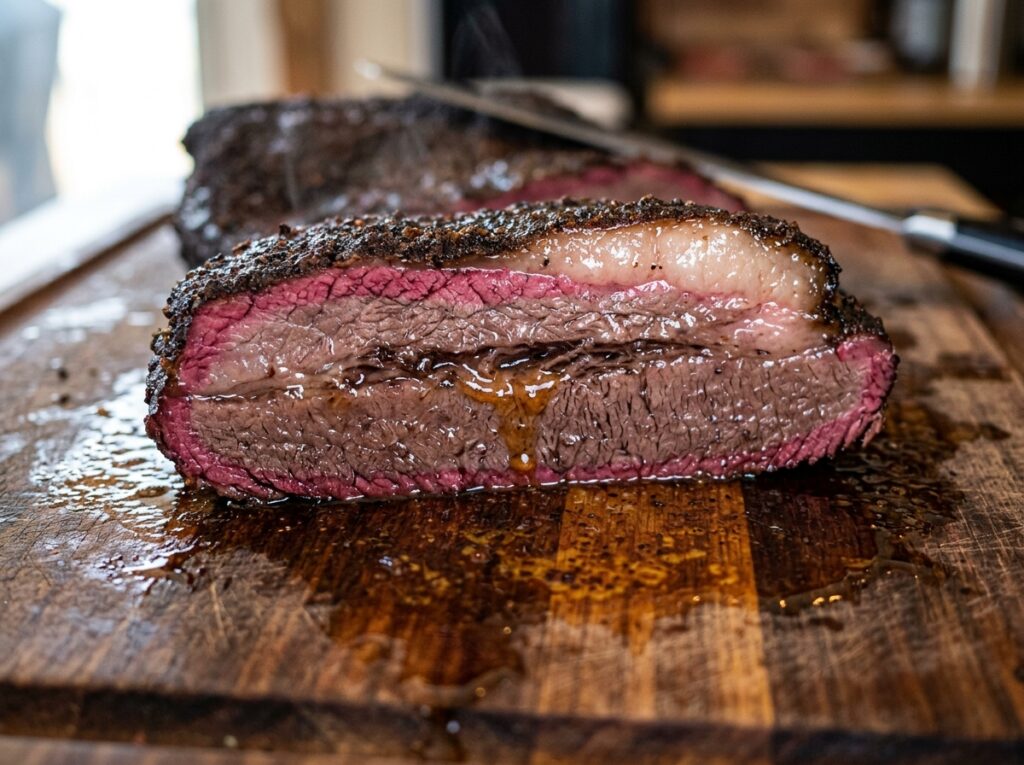
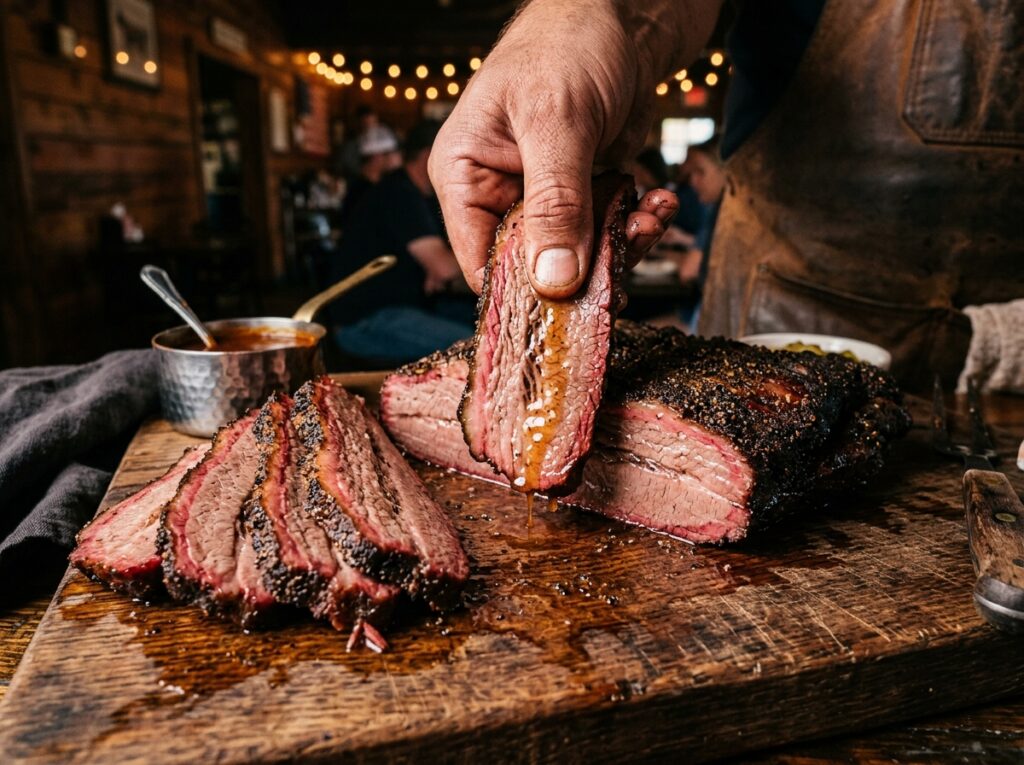
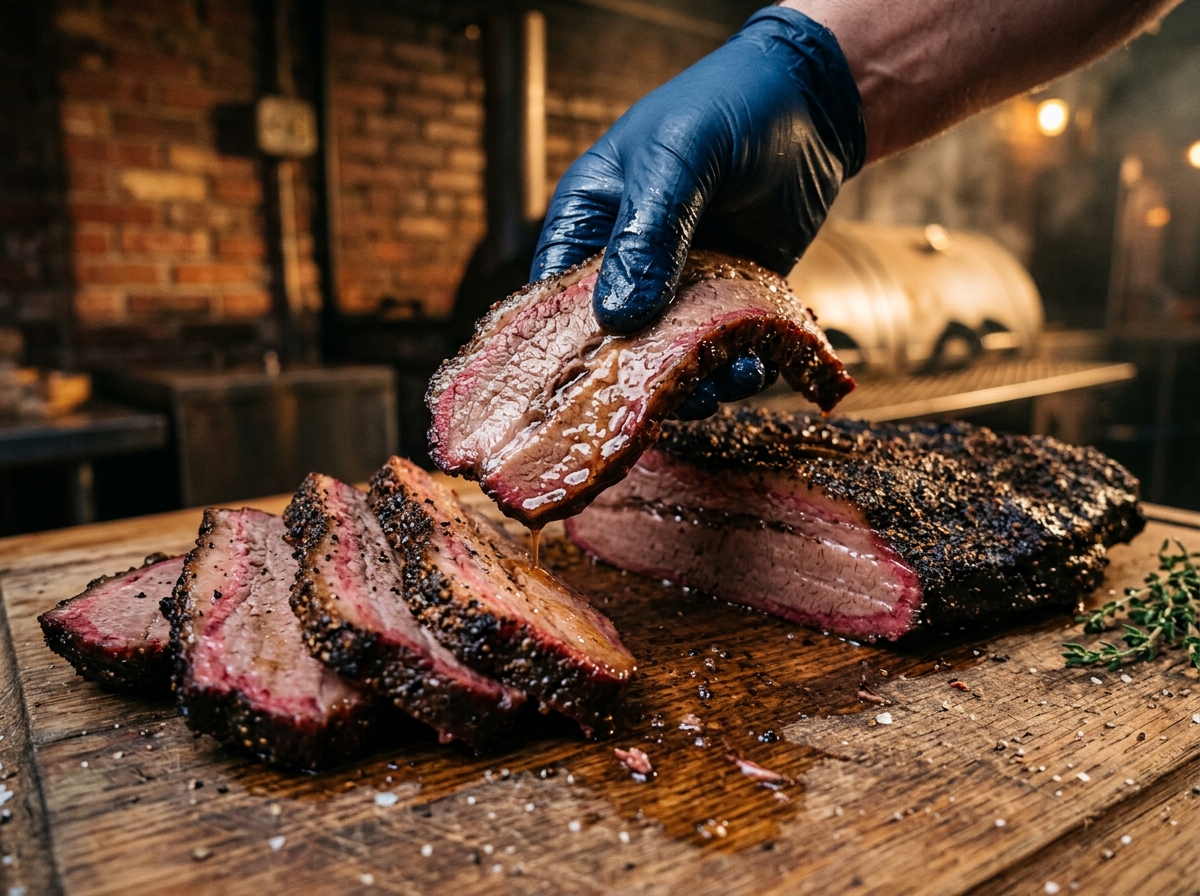
A properly cooked Slow-Smoked Beef Brisket should have a smoke ring—a pink layer just under the bark caused by nitrogen dioxide reacting with myoglobin in the meat. It should glisten with rendered fat and gelatin. And when you press a slice gently with your finger, juices should pool on the surface.

Slow-Smoked Beef Brisket (Texas Style)
Ingredients
Equipment
Method
- Remove the whole packer brisket from refrigeration and place it on a large cutting board, fat side up. Using a sharp boning knife or fillet knife, trim the fat cap down to an even 1/4-inch thickness across the entire top surface. Any thicker and the fat won’t render fully; any thinner and you lose the protective moisture barrier that keeps the lean flat from drying out. Flip the brisket over and remove all silver skin (the tough, shiny membrane on the bottom)—it doesn’t render and stays chewy. Also trim away any hard, waxy fat pockets between the point and the flat. The goal is a smooth, aerodynamic shape with even thickness and no sharp edges that will dry out. Save fat trimmings to render into beef tallow for cooking.
- In a bowl, mix together coarse kosher salt and coarse cracked black pepper (this is the traditional Texas Dalmatian rub). If using optional garlic powder, onion powder, or smoked paprika, add them now. For better rub adhesion, you can apply a thin layer of yellow mustard or Worcestershire sauce to the entire brisket surface first—this adds no flavor after 12 hours of smoke but helps the rub stick. Coat the entire brisket liberally with the rub mixture, pressing it into the meat so it adheres well. Don’t be shy—this is a large piece of meat and the bark will concentrate all that seasoning into a flavorful crust. Let the rubbed brisket sit at room temperature for 30-60 minutes while you prepare your smoker. This takes the chill off the meat and helps it cook more evenly.
- Preheat your offset smoker or pellet grill to a steady 225°F-250°F (107°C-121°C). Add Post Oak, Hickory, or Oak wood for smoke. You want thin, blue smoke—nearly invisible wisps that smell sweet and clean, not thick white billows that taste acrid and bitter. Thick white smoke means the wood is smoldering instead of burning cleanly. Adjust airflow (dampers/vents) until the smoke clears to a faint blue haze. Ensure you have enough wood fuel for 10-12 hours of steady smoking.
- Place the trimmed and rubbed Slow-Smoked Beef Brisket on the smoker grate fat side up (this allows rendering fat to baste the meat as it melts). Insert a leave-in digital probe thermometer into the thickest part of the flat (the lean section), making sure the probe doesn’t touch fat or the point. Close the lid and do NOT open it for at least 2 hours. This is the most critical phase for smoke absorption—the cold meat surface will aggressively pull in smoke flavor. After 2 hours, you can lightly spritz the surface with apple cider vinegar, water, or beef broth every 60-90 minutes to keep it moist and help build bark. Do not over-spritz or open the lid unnecessarily—every opening loses heat and extends cook time. The brisket will develop a dark, mahogany bark during this phase as the Maillard reaction and caramelization occur on the dry surface.
- Around hour 5-6, your Slow-Smoked Beef Brisket will hit “The Stall”—the internal temperature will plateau around 150°F-165°F (65°C-74°C) and refuse to climb for 2-4 hours. This is evaporative cooling in action: moisture evaporating from the meat surface absorbs heat energy, creating thermal equilibrium. Do NOT raise the smoker temperature. Do NOT panic. This is where bark develops and collagen begins breaking down into gelatin. You have two choices: (1) Ride it out unwrapped for maximum bark (takes 3-4 extra hours), or (2) Use the Texas Crutch—wrap in butcher paper when internal temp hits 165°F-170°F and bark is set.
- When the internal temperature reaches 165°F-170°F (74°C-77°C) and the bark is dark, firm, and set to the touch, remove the brisket from the smoker. Lay out a 4-foot section of pink butcher paper on your work surface. Place the brisket in the center and wrap tightly, folding the edges to create a sealed package (like wrapping a present). The butcher paper traps some moisture and heat, pushing through the stall faster, while still allowing the bark to breathe and stay firm. NEVER use aluminum foil—it steams the bark and makes it soft and mushy. Return the wrapped brisket to the smoker and continue cooking.
- Continue smoking the wrapped brisket until the internal temperature in the thickest part of the flat reaches 200°F-205°F (93°C-96°C). But temperature alone is not enough—you need probe tenderness. Insert the thermometer probe into multiple spots on the brisket. It should slide in and out like soft butter with almost zero resistance. If it feels firm or catches on muscle fibers, keep cooking even if the temp is already at 205°F. Some briskets need to go to 208°F-210°F to become fully probe-tender. This entire smoking process will take 10-14 hours total depending on brisket size, smoker temperature stability, and how long the stall lasts.
- When the Slow-Smoked Beef Brisket reaches 200°F-205°F and is fully probe-tender, remove it from the smoker. DO NOT slice it immediately. Keep it wrapped in the butcher paper and wrap the entire bundle in old beach towels or a thick blanket. Place it in an insulated cooler (like an Igloo or Yeti) and close the lid. Let it rest for 2-4 hours. During this rest, the internal temperature will slowly drop but residual heat continues breaking down collagen. More importantly, muscle fibers relax and reabsorb moisture. If you slice immediately, juices pour out and the meat tastes dry. A properly rested brisket stays juicy, slices cleanly, and tastes exponentially better. You can safely hold a wrapped brisket in a cooler for up to 6 hours with no quality loss.
- Unwrap the Slow-Smoked Beef Brisket and place it on a large cutting board. Notice that the flat (lean side) and the point (fatty, marbled side) have different grain directions. Separate the point from the flat by cutting along the natural fat seam between them. Slice the flat against the grain into pencil-thick slices (about 1/4 inch thick). The grain in the flat usually runs lengthwise. Rotate and slice the point against its grain (which runs at roughly 90 degrees to the flat) into thicker slices or cubes. The point is juicier and fattier—often called “burnt ends” when cubed and tossed in BBQ sauce. A properly cooked brisket will have a visible pink smoke ring just under the bark, glisten with rendered fat and gelatin, and release juices when gently pressed.
- Arrange sliced Slow-Smoked Beef Brisket on a platter or butcher paper. Serve with classic sides like coleslaw, pickles, white bread, BBQ beans, and optional BBQ sauce on the side (though a properly smoked brisket needs no sauce). Leftover brisket makes incredible tacos, sandwiches, hash, and can be frozen for up to 3 months.
Notes
🧘♂️ Chef Mansoor’s Insight
Brisket has taught me more about patience than any other dish I have cooked. In a world obsessed with thirty-minute meals and instant results, spending twelve hours tending a fire feels like an act of rebellion.
But that is exactly why it matters. Every hour you spend managing temperature, resisting the urge to open the lid, trusting the science of collagen breakdown—that is time spent practicing presence. Slow-Smoked Beef Brisket does not reward shortcuts. It rewards attention, respect, and the willingness to let heat and time do what they do best.
The bark is not just seasoning. It is proof that you waited. The tenderness is not luck. It is the physics of low heat applied long enough to turn tough into sublime. Brisket is patience made edible.
📊 Nutrition Table (Per 4 oz Serving, Cooked Flat, Trimmed)
| Nutrient | Amount |
|---|---|
| Calories | 280 kcal |
| Total Carbohydrates | 0g |
| Protein | 28g |
| Total Fat | 18g |
| Saturated Fat | 7g |
| Cholesterol | 95mg |
| Sodium | 650mg (varies with rub) |
| Iron | 15% DV |
| Zinc | 35% DV |
| Vitamin B12 | 40% DV |
Nutrition values based on USDA data for trimmed, cooked beef brisket. Point cut will be higher in fat and calories.
🌡️ Food Safety & Internal Temperature Guide
Safe minimum internal temperature (USDA): 145°F (63°C) + 3 min rest
Ideal doneness for Slow-Smoked Beef Brisket: 200°F–205°F (93°C–96°C) — for maximum tenderness and collagen breakdown
Danger zone (do not hold): 40°F–140°F (4°C–60°C)
Resting temperature (in cooler): Brisket will hold safely above 140°F for 2–4 hours when wrapped and insulated
Reheating: Reheat to 165°F (74°C) internal temp; best done gently in a 250°F oven wrapped in foil with a splash of beef broth
🧊 Storage & Reheating Guide
| Storage Method | Duration | Best Reheating Practice |
|---|---|---|
| Refrigerator (wrapped) | 4–5 days | Reheat slices in 250°F oven, wrapped in foil with beef broth, 20–30 min |
| Freezer (vacuum-sealed) | 2–3 months | Thaw in fridge overnight; reheat as above or sous vide at 150°F for 1 hour |
| Refrigerator (whole, unsliced) | 5–7 days | Reheat whole wrapped brisket in 250°F oven for 1–2 hours; slice fresh |
| Room temperature | Not recommended | Meat enters danger zone; bacteria growth accelerates after 2 hours |
Pro Tip: Freeze individual slices separated by parchment paper for easy single-serving reheating. Brisket makes incredible tacos, sandwiches, and hash.
❓ Frequently Asked Questions
What is “The Stall” and should I wrap my Slow-Smoked Beef Brisket?
The Stall is when evaporative cooling keeps the brisket’s internal temp stuck around 150°F–165°F for hours. You can ride it out (for maximum bark) or wrap in butcher paper at 165°F–170°F to push through faster while keeping bark firm. Never wrap in foil if you want good bark.
How do I know when my Slow-Smoked Beef Brisket is done?
Temperature (200°F–205°F internal) is important, but probe tenderness is the true test. Insert a thermometer probe—it should slide in and out like soft butter with zero resistance. If it catches or feels firm, keep cooking even if temp is right.
Should I cook fat side up or fat side down?
Debated endlessly. Fat side up allows rendering fat to baste the meat; fat side down shields the lean flat from direct heat. On most offset smokers, fat-side-up works best. On pellet grills with bottom heat, fat-side-down can help. Try both and see what your smoker prefers.
Why is my bark soft and not crunchy?
Most likely you wrapped too early (before bark set), used foil instead of butcher paper (which steams the bark), or your rub had too much sugar (which caramelizes and then gets sticky). Wait until 165°F–170°F and bark is dark before wrapping, and use butcher paper.
How long should I rest my Slow-Smoked Beef Brisket?
Minimum 2 hours, ideally 3–4 hours in an insulated cooler wrapped in towels. This allows juices to redistribute and fibers to relax. Slicing immediately causes juice loss and drier meat.
Can I cook Slow-Smoked Beef Brisket in the oven?
You can braise brisket in the oven (covered, low temp, with liquid), but you will not get bark or smoke flavor. For true Slow-Smoked Beef Brisket, you need a smoker or grill setup that produces wood smoke.
🔗 More from Flavour Bazar
If this Slow-Smoked Beef Brisket ignited your inner pitmaster, explore these other science-driven techniques:
Homemade Chicken Gravy: The Science of Fats and Emulsification
Learn roux chemistry and fat rendering
Probiotic Chickpea Salad: Gut-Friendly Fuel
Balance heavy BBQ with fresh, energizing sides
Air Fryer Whole Chicken (The Perfect Sunday Roast)
Create the drippings for your gravy and serve alongside these biscuits for the ultimate comfort meal.
Air Fryer Smashed Potatoes (Crispy Edges, Fluffy Centers)
Another Southern side dish staple, perfected with science.
Crispy Air Fryer Brussels Sprouts with Garlic
Caramelization and Maillard browning applied to vegetables.
Air Fryer Salmon: The Science of the Perfect 15-Minute Recipe
The perfect salmon.
Outbound Link (Authority Building):
🔬 USDA Beef Grading Standards — Official resource on Prime, Choice, and Select classifications
For More Healthy Recipes Visit: flavourbazar.com