No-Churn Mango Ice Cream: The Science of Smoothness
By Chef Mansoor | Flavour Bazar
The Dream Scoop (No Machine Required)
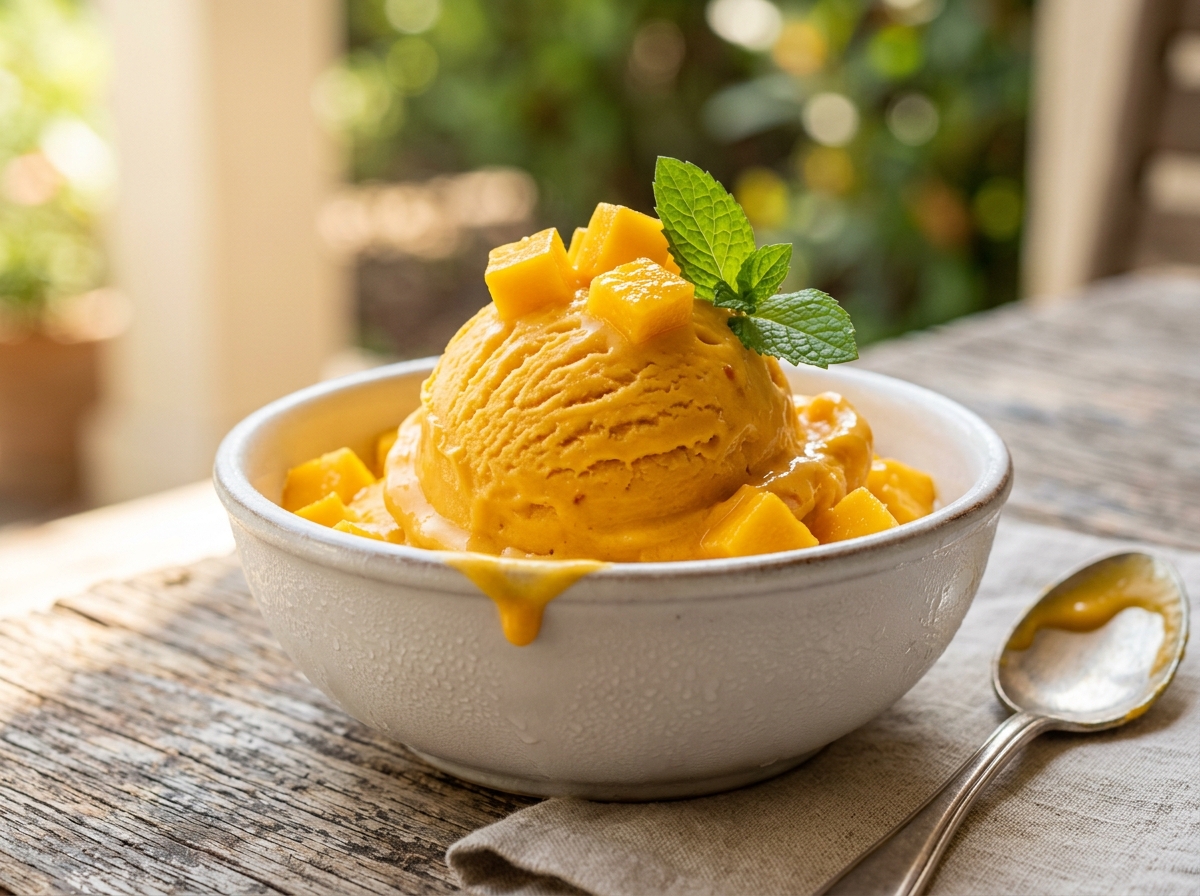
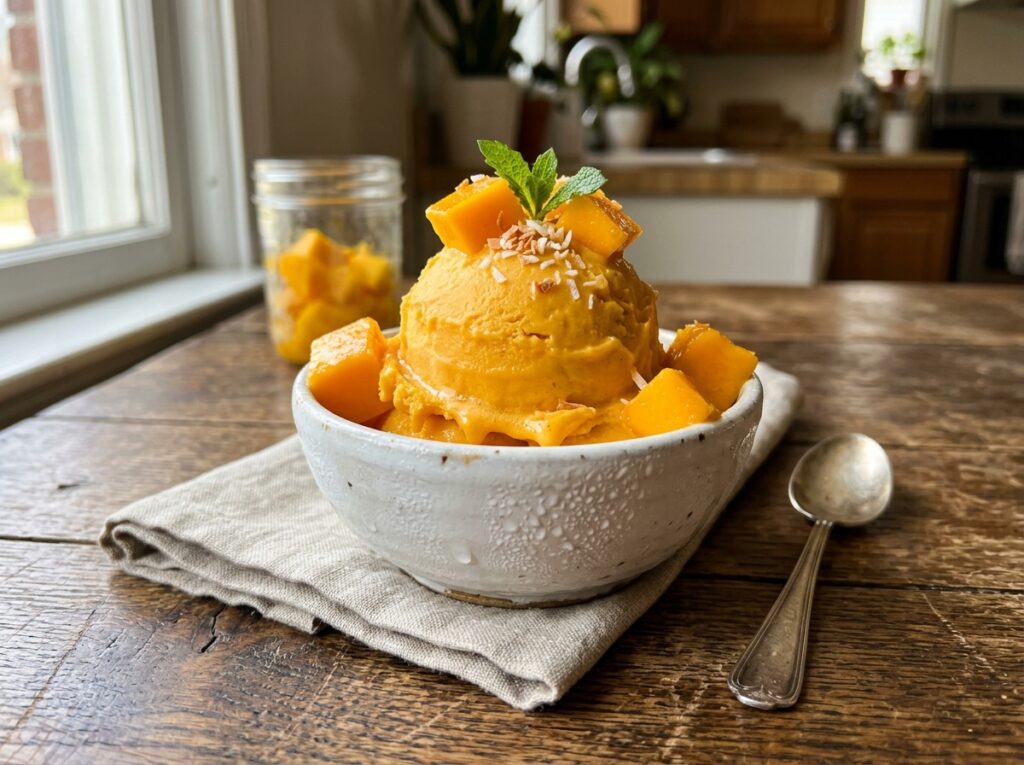
You slide a spoon into the freezer container and it glides through like butter—no chiseling, no waiting twenty minutes on the counter, no rock-hard disappointment. What you lift out is creamy, scoopable, sunset-orange mango ice cream that tastes like it came from a professional churner. Except it did not. No machine. No ice cream maker gathering dust in your garage. Just three core ingredients, a bowl, a whisk, and an understanding of how sugar, fat, and air work together to defeat ice crystals.
I have batch-tested various fat-to-sugar ratios to ensure this No-Churn Mango Ice Cream remains soft enough to scoop straight from the freezer, bypassing the dreaded “ice brick” phase that ruins most homemade frozen desserts. The secret is not a fancy technique—it is applied science. When you understand freezing point depression (how sugar lowers the temperature at which water freezes) and air incorporation (how whipped cream creates a protective matrix around tiny ice crystals), you can make ice cream that rivals anything from a churn, using nothing but a mixing bowl and your freezer.
This No-Churn Mango Ice Cream is what I make when summer mangoes flood the markets and I want maximum tropical flavor with minimum fuss. It is what I serve to guests who assume I spent hours cranking a machine. And it is proof that sometimes, the simplest methods—when backed by the right science—deliver the best results.
The Science: How No-Churn Mango Ice Cream Stays Creamy Without a Machine
The Antifreeze Effect: Why Sweetened Condensed Milk is the Hero
Traditional ice cream relies on a churner to constantly agitate the mixture as it freezes, breaking up ice crystals before they can grow large and crunchy. Without a machine, you need a different strategy: prevent large ice crystals from forming in the first place.
Enter sweetened condensed milk. This is whole milk with about sixty percent of the water removed and sugar added until it reaches roughly forty-five percent sugar by weight. That high sugar concentration does something remarkable: it acts as a natural antifreeze.
Here is the chemistry: pure water freezes at 32°F (0°C). But when you dissolve sugar (or any solute) into water, you lower the freezing point—a phenomenon called freezing point depression. The more sugar you add, the colder the mixture has to get before it turns solid. In a No-Churn Mango Ice Cream, the condensed milk’s extreme sugar concentration means that even at typical home freezer temperatures (0°F / -18°C), not all the water freezes solid. Some remains as a viscous, unfrozen syrup that keeps the texture soft and scoopable.
Freezing Point Depression∝Solvent VolumeSolute Concentration
In simple terms: more sugar dissolved in less water equals a lower freezing point and a creamier, softer ice cream.
Air Incorporation: The Protective Matrix
The second piece of the puzzle is air. Professional ice cream makers whip air into the base as it churns—this is called overrun in the industry. Air does two things: it lightens the texture (making it feel creamy instead of dense) and it physically separates water molecules, making it harder for them to cluster into large ice crystals.
In a No-Churn Mango Ice Cream, you achieve this by whipping cold heavy cream to stiff peaks before folding it into the mango-condensed milk mixture. The whipped cream is essentially a foam—a network of tiny air bubbles stabilized by milk fat and proteins. When you fold this foam into the sweetened mango base and freeze it, those air bubbles remain locked in place, creating a light, smooth texture that mimics the aeration a churner provides.
The fat in the heavy cream (at least thirty-six percent milkfat) is critical. Fat globules coat the air bubbles and prevent them from collapsing. Low-fat or light cream will not whip to stable peaks, and the final No-Churn Mango Ice Cream will be icy and dense instead of creamy and light.
The Mango Factor: Managing Water Content
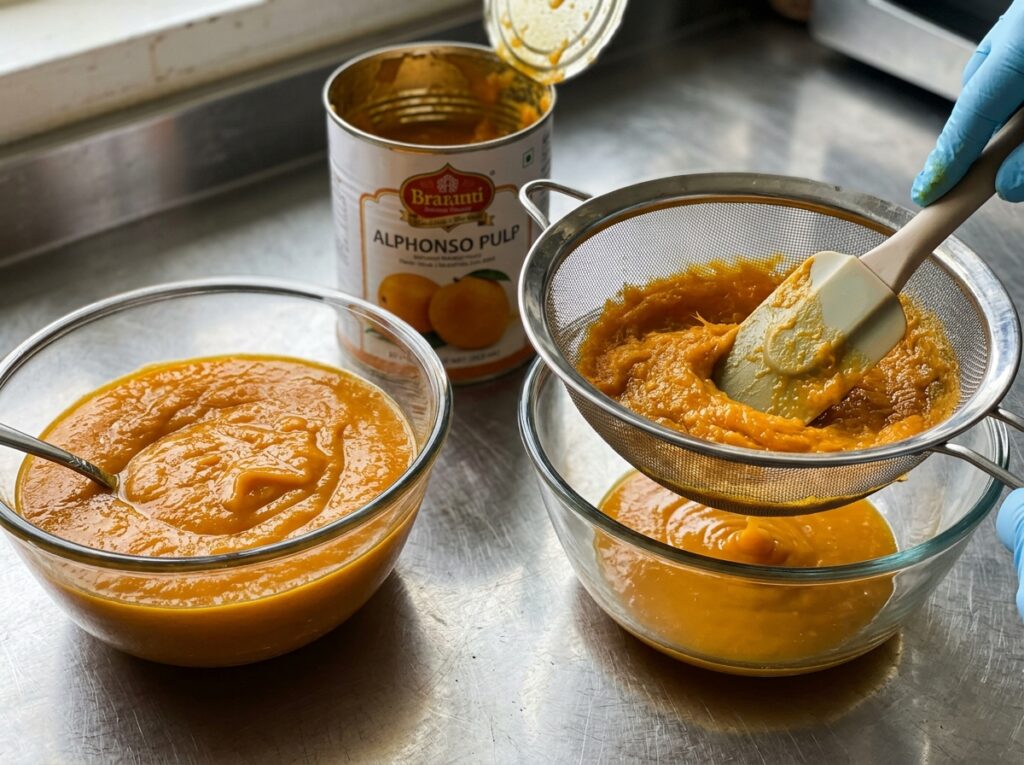
Fresh mango is about eighty-three percent water. If you blend fresh mango and pour it directly into your No-Churn Mango Ice Cream base, you are adding a lot of free water—water that will freeze into hard, crunchy ice crystals. The fix is twofold: reduce the mango pulp by simmering it gently to evaporate excess water and concentrate flavor, or use canned Alphonso mango pulp, which is already thick and has lower water content. If your mango mixture is watery, strain it through a fine-mesh sieve to remove thin juice and fibrous strands, leaving only the thick, velvety pulp that will blend seamlessly into the cream.
🛒 Pro Buying Guide: Ingredients That Make or Break No-Churn Mango Ice Cream (USA)
Sweetened Condensed Milk: The Foundation
Use Eagle Brand Sweetened Condensed Milk or Nestlé Carnation (both widely available at Walmart, Target, Kroger, Publix). These are shelf-stable and found in the baking aisle. Do not confuse condensed milk with evaporated milk, which is unsweetened and will not provide the sugar or thickness needed for this No-Churn Mango Ice Cream. One standard can is 14 oz (396g)—you will use the entire can.
Heavy Whipping Cream: Fat is Essential
Heavy whipping cream with at least 36% milkfat is non-negotiable. Brands like Organic Valley, Horizon Organic, or Trader Joe’s Heavy Cream work beautifully. Do not use “whipping cream” (30-35% fat) or “light cream”—they will not whip to stiff peaks and the final No-Churn Mango Ice Cream will be icy. You need two cups (480ml) of cold heavy cream.
Mango: Alphonso Pulp or Fresh Ataulfo
For the deepest, most vibrant orange color and intense tropical flavor, Alphonso Mango Pulp (available in cans at Indian grocery stores like Patel Brothers, or online via Amazon) is the gold standard. It is already thick, smooth, and low in fiber. One 30 oz can will give you more than enough.
If you prefer fresh: Ataulfo mangoes (Honey mangoes), available seasonally at Whole Foods, Trader Joe’s, and Kroger, are small, golden, and incredibly sweet with minimal fiber—perfect for a No-Churn Mango Ice Cream. You will need about three ripe Ataulfo mangoes (or two large Kent mangoes) to yield roughly 1.5 cups of thick pulp. Peel, cube, blend smooth, and simmer for 8-10 minutes to reduce water content.
Optional Flavor Boosters
- Fresh lime juice (1 tablespoon / 15ml) — brightens mango flavor
- Vanilla extract (1 teaspoon / 5ml) — adds depth
- Cardamom powder (1/4 teaspoon / 0.5g) — traditional Indian ice cream flavor
- Pinch of salt — enhances sweetness perception
Equipment: Metal Loaf Pan for Even Freezing
A 9×5-inch metal loaf pan freezes faster and more evenly than plastic or glass because metal conducts cold efficiently. This results in smaller ice crystals and a smoother No-Churn Mango Ice Cream. Line it with parchment paper for easy removal if you want to slice the ice cream into clean blocks for serving.
📊 Ingredients Table (US Customary + Metric)
| Ingredient | US Customary | Metric |
|---|---|---|
| Heavy whipping cream, cold | 2 cups | 480ml |
| Sweetened condensed milk | 14 oz (1 can) | 396g |
| Alphonso mango pulp (or fresh reduced pulp) | 1 1/2 cups | 360ml |
| Fresh lime juice | 1 tablespoon (optional) | 15ml |
| Vanilla extract | 1 teaspoon (optional) | 5ml |
| Fine sea salt | 1 pinch | 1 pinch |
Optional Garnish:
- Fresh mango cubes
- Toasted coconut flakes
- Crushed pistachios
Yield: About 1.5 quarts (6 cups / 1.4L)
Servings: 10-12 scoops
Prep Time: 15 minutes
Freeze Time: 6 hours (minimum overnight)
Total Time: 6 hours 15 minutes
⚠️ Common Mistakes Table (8 Mistakes That Ruin No-Churn Mango Ice Cream)
| The Mistake | What Actually Happens | The Fix |
|---|---|---|
| Using low-fat or light cream | Won’t whip to stiff peaks; ice cream turns icy and dense | Use heavy whipping cream with at least 36% milkfat only |
| Not chilling the bowl and whisk | Cream takes forever to whip; may not reach stiff peaks | Chill bowl and beaters in freezer for 10-15 minutes before whipping |
| Adding too much watery mango juice | Excess water freezes into hard ice crystals; icy texture | Reduce fresh mango or strain pulp; use thick Alphonso pulp |
| Over-whipping the cream into butter | Cream separates; ice cream tastes greasy and grainy | Stop at stiff peaks; cream should hold shape but still look glossy |
| Rough stirring when folding | Deflates whipped cream; removes air; ice cream becomes dense | Fold gently with a spatula from bottom up; preserve air bubbles |
| Peeking/stirring the freezer too often | Disrupts freezing process; allows warm air in; forms ice crystals | Freeze undisturbed for at least 6 hours; resist the urge to check |
| Using a glass or plastic container | Freezes unevenly and slowly; larger ice crystals form | Use a metal loaf pan for fast, even freezing and smooth texture |
| Skipping the surface seal | Ice crystals form on the surface; freezer burn develops | Press plastic wrap directly onto surface before freezing |
🔪 Step-by-Step Method: Crafting Perfect No-Churn Mango Ice Cream (Prose Only)
Step 1: The Mango Reduction (Concentrating Flavor, Removing Water)
If you are using fresh mangoes for your No-Churn Mango Ice Cream, start by peeling and cubing three ripe Ataulfo or two large Kent mangoes. Blend the mango flesh until completely smooth. Pour the purée into a small saucepan and simmer over medium-low heat for 8-10 minutes, stirring frequently, until it reduces by about one-quarter and looks thick and glossy. This evaporates excess water and concentrates the natural sugars, creating a more intense mango flavor and preventing icy texture later. Stir in one tablespoon of fresh lime juice and a pinch of salt. Let the reduced mango pulp cool to room temperature, then refrigerate until completely cold.
If you are using canned Alphonso mango pulp, simply measure 1.5 cups and stir in the lime juice and salt. Alphonso pulp is already thick and concentrated, so no reduction is needed—though you can strain it through a fine-mesh sieve if you want an ultra-smooth, fiber-free texture for your No-Churn Mango Ice Cream.
Step 2: The Cold Whip (Building the Air Matrix)
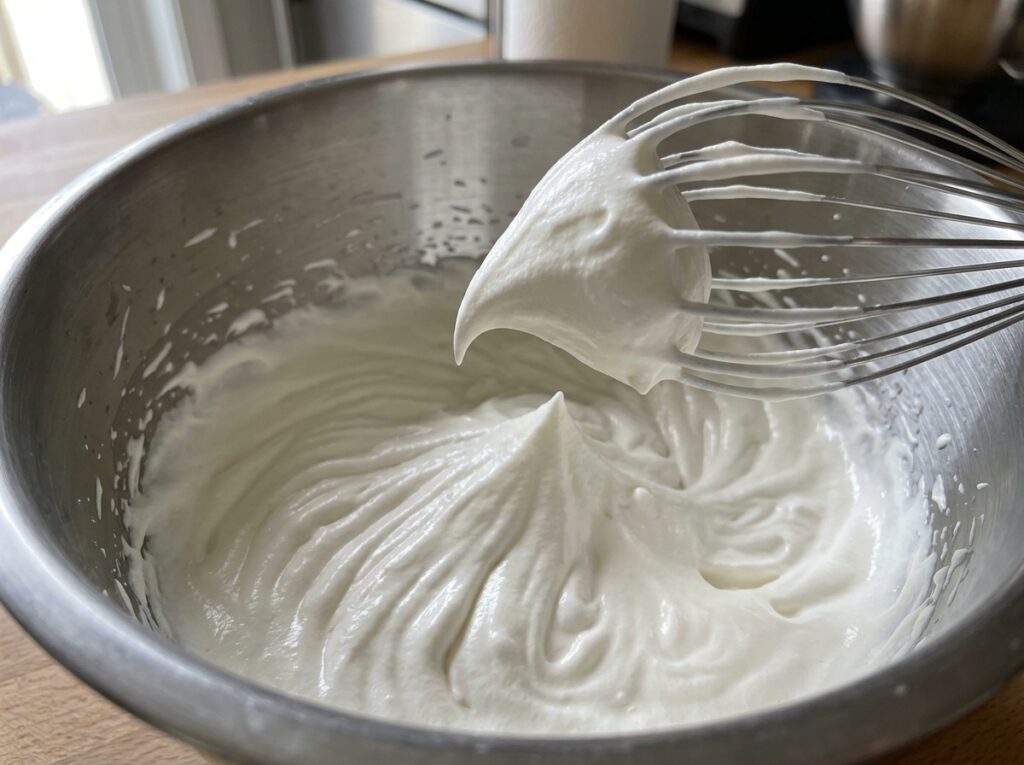
Place a large mixing bowl and the beaters of your electric mixer (or the whisk attachment of a stand mixer) in the freezer for 10-15 minutes until very cold. Cold equipment helps the cream whip faster and to more stable peaks. Pour two cups of cold heavy whipping cream into the chilled bowl. Start beating on medium speed until the cream begins to thicken and soft peaks form (the cream curls gently when you lift the beaters). Increase to medium-high speed and continue whipping until stiff peaks form—the cream should stand straight up when you lift the beaters, and the texture should be thick, smooth, and glossy, not grainy or curdled.
Do not over-whip. If you continue beating past stiff peaks, the cream will turn into butter, separating into fat and liquid. Stop as soon as the peaks hold firmly. This whipped cream is the structural foundation of your No-Churn Mango Ice Cream, trapping air and preventing large ice crystals from forming.
Step 3: The Sweetened Mango Base (Condensed Milk Magic)
In a separate medium bowl, whisk together the entire 14 oz can of sweetened condensed milk and the cold, thick mango pulp until smooth and fully combined. The mixture should be a vibrant orange color and thick but pourable. If you are adding optional vanilla extract or cardamom powder, stir them in now. Taste the mixture—it should be sweet, tangy, and intensely mango-flavored. This is your base, and it carries all the sugar (the antifreeze) that will keep your No-Churn Mango Ice Cream soft and scoopable.
Step 4: The Gentle Fold (Preserving Air, Achieving Creaminess)
This is the most critical step for texture. Add about one-third of the whipped cream to the mango-condensed milk mixture. Using a large silicone spatula, fold gently from the bottom of the bowl up and over, turning the bowl as you go. This initial fold lightens the dense mango base and makes it easier to incorporate the rest of the cream without deflating it.
Add the remaining whipped cream in two more additions, folding gently each time just until no white streaks remain. The goal is to preserve as much air as possible—those tiny bubbles are what give your No-Churn Mango Ice Cream its creamy, light texture. If you stir aggressively or use a whisk, you will knock out the air and end up with dense, icy results. The final mixture should look fluffy, slightly thick, and uniformly orange.
Step 5: The Freeze and Surface Seal (Preventing Ice Crystals and Freezer Burn)
Pour the No-Churn Mango Ice Cream mixture into a 9×5-inch metal loaf pan (or any freezer-safe container with at least 1.5 quart capacity). Smooth the top with a spatula. Here is a professional trick: press a piece of plastic wrap directly onto the surface of the ice cream, eliminating any air gap. This prevents ice crystals from forming on top and protects against freezer burn, keeping your No-Churn Mango Ice Cream smooth and creamy even after days in the freezer.
Cover the pan tightly with a lid or additional plastic wrap and foil. Freeze for at least 6 hours, preferably overnight (8-12 hours). Do not open the freezer to check on it during this time—every time you introduce warm air, you risk forming ice crystals. Patience is the final ingredient.
Step 6: The Perfect Scoop
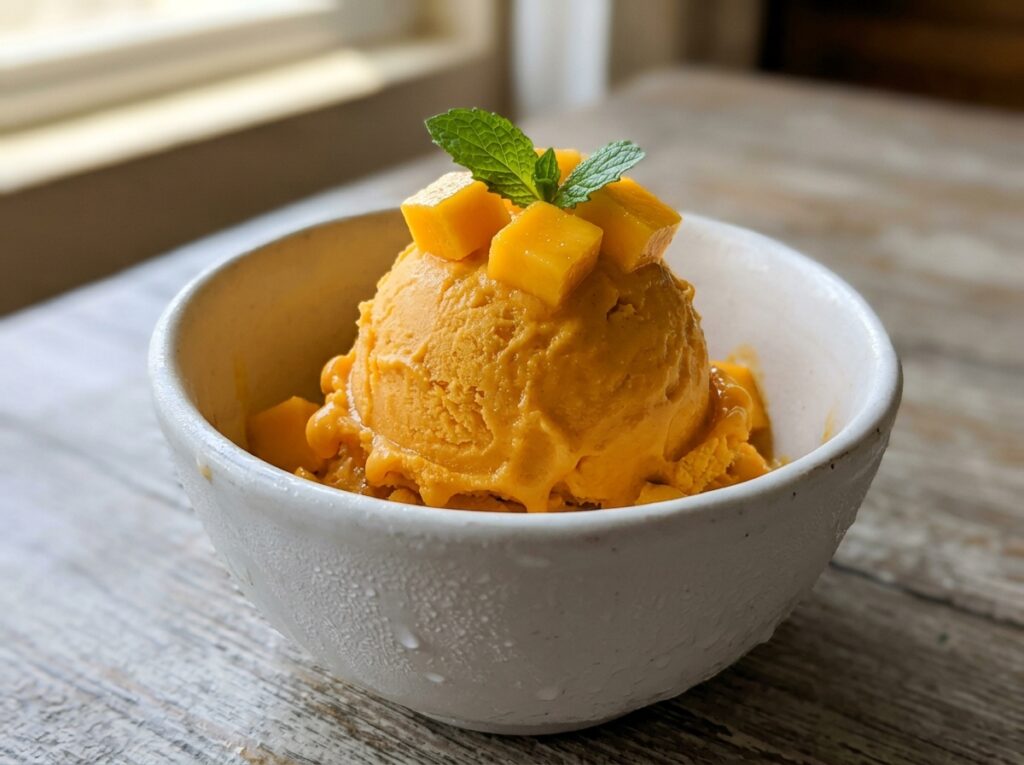
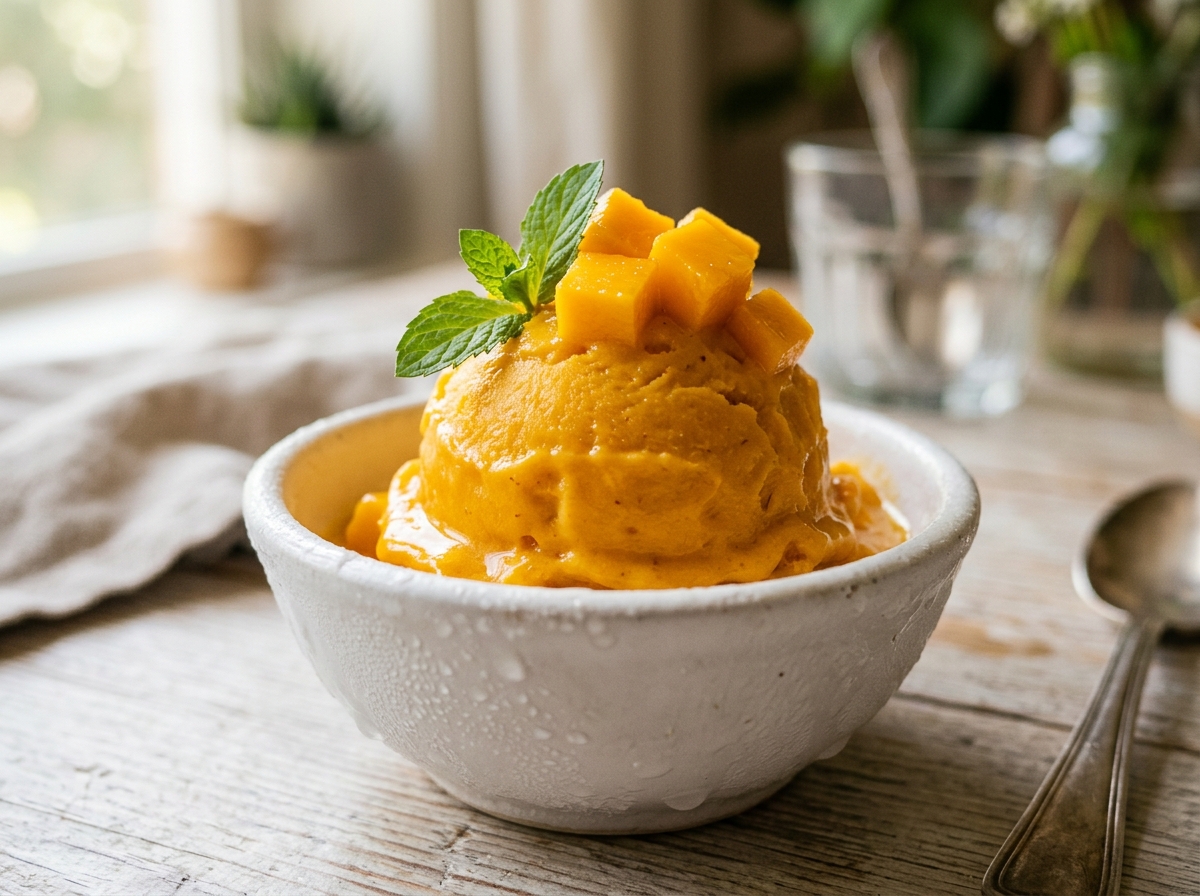
When you are ready to serve, remove the No-Churn Mango Ice Cream from the freezer. Unlike traditional ice cream, it should be soft enough to scoop almost immediately—no need to wait on the counter. If your freezer runs very cold and the ice cream feels firm, let it sit at room temperature for 3-5 minutes. Use a sturdy ice cream scoop dipped in warm water for clean, beautiful scoops. Serve immediately, garnished with fresh mango cubes, toasted coconut, or crushed pistachios.

No-Churn Mango Ice Cream
Ingredients
Equipment
Method
- If using fresh mangoes for your No-Churn Mango Ice Cream, peel and cube 3 ripe Ataulfo or 2 large Kent mangoes. Blend the flesh in a blender or food processor until completely smooth. Pour the fresh mango purée into a small saucepan and simmer over medium-low heat for 8-10 minutes, stirring frequently, until it reduces by about one-quarter and becomes thick and glossy. This evaporates excess water and concentrates natural sugars, preventing icy texture later. Stir in 1 tablespoon fresh lime juice and a pinch of salt. Remove from heat and let cool to room temperature, then refrigerate until completely cold (at least 1 hour). If using canned Alphonso mango pulp, simply measure 1 1/2 cups and stir in lime juice and salt. For ultra-smooth texture, strain through a fine-mesh sieve to remove any fibers. Refrigerate until cold.
- Place a large metal mixing bowl and the beaters of your electric hand mixer (or whisk attachment of a stand mixer) in the freezer for 10-15 minutes until very cold. Cold equipment helps cream whip faster and more stably. Pour 2 cups of cold heavy whipping cream into the chilled bowl. Beat on medium speed until the cream begins to thicken and soft peaks form (cream curls gently when beaters are lifted). Increase speed to medium-high and continue whipping until stiff peaks form—the cream should stand straight up when you lift the beaters, looking thick, smooth, and glossy, not grainy or curdled. CRITICAL: Do not over-whip. If you continue beating past stiff peaks, the cream will separate into butter and liquid. Stop as soon as peaks hold firmly. This whipped cream is the structural foundation that traps air and prevents large ice crystals from forming in your No-Churn Mango Ice Cream. Set aside.
- In a separate medium bowl, whisk together the entire 14 oz can of sweetened condensed milk and the cold, thick mango pulp until smooth and fully combined. The mixture should be vibrant orange and thick but pourable. If adding optional vanilla extract or cardamom powder, stir them in now. Taste the mixture—it should be sweet, tangy, and intensely mango-flavored. This sweetened base carries all the sugar that acts as “antifreeze,” keeping your No-Churn Mango Ice Cream soft and scoopable even when frozen solid.
- This is the most critical step for achieving creamy texture. Add about one-third of the whipped cream to the mango-condensed milk mixture. Using a large silicone spatula, fold gently from the bottom of the bowl up and over the top, turning the bowl as you go. This initial fold lightens the dense mango base and makes it easier to incorporate the remaining cream without deflating it. Add the rest of the whipped cream in two more additions, folding gently each time just until no white streaks remain. The goal is to preserve as much air as possible—those tiny bubbles give your No-Churn Mango Ice Cream its light, creamy texture. Do not stir aggressively or use a whisk, or you will knock out the air and create dense, icy results. The final mixture should look fluffy, slightly thick, and uniformly sunset-orange.
- Pour the No-Churn Mango Ice Cream mixture into a 9×5-inch metal loaf pan (or any freezer-safe container with at least 1.5 quart / 6 cup capacity). Metal conducts cold better than glass or plastic, resulting in faster, more even freezing and smaller ice crystals. Smooth the top with an offset spatula. PROFESSIONAL TRICK: Press a piece of plastic wrap directly onto the surface of the ice cream, eliminating any air gap between the plastic and the mixture. This prevents ice crystals from forming on top and protects against freezer burn. Cover the pan tightly with a lid, additional plastic wrap, or aluminum foil. Freeze for at least 6 hours, preferably overnight (8-12 hours) for best texture. Do not open the freezer to check during this time—introducing warm air creates ice crystals. Be patient; this is the final critical step.
- Remove the No-Churn Mango Ice Cream from the freezer. Thanks to the high sugar content from condensed milk, it should be soft enough to scoop almost immediately—no 20-minute countertop wait required. If your freezer runs very cold (below 0°F / -18°C) and the ice cream feels firm, let it sit at room temperature for 3-5 minutes to soften slightly. Use a sturdy ice cream scoop dipped in warm water for clean, beautiful rounded scoops. Wipe the scoop between servings for professional presentation. Serve immediately in chilled bowls, garnished with fresh mango cubes, toasted coconut flakes, crushed pistachios, or fresh mint leaves.
Notes
🧘♂️ Chef Mansoor’s Insight
There is a strange comfort in knowing that science can simplify tradition without sacrifice. For centuries, ice cream required churning—manual labor, machinery, ice and salt baths. But understanding freezing point depression and air emulsions showed us a shortcut that does not compromise quality. This No-Churn Mango Ice Cream is proof that the best techniques are not always the oldest or most complicated—they are the ones that respect the chemistry and trust it to do the work. I have made ice cream both ways, and this method delivers texture and flavor that rival any churner, with a fraction of the effort. The lesson? Learn the principles. Then let the principles do the heavy lifting while you enjoy the results.
📊 Nutrition Table (Per Serving, 10 Servings)
| Nutrient | Amount |
|---|---|
| Calories | 280 kcal |
| Total Carbohydrates | 32g |
| Total Sugars | 28g |
| Protein | 4g |
| Total Fat | 15g |
| Saturated Fat | 9g |
| Cholesterol | 55mg |
| Sodium | 70mg |
| Vitamin A | 30% DV |
| Vitamin C | 25% DV |
| Calcium | 12% DV |
Estimates based on USDA data for heavy cream, condensed milk, and Alphonso mango pulp. Values vary with mango variety and optional additions.
🌡️ Food Safety & Dairy Handling
Safe freezer temperature: 0°F / -18°C or colder
Safe refrigerator temp (for ingredients): ≤ 40°F / 4°C
Danger zone (do not hold): 40°F–140°F / 4°C–60°C
Dairy stability: Heavy cream and condensed milk must be kept refrigerated until use. Once mixed and frozen, No-Churn Mango Ice Cream is safe indefinitely at proper freezer temperatures, but quality is best within 2-3 weeks.
Serving safety: Do not leave No-Churn Mango Ice Cream at room temperature for more than 15-20 minutes. If it melts, do not refreeze—the texture will be compromised and bacteria may grow.
🧊 Storage Guide
| Storage Method | Duration | Best Practice |
|---|---|---|
| Freezer (airtight container) | 2-3 weeks (best quality) | Press plastic wrap directly on surface; cover tightly to prevent freezer burn |
| Freezer (long-term) | Up to 2 months | Quality declines over time; ice crystals may form; still safe but less creamy |
| Room temperature | Not recommended | Ice cream will melt; bacteria can grow in dairy; do not refreeze melted ice cream |
| Refrigerator | Not applicable | Will not freeze; will remain liquid |
Pro Tip: For best texture, store No-Churn Mango Ice Cream in the coldest part of your freezer (back, not door) in an airtight container with surface-contact plastic wrap.
❓ Frequently Asked Questions
Why is my No-Churn Mango Ice Cream icy instead of creamy?
Most common causes: too much watery mango juice (reduce the pulp or use thick Alphonso pulp), low-fat cream that did not whip properly, or deflated whipped cream from rough folding. Always whip to stiff peaks and fold gently to preserve air.
Can I use a different fruit?
Absolutely. This method works with strawberries, peaches, blueberries, passion fruit, or any thick fruit purée. Reduce fresh fruit to concentrate flavor and remove water, or use thick fruit purées and compotes.
Do I need an ice cream maker?
No. That is the entire point of No-Churn Mango Ice Cream—it requires no machine, no churning, and no special equipment beyond a bowl and a whisk.
How do I prevent freezer burn?
Press plastic wrap directly onto the surface of the ice cream before covering the container. This eliminates air exposure and prevents ice crystals from forming on top.
Can I make this dairy-free or vegan?
It is challenging. The science relies on dairy fat (heavy cream) and sweetened condensed milk. Coconut cream can replace heavy cream, but the texture will be different (grainier, less smooth). Dairy-free condensed coconut milk exists but is harder to find and results vary.
Why use sweetened condensed milk instead of regular sugar?
Condensed milk provides both sugar (for freezing point depression) and concentrated milk solids (for creaminess) in one ingredient. Its low water content is critical—adding sugar and milk separately would introduce too much water, causing icy texture.
🔗 More from Flavour Bazar
If this No-Churn Mango Ice Cream brings you tropical joy, explore these other science-backed summer recipes:
🍉 Watermelon Mint Cooler: The Science of Summer Hydration — Pair with this creamy dessert for a complete summer party menu
🥭 No-Bake Mango Cheesecake: The Science of the Perfect Set — Another mango masterpiece with gelatin science
🍓 Strawberry Shortcake: The Science of the Perfect Crumb — Classic summer dessert with biscuit chemistry
🥗 Probiotic Chickpea Salad: Gut-Friendly Fuel — Balance rich desserts with a nutritious, energizing lunch
Outbound Link (Authority Building):
🔬 Understanding Brix Levels in Mango Varieties — Learn how sugar content varies across mango types and affects flavor intensity
For More Healthy Recipes Visit: flavourbazar.com