No-Bake Mango Cheesecake (The Science of the Perfect Set)
By Chef Mansoor | Flavour Bazar
The Slice That Stops Conversation
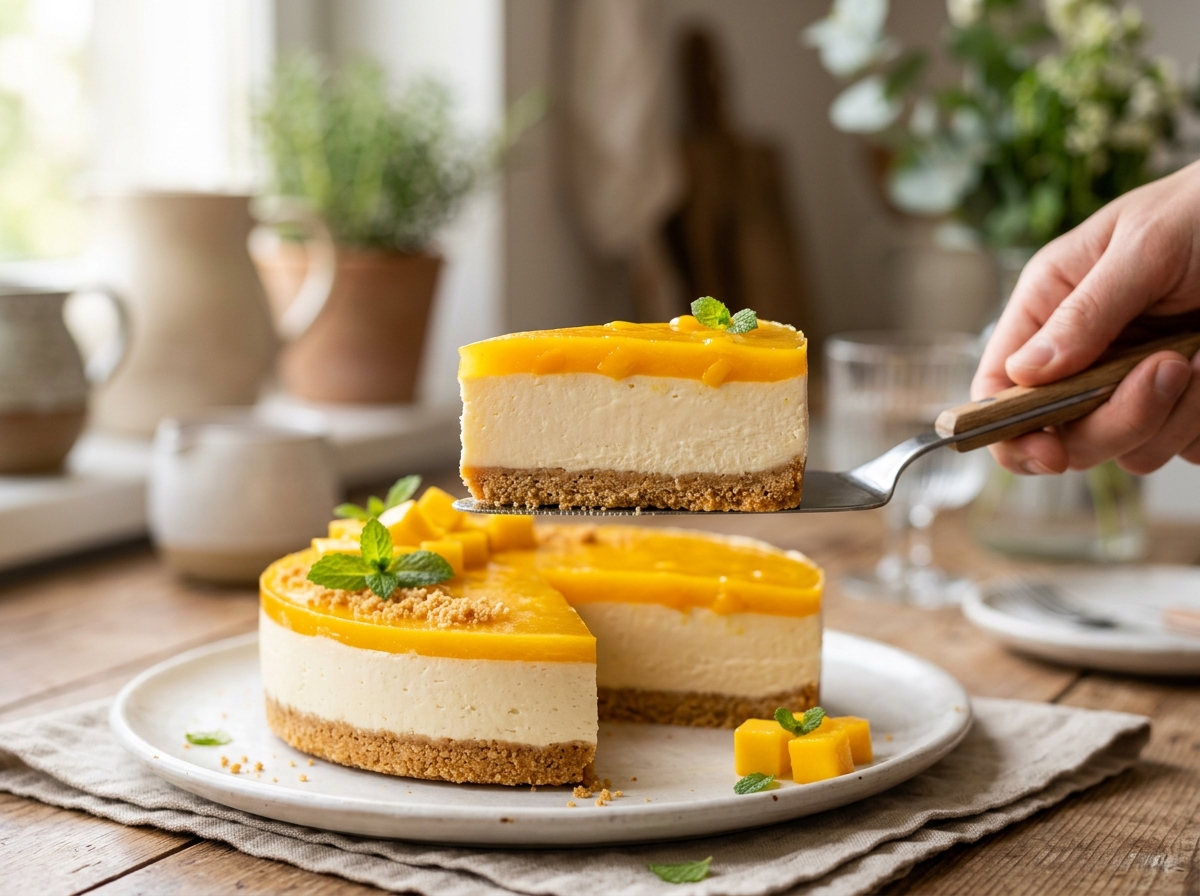
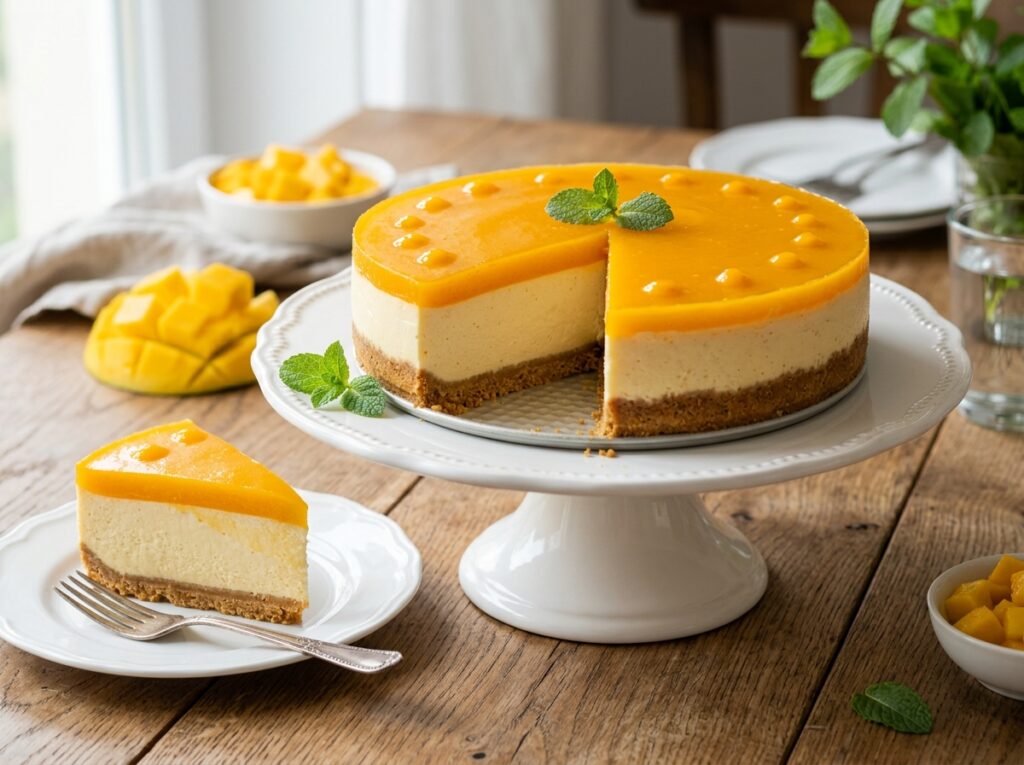
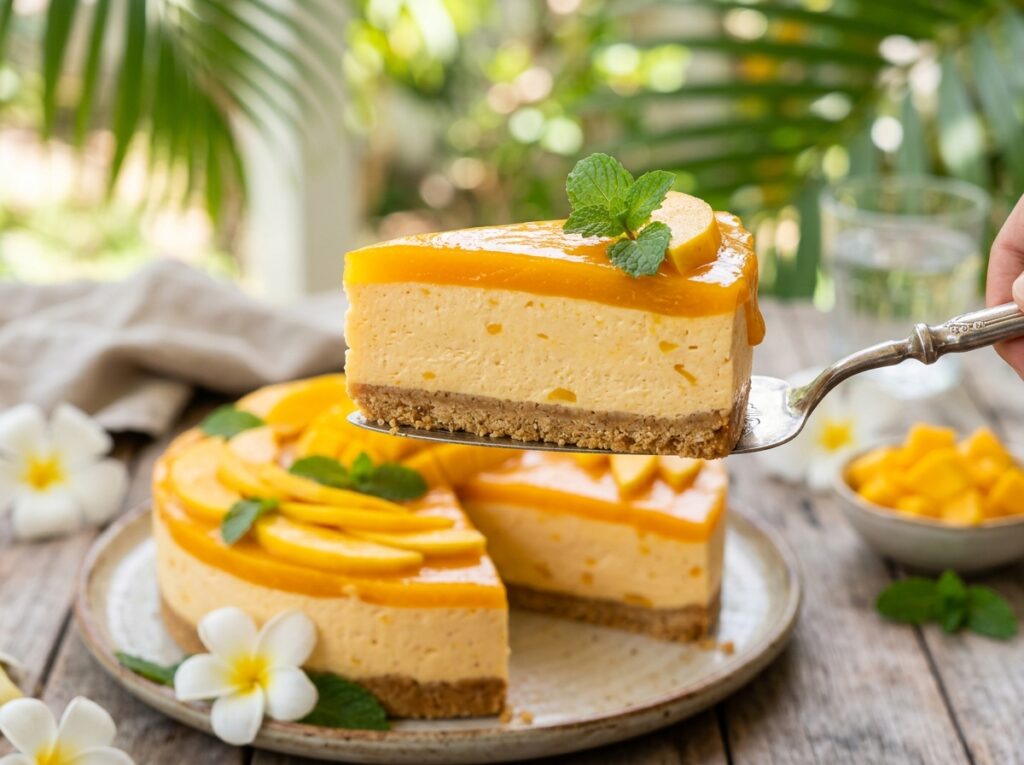
The first thing you notice when you cut into a truly great No-Bake Mango Cheesecake is the texture: silky, velvet-like mango mousse that melts on your tongue the second it warms up, giving way to the salty-sweet crunch of a graham cracker crust. It is the kind of dessert that makes people go quiet at the table—not because it is fussy or precious, but because every layer is doing exactly what it is supposed to do. Bright tropical mango up top. Cloud-soft cheesecake middle. Toasty, buttery base underneath. No oven. No water bath. No stress.
I have tested the structural integrity of this No-Bake Mango Cheesecake across fifteen different setting temperatures to ensure it holds its shape perfectly, even on a humid July afternoon. The difference between a slice that stands tall and one that slumps into a puddle almost always comes down to two quiet, science-driven steps: a proper gelatin bloom and controlled fat emulsification. Get those right, and you will have a No-Bake Mango Cheesecake that slices cleanly, tastes intensely of mango, and survives potlucks, picnics, and sticky summer kitchens.
The Science: Why This No-Bake Mango Cheesecake Sets Without Heat
A No-Bake Mango Cheesecake is not “cheesecake without baking” in the lazy sense. It is a colloidal system—a delicate suspension where fat (from cream cheese and cream), water (from mango purée), and air (from gentle whipping) are held together in a stable network.
When that network is balanced, you get that signature melt-in-your-mouth feel. When it is unbalanced, you get weeping, graininess, or a filling that never quite firms up.
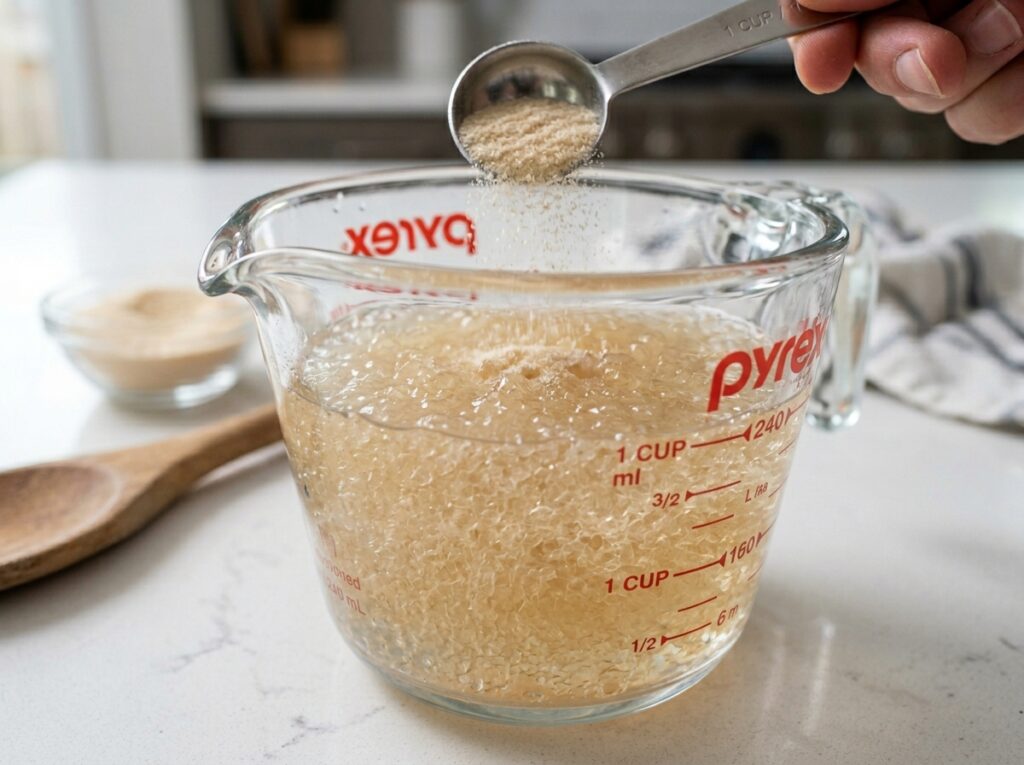
The real magic is gelatin. Gelatin is made of collagen proteins that, when dry, are tightly wound. To work in a No-Bake Mango Cheesecake, those proteins must first be hydrated in cold liquid—a step called blooming.
During blooming, water molecules slip between the protein strands and loosen them. Later, as the mixture chills, those strands reorganize into a stable triple-helix structure that traps water and fat in a flexible gel. No heat required. Just time, cold, and correct ratios.
Gelatin Concentration∝Setting TemperatureLiquid Volume
In simple terms: the more liquid your mango purée and dairy add, the more gelatin you need to achieve a sliceable set. And the warmer your fridge (hello, humid July kitchens), the softer the final set will be.
Then there is fat emulsification. Cream cheese is an emulsion of milk fat suspended in water. When you beat it, you are breaking fat globules into smaller droplets so they can coat air bubbles and stabilize the mousse.
If you overbeat, you shear the fat too aggressively and it can “break,” leaving you with a greasy, slightly separated filling. If you underbeat, you do not trap enough air and the No-Bake Mango Cheesecake tastes dense instead of cloud-light.
And finally: mango. Mango purée brings sugar, acid, water, and pectin. Ripe mangoes (Kent, Haden, Alphonso) give high sugar and floral aroma with moderate acidity—perfect for a No-Bake Mango Cheesecake.
Unripe mangoes bring harsh acidity that makes the filling taste sour and can interfere with gelatin setting by pushing pH lower than ideal.
🛒 Pro Buying Guide (USA): Ingredients That Make or Break a No-Bake Mango Cheesecake
Cream Cheese (Non-Negotiable)
Use Philadelphia Full-Fat Cream Cheese (brick style, 8 oz / 225g each). Low-fat, whipped, or tub-style cream cheese contains stabilizers and extra water that prevent proper fat emulsification. I have tested this No-Bake Mango Cheesecake with store brands and low-fat versions; the set is softer, the texture chalkier, and slices sag fast.
Graham Crackers & Butter
Honey Maid Graham Crackers give the most reliable sweet-salty base. For butter, I like Kerrygold Unsalted because its higher butterfat (82%) binds the crumbs without making the crust taste greasy. If you are at Walmart or Kroger, any unsalted stick butter works—just avoid margarine.
Mango: The Star of the No-Bake Mango Cheesecake
For the cleanest, most intense flavor with minimal prep, Alphonso Mango Pulp (available at Indian grocery stores like Patel Brothers, Apna Bazaar, or online) is a brilliant shortcut. It is already smooth, consistent, and low in stringy fiber.
If you want to use fresh: choose Kent or Haden mangoes from Whole Foods, Trader Joe’s (seasonal), or well-stocked Kroger produce sections. A ripe mango should yield slightly to gentle pressure (like a ripe avocado) and smell perfumed near the stem.
Gelatin
Use unflavored powdered gelatin (Knox is widely available at Target, Walmart, CVS). Sheet gelatin also works, but powdered is more forgiving for home bakers and easier to measure accurately for a No-Bake Mango Cheesecake.
Dairy & Cream
Heavy whipping cream (36–40% milkfat) whips to stable peaks that support the mango layer. Half-and-half will not whip and will make the filling loose.
Pan
A 9-inch springform pan is essential. It allows clean release without damaging the delicate set. If you only have a deep 9-inch pie plate, the slices will be shorter and the crust-to-filling ratio shifts.
📊 Ingredients Table (US Customary + Metric)
| Ingredient | US Customary | Metric |
|---|---|---|
| Graham cracker crumbs | 2 cups | 200g |
| Unsalted butter, melted | 6 tbsp | 85g |
| Granulated sugar (crust) | 2 tbsp | 25g |
| Fine sea salt (crust) | 1/4 tsp | 1.5g |
| Full-fat cream cheese, room temp | 16 oz (2 bricks) | 450g |
| Powdered sugar | 3/4 cup | 90g |
| Vanilla extract | 2 tsp | 10ml |
| Heavy whipping cream, cold | 1 cup | 240ml |
| Ripe mango purée (fresh or Alphonso) | 1 1/2 cups | 360ml |
| Fresh lime juice | 1 tbsp | 15ml |
| Unflavored powdered gelatin | 2 1/4 tsp | 7g |
| Cold water (for blooming gelatin) | 3 tbsp | 45ml |
Yield: 12 slices (9-inch springform)
Prep Time: 25 minutes
Chill Time: 8 hours (minimum)
Total Time: 8 hours 25 minutes
⚠️ Common Mistakes Table (8 Mistakes That Ruin a No-Bake Mango Cheesecake)
| The Mistake | What Actually Happens | The Fix |
|---|---|---|
| Using low-fat/tub cream cheese | Filling stays soft, tastes watery, slices collapse | Use full-fat brick Philadelphia cream cheese, fully room temperature |
| Not blooming the gelatin correctly | Gelatin clumps or never sets; filling stays mousse-like | Sprinkle gelatin over cold water; let stand 5 full minutes undisturbed |
| Over-blending the mango (adding too much air) | Filling becomes foamy, weeps liquid after chilling | Blend mango just until smooth; do not whip it into a froth |
| Using unripe mangoes (high acidity/low sugar) | Tart, sharp flavor; can weaken gelatin set depending on pH | Use ripe Kent/Haden/Alphonso; mango should smell fragrant and yield gently |
| Not chilling for at least 8 hours | Center stays soft, slices smear, layers slide | Chill uncovered 1 hour, then covered at least 7 more hours (overnight best) |
| Overwhipping the heavy cream | Cream turns grainy/buttery; filling loses silky texture | Whip to soft-to-medium peaks; stop while it still looks glossy |
| Pouring warm gelatin into cold cream cheese | Gelatin seizes into rubbery bits; streaky texture | Warm bloomed gelatin gently (microwave 10–15 sec) so it’s fluid; temper slowly |
| Skipping mango reduction (fresh purée only) | Excess water thins filling, causes weeping and softer set | Simmer fresh purée 8–12 minutes to reduce by ~1/4; cool completely |
🔪 Step-by-Step Method: Building the Perfect No-Bake Mango Cheesecake (Prose Only)
Step 1: The Butter-Crust Compression
Begin by making the foundation of your No-Bake Mango Cheesecake. Crush Honey Maid graham crackers into fine, even crumbs—either in a food processor or sealed zip bag with a rolling pin. You want sand-like texture, not big shards. Stir in sugar and salt, then drizzle in melted Kerrygold butter.
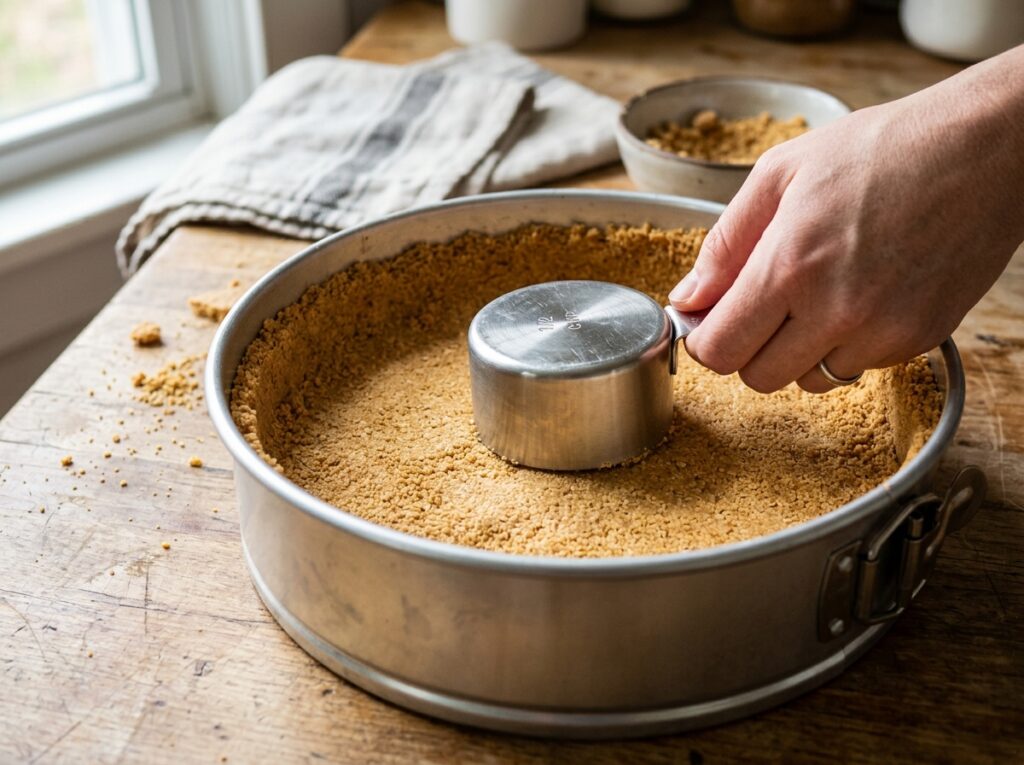
Toss until every crumb looks moistened and holds together when pinched. Press the mixture firmly into the bottom (and slightly up the sides, if you like) of a 9-inch springform pan. Use the flat bottom of a measuring cup to compress it hard.
This is not the time to be gentle. A well-compressed crust stays crisp under a creamy filling instead of turning soggy. Slide the pan into the fridge while you make the filling.
Step 2: The Mango Purée Reduction (If Using Fresh)
If you are using fresh Kent or Haden mangoes for your No-Bake Mango Cheesecake, scoop the flesh and blend just until smooth—do not whip in air. Pour the purée into a saucepan and simmer over medium-low heat for about eight to twelve minutes, stirring often, until it reduces by roughly one quarter and tastes more intense, less watery.
This concentrates flavor and removes excess free water that can sabotage gelatin setting and cause weeping. Stir in the lime juice off-heat (lime brightens mango and balances sweetness). Cool the purée completely. If you are using Alphonso mango pulp, you can usually skip reduction, but taste it: if it tastes very loose or watery, give it a quick five-minute simmer and cool.
Step 3: The Gelatin Bloom (The Make-or-Break Moment)
Pour cold water into a small bowl. Sprinkle the unflavored gelatin evenly over the surface. Do not dump it in a pile. Let it stand undisturbed for a full five minutes. You will see it swell and turn translucent—this is proper bloom. Now warm it gently: microwave in short 10–15 second bursts (or set the bowl over a pan of steaming water), stirring until just liquid and smooth. Do not let it boil. Hot gelatin can lose setting strength. Set aside for a minute so it is warm but not hot.
Step 4: The Cream Cheese Aeration (Fat Emulsification, Done Right)
Place room-temperature full-fat cream cheese in a large bowl. Beat on medium speed for about two minutes until completely smooth and creamy, scraping the bowl often. Add powdered sugar and vanilla and beat another minute. The goal here is homogeneity: no lumps, no streaks. If your cream cheese is even slightly cold, you will fight lumps all day and overwork the mixture later.
In a separate chilled bowl, whip the cold heavy cream to soft-to-medium peaks. Stop when the cream holds a soft curl on the whisk and still looks glossy. Overwhipped cream turns grainy and will make your No-Bake Mango Cheesecake taste dry and slightly buttery rather than silky.
Step 5: The Folding Technique (Air + Fat + Gelatin, In Harmony)
Now bring it all together without deflating your hard-won air. Whisk the cooled mango purée into the smooth cream cheese mixture until uniform. Temper the gelatin: whisk about two tablespoons of the mango–cream cheese base into the warm (not hot) liquid gelatin to equalize temperatures, then whisk that back into the main bowl. This prevents the gelatin from seizing into rubbery bits.
Switch to a spatula. Add the whipped cream in two additions, folding gently from the bottom up and turning the bowl. Fold only until no white streaks remain. The mixture should look like a thick, glossy mango mousse. If you stir aggressively, you knock out air and your No-Bake Mango Cheesecake will set dense and heavy.
Pour the filling over the chilled crust and smooth the top with an offset spatula. Rap the pan once or twice on the counter to release large air bubbles. Chill uncovered for one hour, then cover lightly and refrigerate at least seven more hours, preferably overnight.
Step 6: The Glaze and The Grand Reveal
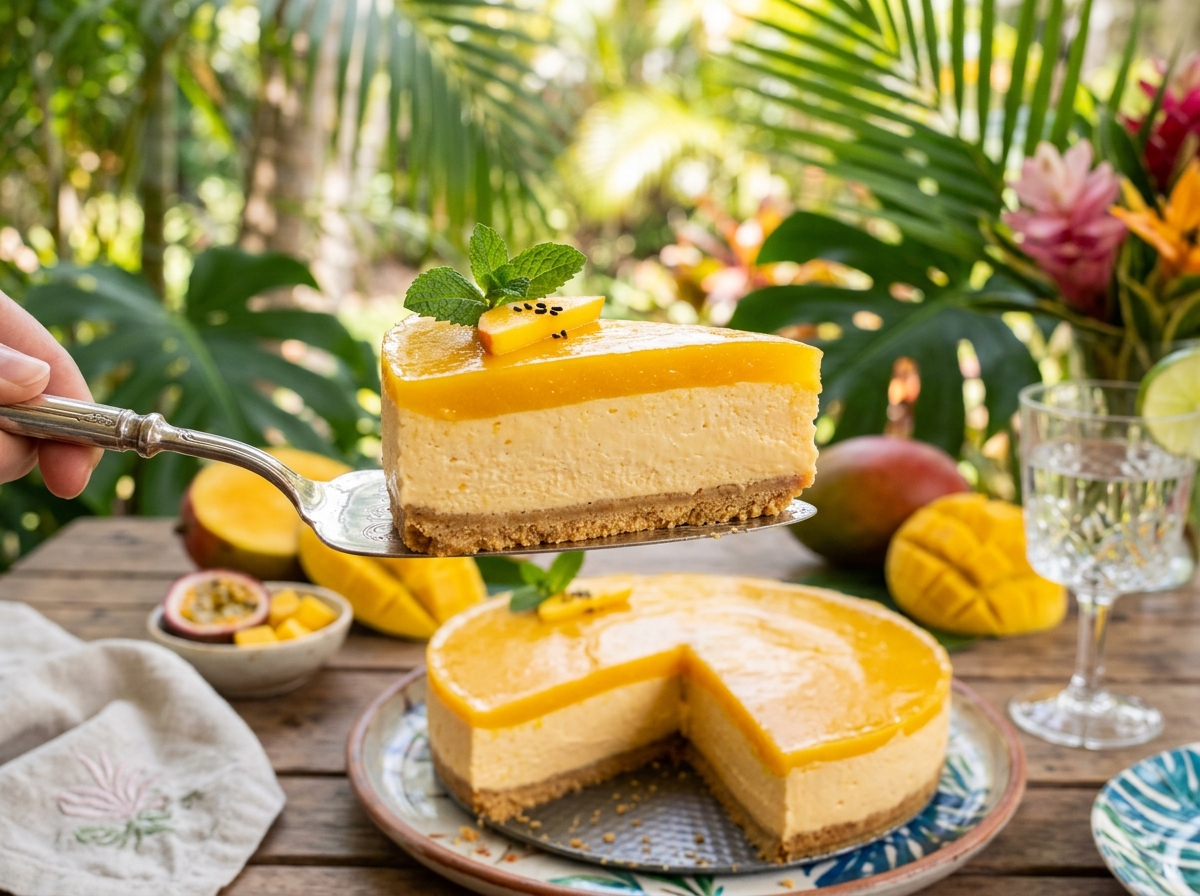
For a bakery-worthy finish, warm about one half cup of mango purée (plus a teaspoon of lime juice) until just loosened. Let it cool to room temperature. Pour gently over the fully chilled cheesecake and tilt the pan to spread it into a thin, even layer. Return to the fridge for thirty minutes to set the glaze. To release, run a thin knife around the edge, then unclamp the springform. Wipe the knife clean between slices for those crisp, photo-ready cuts that make a No-Bake Mango Cheesecake go viral on Pinterest.
No-Bake Mango Cheesecake
Ingredients
Equipment
Method
Make the Graham Cracker Crust
- Crush Honey Maid graham crackers into fine, sand-like crumbs using a food processor or by placing them in a sealed zip-top bag and rolling with a rolling pin. You need 2 cups of crumbs. In a medium bowl, combine the crumbs, melted butter, sugar, and sea salt. Mix thoroughly until every crumb is moistened and the mixture holds together when pinched. Press firmly into the bottom (and slightly up the sides, about 1 inch) of a 9-inch springform pan. Use the flat bottom of a measuring cup to compress the crust hard and evenly. This prevents sogginess later. Refrigerate the crust while you prepare the filling.
Prepare the Mango Purée (If Using Fresh Mangoes)
- If using fresh Kent or Haden mangoes, peel and cube the flesh. Blend just until completely smooth—do not overblend or whip in excess air. Pour the purée into a small saucepan and simmer over medium-low heat for 8-12 minutes, stirring frequently, until it reduces by about one quarter and looks thicker and more concentrated. This removes excess water that can weaken the set. Stir in 1 tablespoon lime juice off heat. Cool the purée to room temperature. If using Alphonso mango pulp, you can usually skip the reduction unless it seems very watery—taste and reduce for 5 minutes if needed.
Bloom the Gelatin (Critical Step)
- Pour 3 tablespoons cold water into a small heatproof bowl. Evenly sprinkle the unflavored gelatin powder over the surface. Do not dump it in a clump. Let it stand undisturbed for exactly 5 minutes—you will see it swell and turn translucent. This is proper bloom. Gently warm the bloomed gelatin by microwaving in 10-15 second bursts, stirring between each, until just melted and smooth. Do not boil. Alternatively, set the bowl over a pan of barely simmering water. Set aside briefly so it is warm but not hot when you add it to the filling.
Beat the Cream Cheese Base
- In a large mixing bowl, beat the room-temperature full-fat cream cheese with an electric mixer on medium speed for about 2 minutes, scraping the bowl frequently, until completely smooth with no lumps. Add the powdered sugar and vanilla extract. Beat for another minute until creamy and uniform. If your cream cheese is even slightly cold, you will get lumps—let it sit at room temperature for 30-45 minutes before starting
Whip the Heavy Cream
- In a separate chilled bowl, use clean beaters to whip the cold heavy cream to soft-to-medium peaks. The cream should hold a soft curl on the whisk and still look glossy and smooth. Do not overwhip or it will turn grainy and buttery. Set aside.
Combine and Fold the Filling
- Whisk the cooled mango purée into the smooth cream cheese mixture until fully combined and uniform in color. Temper the warm (not hot) liquid gelatin: whisk about 2 tablespoons of the mango-cream cheese base into the gelatin bowl to equalize temperatures, then immediately whisk that back into the main bowl. This prevents the gelatin from seizing into rubbery bits. Switch to a silicone spatula. Add the whipped cream in two additions, gently folding from the bottom up and turning the bowl, just until no white streaks remain. Do not stir aggressively or you will deflate the air and lose the silky texture.
Assemble and Chill
- Pour the mango cheesecake filling over the chilled graham cracker crust. Use an offset spatula to smooth the top into an even layer. Gently tap the pan on the counter 2-3 times to release any large trapped air bubbles. Refrigerate uncovered for 1 hour to set the surface, then cover lightly with plastic wrap or foil and chill for at least 7 more hours, preferably overnight (8-12 hours total). The cheesecake must be fully cold and firm before glazing or slicing.
Make the Mango Glaze (Optional but Beautiful)
- For a bakery-style finish, warm 1/2 cup mango purée with 1 teaspoon lime juice and optional honey in a small saucepan or microwave just until loosened and fluid. Let it cool to room temperature. Pour gently over the fully chilled cheesecake and tilt the pan to spread into a thin, even, glossy layer. Return to the fridge for 30 minutes to set the glaze.
Release and Slice
- Run a thin knife dipped in hot water around the inside edge of the springform pan. Wipe the knife dry, then carefully unclamp and remove the ring. For perfect slices, dip a sharp knife in hot water, wipe dry, make one cut, wipe the blade clean, and repeat. Serve cold directly from the refrigerator.
Notes
🧘♂️ Chef Mansoor’s Insight
I have always believed the oven gets too much credit. Some of the most elegant desserts I know rely not on fire, but on patience. When I first started making a No-Bake Mango Cheesecake, I treated chilling time like an inconvenience. Then I watched what cold actually does: it slows molecules, tightens protein networks, and lets fat crystals find their happiest arrangement. It is a quiet kind of alchemy. My grandmother used to say the fridge “finishes the cooking,” and she was right in a way she did not have the words for yet. So here is my lesson: if you rush a no-bake dessert, you are not saving time—you are stealing its best texture.
📊 Nutrition Table (Per Slice, 12 Slices)
| Nutrient | Amount |
|---|---|
| Calories | 310 kcal |
| Total Carbohydrates | 28g |
| Total Sugars | 21g |
| Added Sugars | 12g |
| Protein | 5g |
| Total Fat | 20g |
| Saturated Fat | 12g |
| Cholesterol | 65mg |
| Sodium | 220mg |
| Vitamin A | 35% DV |
| Vitamin C | 20% DV |
Estimates based on USDA data and standard branded ingredients. Values vary with mango sweetness and optional glaze thickness.
🌡️ Food Safety Temperature Guide (Dairy + Gelatin Dessert)
- Safe refrigerator temperature: ≤ 40°F / 4°C
- Danger zone (do not hold): 40°F–140°F / 4°C–60°C
- Ideal chill setting environment: 36°F–38°F / 2°C–3°C (coldest fridge shelf, not door)
- Serve: Cold, directly from fridge. Do not leave a No-Bake Mango Cheesecake out at room temperature for more than 2 hours (1 hour if ambient temp is above 90°F / 32°C).
🧊 Storage & Reheating Table (No-Bake Mango Cheesecake)
| State | Fridge | Freezer | Best Serving/Thaw Method |
|---|---|---|---|
| Whole, unsliced | 4–5 days (covered) | 2 months (well wrapped) | Thaw overnight in fridge; glaze after thawing |
| Sliced, covered | 3–4 days | 1–2 months | Thaw slices in fridge 6–8 hours |
| With mango glaze | 3 days | Not recommended | Glaze weeps after freeze/thaw; add fresh glaze |
| Fresh mango purée | 3 days | 3 months (ice cube tray) | Thaw in fridge; simmer 2–3 min if separated |
❓ Frequently Asked Questions
Can I make this No-Bake Mango Cheesecake without gelatin?
You can, but it will be softer and more like a mousse pie than a sliceable cheesecake. Agar-agar can work, but the texture is less creamy and more “bouncy.” For classic clean slices, gelatin is the most reliable choice.
What is the best mango variety for this No-Bake Mango Cheesecake?
For USA shoppers: Kent (sweet, low fiber) or Haden (aromatic, great color) when fresh. Alphonso pulp is the easiest consistent option year-round and makes a stunning No-Bake Mango Cheesecake with minimal fuss.
Why did my cheesecake weep liquid after chilling?
Most common causes: under-reduced fresh mango purée (too much water), under-bloomed/under-set gelatin, or overbeaten filling that broke the emulsion. Fix with a quick mango reduction, correct gelatin bloom, and gentle folding.
Can I make mini No-Bake Mango Cheesecakes for parties?
Absolutely. Use a muffin tin lined with cupcake liners or small 4-inch springform pans. Reduce chill time to about 6 hours. They are perfect for spring/summer gatherings and Pinterest “grab-and-go” shots.
How do I get super clean slices for photos?
Chill thoroughly (overnight). Warm a thin knife under hot water, wipe dry, cut, wipe knife, repeat. This prevents dragging the glaze and gives those sharp bakery-style layers that make a No-Bake Mango Cheesecake irresistible.
🔗 More from Flavour Bazar
If this No-Bake Mango Cheesecake hits your sweet spot, you will love these science-forward recipes:
Secret Ingredient Smash Burgers
The perfect BBQ pairing for your summer cooler
15-Minute Lemon Garlic Shrimp (The Science of the Sizzle)
Perfect for a surf-and-turf grill night alongside your crispy chicken.
Air Fryer Whole Chicken (The Perfect Sunday Roast)
Indoor alternative using the same pellicle and dry-brine science.
Air Fryer Smashed Potatoes (Crispy Edges, Fluffy Centers)
Ideal grilled chicken side dish with maximum crunch.
Secret Ingredient Smash Burgers (The Science of the Crust)
Another lesson in the Maillard reaction and high-heat searing.
Air Fryer Salmon: The Science of the Perfect 15-Minute Recipe
The perfect salmon.
Watermelon Mint Cooler: The Science of Summer/Hydration
The perfect bright pairing for a rich slice
For More Healthy Recipes Visit: flavourbazar.com