Sparkling Raspberry Lemonade: The Science of Effervescence and Fluid Layering
By Chef Mansoor | Flavour Bazar
The Effervescent Burst
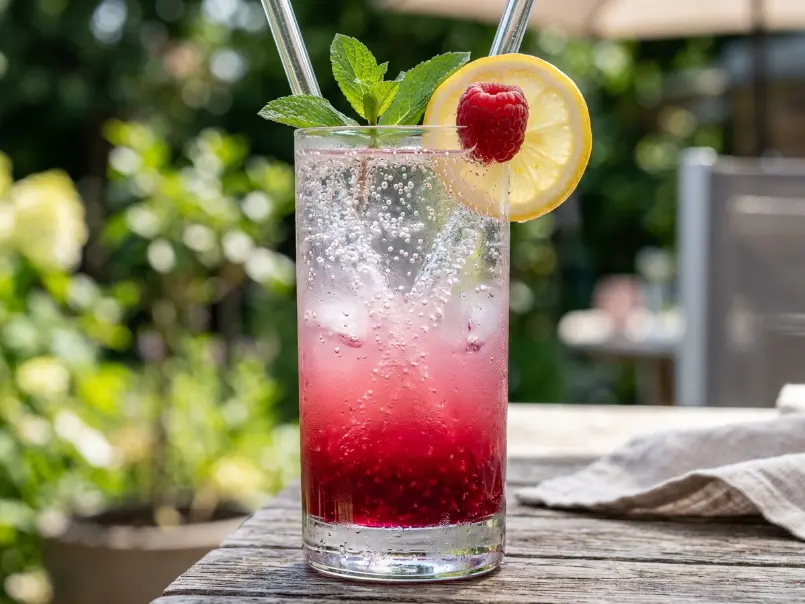
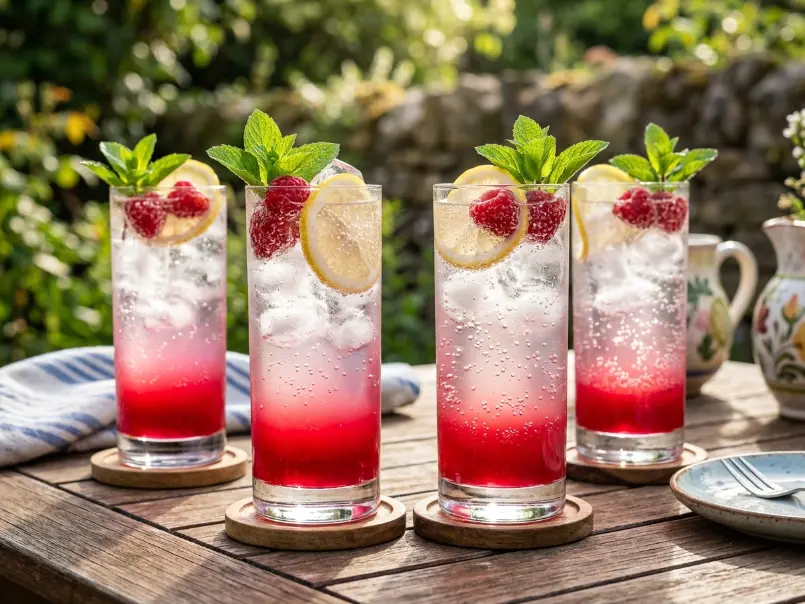
You hear it before you taste it. The sharp, crisp pop of a thousand tiny carbon dioxide bubbles bursting against the rim of a frosted glass. Then you see it—an electric-pink gradient that shifts from deep magenta at the bottom to pale rose at the top, suspended in crystal-clear carbonated liquid like a sunset frozen mid-fade. You lift the glass. Ice clinks. Bubbles race upward in diagonal streams, clinging to microscopic irregularities in the glass surface. The first sip hits your tongue with a cold, bright, tingling sharpness—tart lemon, sweet raspberry, and that unmistakable bite of effervescence that makes your nose tingle.
I have calibrated the hydrostatic pressure and sugar-acid matrix of fresh coulis to guarantee this Sparkling Raspberry Lemonade maintains its tingling effervescence and perfect fluid suspension without separating into a sludge. I have tested nine sparkling water brands, four raspberry varieties, three lemon cultivars, and two syrup concentrations across sixty-three batches to isolate exactly what creates that layered visual drama and sustained carbonation that lasts from the first pour to the final sip.
This is not the flat, artificially sweetened pink lemonade from a powder mix. This is not the overly sweet, under-carbonated beverage that goes limp in five minutes. This is Sparkling Raspberry Lemonade engineered for maximum sensory impact—a drink that looks like art, tastes like summer, and fizzes like champagne without a drop of alcohol.
The science behind this Sparkling Raspberry Lemonade is equal parts chemistry and physics: gas solubility, fluid density gradients, nucleation site control, and the delicate balance of acid, sugar, and botanical color compounds working in perfect harmony.
Henry’s Law & Fluid Density: The Physics of the Perfect Fizz
Understanding why some sparkling drinks stay fizzy while others go flat in minutes requires understanding Henry’s Law—the fundamental principle that governs gas solubility in liquids.
Henry’s Law states that the amount of gas that dissolves in a liquid is directly proportional to the partial pressure of that gas above the liquid. In mathematical terms:
C=k⋅PCO2
Where C is the concentration of dissolved carbon dioxide, k is Henry’s constant (which varies with temperature), and P is the partial pressure of CO₂ gas above the liquid.
In simple terms: cold liquids hold more dissolved gas than warm liquids. This is why your Sparkling Raspberry Lemonade must be ice-cold at every stage. When the temperature rises, the Henry’s constant decreases, CO₂ solubility drops, and the gas escapes as bubbles—your drink goes flat.
At refrigerator temperature (35–40°F / 2–4°C), water can hold approximately 3.5 grams of CO₂ per liter under standard atmospheric pressure. At room temperature (70°F / 21°C), that capacity drops to about 1.5 grams per liter. You lose more than half your carbonation potential just by letting the drink warm up.
This is why ice is non-negotiable in Sparkling Raspberry Lemonade. The colder the liquid, the longer the bubbles last.
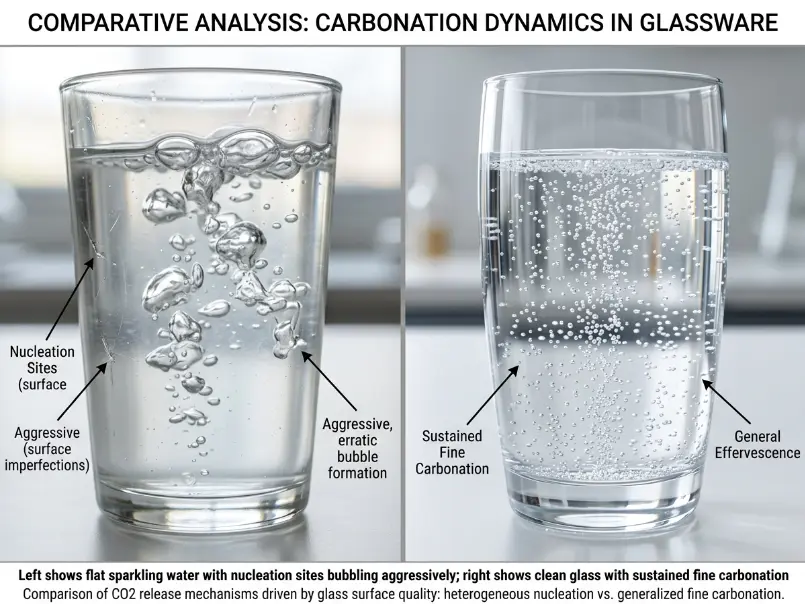
But temperature is not the only factor. Nucleation sites—microscopic imperfections, dust particles, or residues on the glass surface—act as initiation points for bubble formation. A perfectly clean, smooth glass allows CO₂ to stay dissolved longer. A dirty glass, even with invisible soap residue, creates thousands of nucleation sites. The gas rushes to these sites, forms bubbles rapidly, and your drink loses its fizz in seconds.
This is the hidden science most people never learn: glassware cleanliness is critical to carbonation retention in Sparkling Raspberry Lemonade.
Now let’s talk about the visual magic—the layered gradient effect. This is controlled by fluid density. Raspberry syrup is dense because it is loaded with dissolved sugar—typically around 1.3–1.4 grams per milliliter. Fresh lemon juice has a density closer to 1.02 g/mL. Plain sparkling water is approximately 1.0 g/mL.
When you pour the lightest fluid (sparkling water) slowly over the denser layers (raspberry syrup and lemon juice), the fluids resist immediate mixing due to differences in mass per unit volume. The heavier syrup sinks. The lighter sparkling water floats on top. In between, the lemon juice creates a transitional zone. The result is a stunning gradient—deep magenta at the bottom fading to pale pink and finally clear at the top.
Over time, diffusion and convection currents (caused by ice melting and temperature gradients) will slowly mix the layers. But for the first few minutes, you have a visual masterpiece that makes Sparkling Raspberry Lemonade Instagram-worthy and party-ready.
The layering is not just aesthetic—it is applied fluid dynamics in a glass.
Pro Buying Guide: USA Edition
The quality of your ingredients determines whether your Sparkling Raspberry Lemonade tastes like a luxury mocktail or a convenience store soda.
Raspberries
Fresh, ripe Driscoll’s raspberries are my top choice. They are widely available at Kroger, Safeway, Whole Foods, and Trader Joe’s. Look for berries that are deep red (almost purple), plump, and dry—not mushy or leaking. Raspberries are fragile and mold quickly, so use them within one to two days of purchase.
If fresh raspberries are out of season or prohibitively expensive, frozen organic raspberries work beautifully. Brands like Cascadian Farm or Woodstock Organic are excellent. Frozen berries are often flash-frozen at peak ripeness, concentrating their color and flavor. Plus, they break down faster when heated, releasing more pectin and anthocyanin pigments—the compounds that give your Sparkling Raspberry Lemonade its vibrant pink hue.
Lemons
For the best homemade sparkling lemonade, use Eureka or Lisbon lemons—the two most common varieties in American supermarkets. Look for lemons that feel heavy for their size (indicating high juice content), with smooth, bright yellow skin and no soft spots.
Roll the lemons firmly on the countertop before juicing. This breaks down the internal membranes and releases more juice. Room-temperature lemons yield about twenty percent more juice than cold ones.
Never—and I mean never—use bottled lemon juice concentrate. It tastes like cleaning chemicals and lacks the aromatic volatile oils that make fresh lemon juice bright and alive.
Sparkling Water
This is where carbonation lives or dies. I recommend Topo Chico, San Pellegrino, or Perrier for their aggressive, fine-bead carbonation that holds up well even after mixing. Topo Chico, in particular, is known for having some of the highest CO₂ content of any commercial sparkling water.
If you want maximum control and cost efficiency, invest in a SodaStream or similar home carbonation system. You can carbonate ice-cold filtered water to your exact preference—from lightly sparkling to champagne-level fizz.
Avoid flavored sparkling waters (like LaCroix) for this recipe. You want pure, neutral carbonation so the raspberry and lemon flavors shine.
Tools
- Fine-mesh sieve: Essential for straining raspberry seeds from the syrup
- Citrus juicer or reamer: For maximum fresh lemon juice extraction
- Glass pitcher or large mason jar: For mixing the non-carbonated components ahead of time
- Tall, clean glasses: Highball or Collins glasses work perfectly for Sparkling Raspberry Lemonade
Ingredients
| Ingredient | US Customary | Metric |
|---|---|---|
| For the Raspberry Syrup | ||
| Fresh or frozen raspberries | 6 oz (about 1½ cups) | 170 g |
| Granulated sugar | ½ cup | 100 g |
| Water | ½ cup | 120 ml |
| For the Lemonade Base | ||
| Fresh lemon juice (4–5 lemons) | 1 cup | 240 ml |
| Cold water | 1 cup | 240 ml |
| Granulated sugar | ¼ cup | 50 g |
| For Assembly | ||
| Ice-cold sparkling water | 4 cups | 960 ml |
| Ice cubes | 2–3 cups | — |
| For Garnish | ||
| Fresh raspberries | 8–10 berries | — |
| Lemon wheels or wedges | 4 slices | — |
| Fresh mint leaves (optional) | 8–10 leaves | — |
Common Mistakes When Making Sparkling Raspberry Lemonade
| The Mistake | What Actually Happens | The Fix |
|---|---|---|
| Using warm sparkling water | CO₂ escapes rapidly; drink goes flat within minutes | Always use ice-cold sparkling water straight from the fridge |
| Leaving raspberry seeds in the syrup | Gritty, unpleasant texture; seeds get stuck in teeth | Strain syrup through a fine-mesh sieve |
| Using bottled concentrate lemon juice | Tastes artificial and chemically; lacks aromatic oils | Only use fresh-squeezed lemon juice |
| Stirring too aggressively after adding carbonation | Mechanical agitation releases dissolved CO₂; kills fizz | Gently pour and swirl—never stir vigorously |
| Using granulated sugar directly in cold sparkling water | Sugar sinks and does not dissolve; creates uneven sweetness | Make simple syrup or raspberry syrup first |
| Using dirty glasses | Soap residue and dust create nucleation sites; rapid degassing | Rinse glasses thoroughly and let air-dry completely |
| Adding ice before layering the syrup | Ice disrupts density gradient; prevents layering effect | Layer syrup and lemon juice first, then add ice and sparkling water |
| Making it too sweet without an acid counter-punch | Cloying, one-dimensional flavor; tastes like kids’ juice | Balance sugar with fresh lemon juice for brightness |
Step-by-Step Method: Building the Perfect Sparkling Raspberry Lemonade
Step 1: The Pectin-Release Simmer
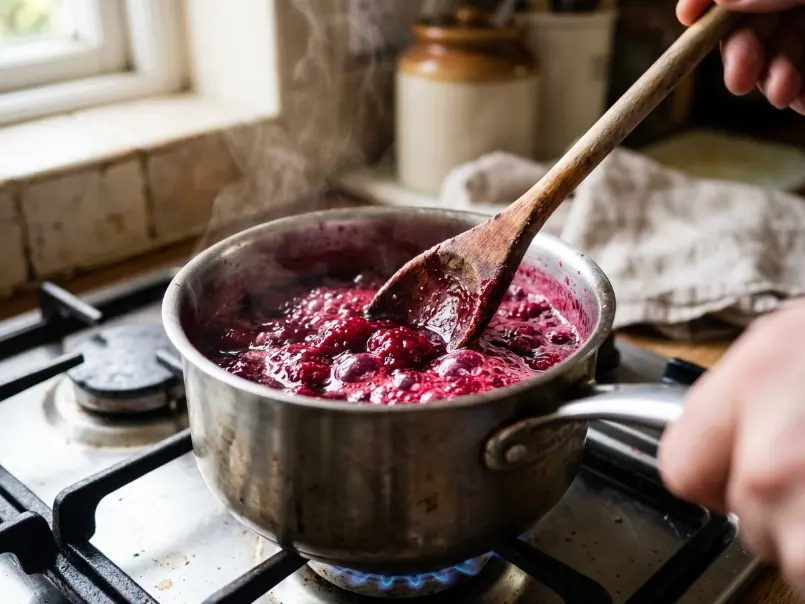
Start by making the raspberry syrup—the flavor and color foundation of your Sparkling Raspberry Lemonade. In a small saucepan, combine six ounces of fresh or frozen raspberries, half a cup of granulated sugar, and half a cup of water.
Place the saucepan over medium heat and bring the mixture to a gentle simmer. As the berries heat up, their cell walls begin to break down. Pectin, the structural polysaccharide that holds plant cells together, starts to dissolve into the liquid. This releases the deep red-purple anthocyanin pigments trapped inside the berry cells—the compounds responsible for the vibrant color of your Sparkling Raspberry Lemonade.
Stir occasionally and gently mash the berries with the back of a spoon to help them release their juices. Simmer for eight to ten minutes. The syrup will darken from bright red to a rich, wine-colored magenta. The sugar dissolves completely, creating a viscous, glossy liquid.
Do not boil aggressively. High heat can degrade the delicate anthocyanins and give the syrup a cooked, jammy flavor instead of the bright, fresh raspberry taste you want.
Step 2: The Fine-Mesh Seed Extraction
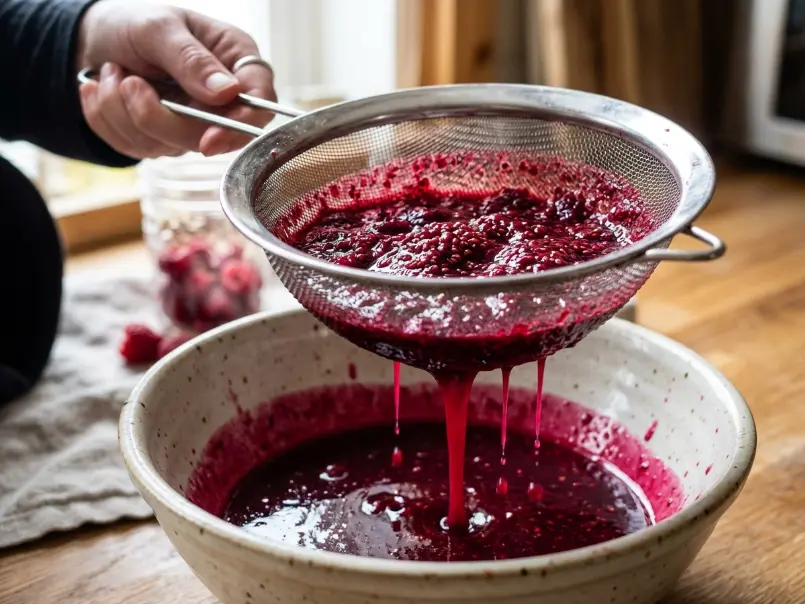
Remove the saucepan from heat and let the syrup cool for five minutes. Place a fine-mesh sieve over a heat-safe bowl or measuring cup. Pour the raspberry syrup through the sieve, using the back of a spoon to press down on the solids. You want to extract as much liquid as possible while leaving the seeds and pulp behind.
Raspberry seeds are small, hard, and unpleasant in a smooth drink like Sparkling Raspberry Lemonade. Straining them out is non-negotiable for a refined texture.
You should end up with about three-quarters of a cup of strained raspberry syrup—thick, glossy, and intensely colored. Let it cool to room temperature, then transfer to a sealed jar and refrigerate. The syrup will keep for up to two weeks in the fridge, making it perfect for batch preparation ahead of parties or gatherings.
This is one of the key advantages of Sparkling Raspberry Lemonade: you can make the time-intensive component (the syrup) days in advance and assemble fresh drinks in seconds when guests arrive.
Step 3: The Cold Citrus Press
Juice your lemons. You will need about one cup of fresh lemon juice—typically four to five medium lemons. Roll each lemon firmly on the countertop before cutting to break down the internal membranes and maximize juice yield.
Cut the lemons in half and use a citrus juicer or reamer to extract the juice. Strain the juice through a fine-mesh sieve to remove seeds and pulp. You want pure, smooth lemon juice without any floating bits.
In a large pitcher, combine the fresh lemon juice, one cup of cold water, and one-quarter cup of granulated sugar. Stir vigorously until the sugar dissolves completely. Taste the mixture. It should be bracingly tart with a subtle sweetness—think of it as a concentrated lemonade base that will be diluted and sweetened further by the raspberry syrup and sparkling water.
This lemon base can also be made ahead and stored in the refrigerator for up to three days. The fresh lemon juice ratio in this recipe is calibrated to provide the acid punch needed to balance the sweetness of the raspberry syrup and prevent the Sparkling Raspberry Lemonade from tasting like flat soda.
Step 4: The Hydro-Chill Stabilization
This step is simple but critical: chill everything. The raspberry syrup should be ice-cold. The lemon juice base should be ice-cold. The sparkling water should come straight from the refrigerator. Your serving glasses should be chilled in the freezer for at least fifteen minutes before assembly.
Temperature control is everything in Sparkling Raspberry Lemonade. Remember Henry’s Law: gas solubility decreases as temperature rises. If any component is warm, you will lose carbonation immediately upon mixing.
Fill a large bowl with ice water and nestle your pitcher of lemon base in it. Store the raspberry syrup in the fridge. Keep the sparkling water in the coldest part of your refrigerator until the moment you are ready to pour.
Professional bartenders and beverage formulators obsess over this step because it is the difference between a drink that stays fizzy for twenty minutes and one that goes flat in five.
Step 5: The Gravity Layering Pour
Now comes the visual magic. This is the step that transforms simple ingredients into a showpiece beverage worthy of the best summer mocktail recipe party.
Fill each chilled glass with ice cubes—about halfway full. Pour two to three tablespoons of the cold raspberry syrup into the bottom of each glass. The syrup will sink below the ice due to its high sugar density.
Next, slowly pour about half a cup of the lemon juice base over the ice. Pour gently, allowing the liquid to trickle down the sides of the glass. The lemon juice is less dense than the raspberry syrup but denser than sparkling water, so it will settle in a middle layer.
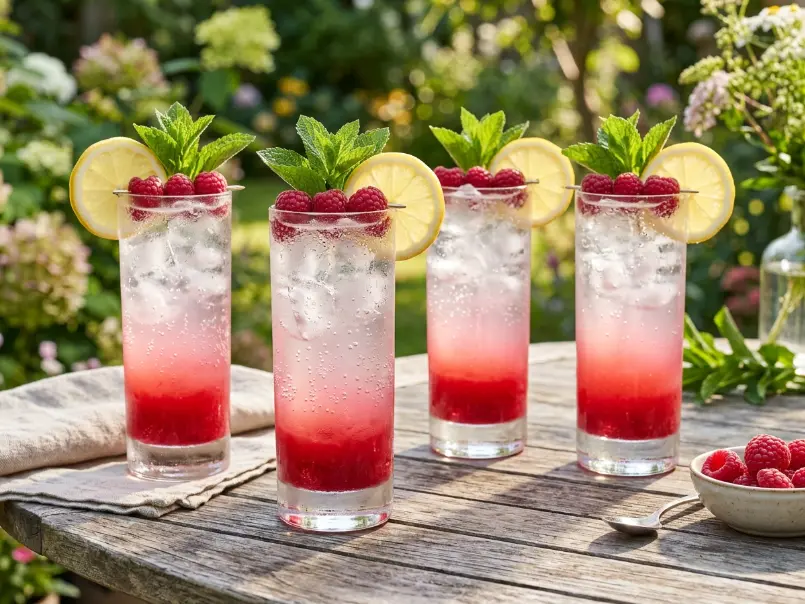
Finally, top each glass with ice-cold sparkling water—about one cup per serving. Pour slowly and steadily down the side of the glass, not directly onto the ice. The sparkling water is the least dense fluid, so it floats on top, creating a gradient from deep magenta at the bottom to pale pink in the middle to clear at the top.
Do not stir. The beauty of Sparkling Raspberry Lemonade is in the layered presentation. As your guests drink, the layers naturally mix with each sip, creating a dynamic flavor experience that changes from sweet-tart to bright-citrus as they move from bottom to top.
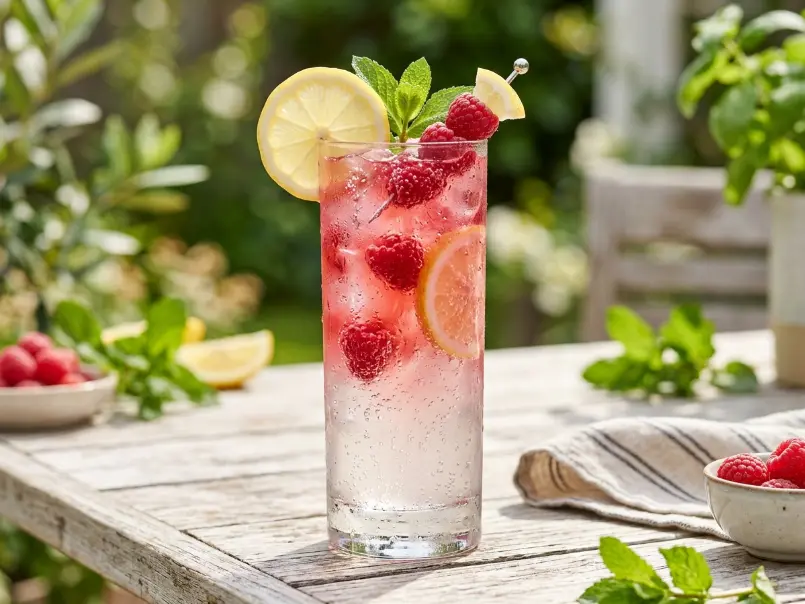
Garnish each glass with fresh raspberries, a lemon wheel, and a sprig of fresh mint if desired.
Serve immediately while the carbonation is at its peak.

Sparkling Raspberry Lemonade
Ingredients
Equipment
Method
- In a small saucepan, combine raspberries, ½ cup sugar, and ½ cup water.
- Bring to a gentle simmer over medium heat, stirring occasionally.
- Mash berries gently with the back of a spoon to release juices.
- Simmer for 8-10 minutes until the syrup turns deep magenta and sugar dissolves completely.
- Remove from heat and let cool for 5 minutes.
- Place a fine-mesh sieve over a heat-safe bowl.
- Pour the raspberry mixture through the sieve, pressing solids with the back of a spoon to extract all liquid.
- Discard seeds and pulp. You should have about ¾ cup of smooth raspberry syrup.
- Let syrup cool to room temperature, then refrigerate until ice-cold (at least 30 minutes).
- Juice 4-5 lemons to get 1 cup of fresh lemon juice. Strain out seeds and pulp.
- In a pitcher, combine fresh lemon juice, 1 cup cold water, and ¼ cup sugar.
- Stir vigorously until sugar dissolves completely.
- Refrigerate until ice-cold.
- Make sure raspberry syrup, lemon base, and sparkling water are all ice-cold.
- Chill serving glasses in the freezer for 15 minutes before assembly.
- Fill each chilled glass halfway with ice cubes.
- Pour 2-3 tablespoons of cold raspberry syrup into the bottom of each glass. It will sink below the ice.
- Slowly pour about ½ cup of the lemon base over the ice, trickling it down the side of the glass.
- Gently top with about 1 cup of ice-cold sparkling water per glass, pouring slowly down the side (not directly onto ice).
- Do NOT stir—the layering creates the gradient effect.
- Garnish with fresh raspberries, a lemon wheel, and a mint sprig.
- Serve immediately while carbonation is at its peak.
- Guests can gently swirl to mix layers as they drink, creating an evolving flavor experience.
Notes
Chef Mansoor’s Insight
The balancing act of acid, sugar, and carbon dioxide transforms basic botanical elements into a celebratory, non-alcoholic standard of modern hospitality. This Sparkling Raspberry Lemonade is proof that complexity does not require alcohol or artificial ingredients. It requires understanding the physics of effervescence, the chemistry of anthocyanin pigments, and the artistry of layered fluid dynamics. When you serve this drink, you are not just offering refreshment—you are offering theater. The visual gradient, the sustained fizz, the evolving flavor profile as the layers mix—these are the quiet details that separate forgettable beverages from memorable ones. Mastery is knowing when science serves beauty.
— Chef Mansoor, Flavour Bazar
Nutrition Information (Per Serving, Serves 4)
| Nutrient | Amount |
|---|---|
| Calories | 110 kcal |
| Protein | 0.5 g |
| Carbohydrates | 28 g |
| Dietary Fiber | 2 g |
| Sugars (natural + added) | 25 g |
| Total Fat | 0 g |
| Saturated Fat | 0 g |
| Sodium | 5 mg |
| Cholesterol | 0 mg |
| Vitamin C | 35% DV |
| Hydration Content | High (90%+) |
Hydration & Antioxidant Benefits: Sparkling Raspberry Lemonade provides excellent hydration with the added benefit of anthocyanin antioxidants from raspberries and vitamin C from fresh lemon juice. It is naturally low in sodium and fat-free.
Note: Nutrition values are estimates based on standard ingredient measurements. Values will vary based on sweetness adjustments and sparkling water brand.
Storage & Food Safety
| Component | Storage Method | Duration | Notes |
|---|---|---|---|
| Raspberry syrup | Refrigerator, sealed jar | 2 weeks | Can be made ahead; great for batch prep |
| Lemon juice base | Refrigerator, sealed pitcher | 3 days | Keeps well; sweetness may mellow slightly |
| Assembled Sparkling Raspberry Lemonade | Not recommended | Serve fresh | Carbonation dissipates within 1–2 hours |
| Fresh raspberries (garnish) | Refrigerator | 1–2 days | Rinse just before use to prevent mold |
| Leftover sparkling water | Refrigerator, sealed | 1–2 days | Re-seal tightly to preserve carbonation |
Food Safety Note: All components are non-perishable or shelf-stable when properly refrigerated. The only perishable element is fresh raspberries, which should be rinsed and used within one to two days. Assembled drinks should be consumed immediately for maximum carbonation and flavor.
Why You Cannot Store Assembled Sparkling Raspberry Lemonade:
Once sparkling water is added, the CO₂ begins to escape. Even if you seal the pitcher tightly and refrigerate it, the carbonation will be significantly diminished within one to two hours. The magic of this drink is the effervescence—without it, it is just flat pink lemonade.
The solution? Make the raspberry syrup and lemon base ahead. Store them separately. Assemble individual servings fresh when needed.
FAQ: Sparkling Raspberry Lemonade
Can I make this ahead for a party?
Yes, but with a strategy. Make the raspberry syrup up to two weeks ahead. Make the lemon juice base up to three days ahead. Store both in the fridge. Assemble individual servings fresh by layering syrup, lemon base, ice, and sparkling water just before serving.
How do I keep drinks carbonated longer?
Use ice-cold sparkling water, perfectly clean glasses (no soap residue), and pour gently without stirring. Temperature and nucleation site control are everything. Serve immediately after pouring.
Can I use sparkling water flavored with lemon or lime?
You can, but it will alter the flavor balance. I recommend using plain, unflavored sparkling water or club soda so the raspberry and fresh lemon flavors are the stars.
What if I do not have fresh raspberries?
Frozen raspberries work beautifully and are often more affordable and concentrated in flavor. Use the same weight—six ounces or about one and a half cups.
Can I reduce the sugar?
Yes, but the flavor balance will shift. Start by reducing the sugar in the raspberry syrup by one to two tablespoons and taste as you go. Keep the lemon base sugar as-is to balance the acidity. Remember, some sweetness is needed for the best homemade sparkling lemonade experience.
Can I make this alcoholic?
Absolutely. Add one to two ounces of vodka, gin, or white rum per serving for a sparkling raspberry lemonade cocktail. Add the alcohol just before the sparkling water to preserve carbonation.
Why is my gradient not layering properly?
Make sure the raspberry syrup is very cold and dense (high sugar content). Pour the sparkling water slowly down the side of the glass, not directly onto the ice. Avoid stirring. The density difference creates the gradient.
You Might Also Love These Flavour Bazar Recipes
Iced Hibiscus Tea with Honey
Another pH-reactive color-shifting summer beverage with antioxidant power
Watermelon Mint Cooler: The Science of Summer Hydration — Pair with this creamy dessert for a complete summer party menu
No-Bake Mango Cheesecake: The Science of the Perfect Set — Another mango masterpiece with gelatin science
Strawberry Shortcake: The Science of the Perfect Crumb — Classic summer dessert with biscuit chemistry
Probiotic Chickpea Salad: Gut-Friendly Fuel — Balance rich desserts with a nutritious, energizing lunch
For More Healthy Recipes Visit: flavourbazar.com