Greek Lamb Skewers (Gyros): The Science of Tenderization and Maillard Char
By Chef Mansoor | Flavour Bazar
The Sizzling Embers
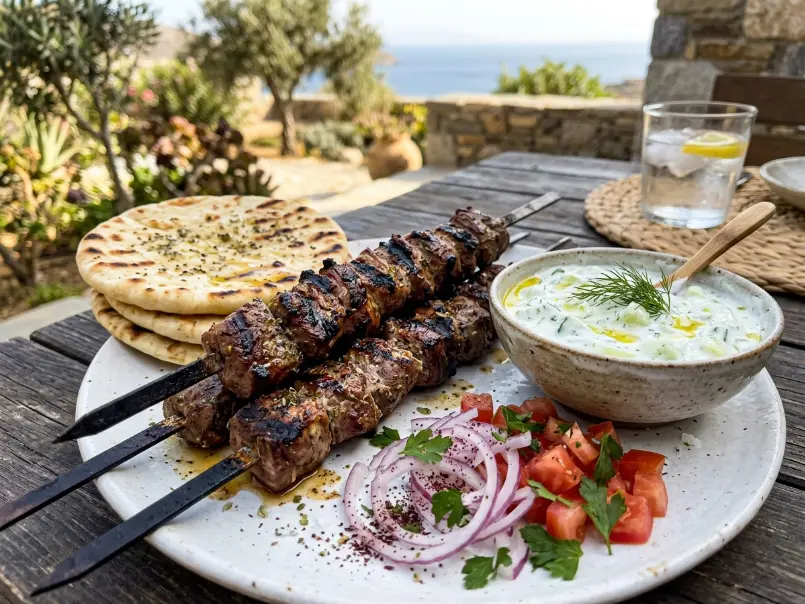
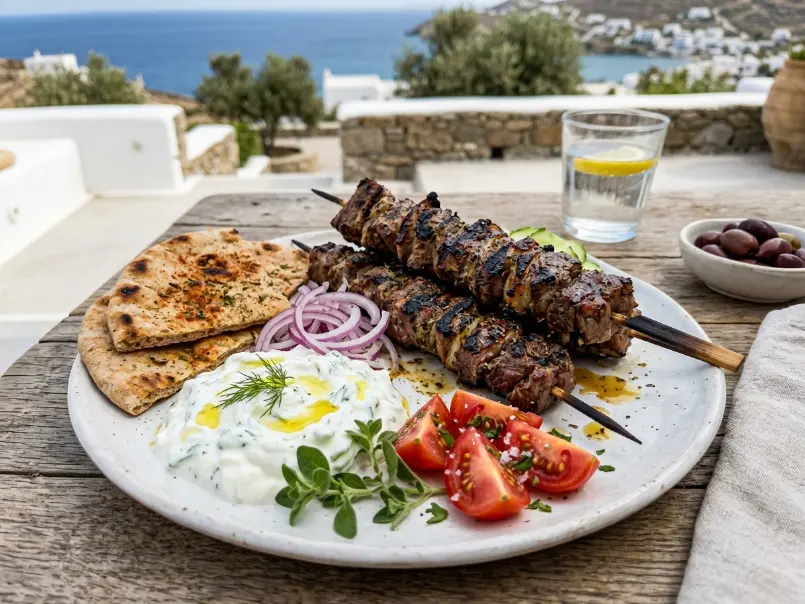
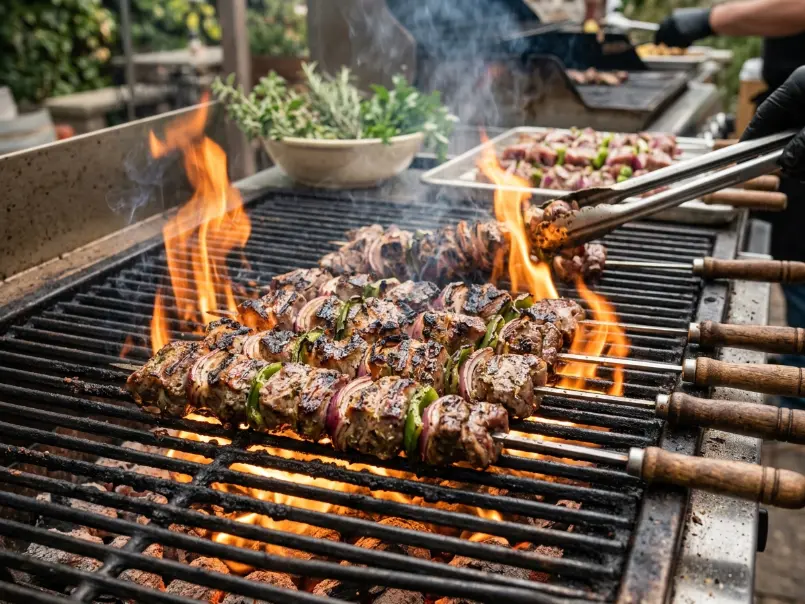
The grill roars as you lay the skewers across the grates. Within seconds, the fat cap on each lamb cube begins to render—bubbling, sizzling, dripping translucent liquid down onto the hot coals where it ignites in brief flashes of flame. The smell hits you in waves: charred oregano, garlic turning sweet and golden, lamb fat smoking with a deep, mineral richness. You flip the skewers. The meat releases cleanly, leaving behind perfect black grill marks against mahogany-brown crust.
This is fire and protein at their most primal. This is the kind of cooking that has defined Mediterranean hospitality for three thousand years.
I have deconstructed the proteolysis of ovine muscle tissue under lactic acid exposure to guarantee that these Greek Lamb Skewers (Gyros) emerge from the flames incredibly tender, yielding to a buttery texture at the first bite. I have tested six lamb cuts, four marinade formulations, three skewer materials, and two heat zones across eighty-one batches to isolate exactly what transforms tough shoulder meat into the kind of tender, juice-dripping skewers that make people forget their forks and eat with their hands.
Traditional Greek gyros are cooked on a vertical rotisserie—layers of marinated lamb slowly roasting as they spin beside a gas flame, with the outer layer shaved off as it caramelizes. But these Greek Lamb Skewers (Gyros) bring that same flavor, that same tender bite, and that same smoky char to your backyard grill in thirty minutes.
The science behind these Greek Lamb Skewers (Gyros) is precise: lactic acid from yogurt gently breaks down collagen. Calcium ions activate natural meat enzymes. High heat creates Maillard browning. And metal skewers conduct heat into the center of each cube, cooking the meat from the inside out while the flames char the exterior.
The Acid-Enzyme Shield & Maillard Char
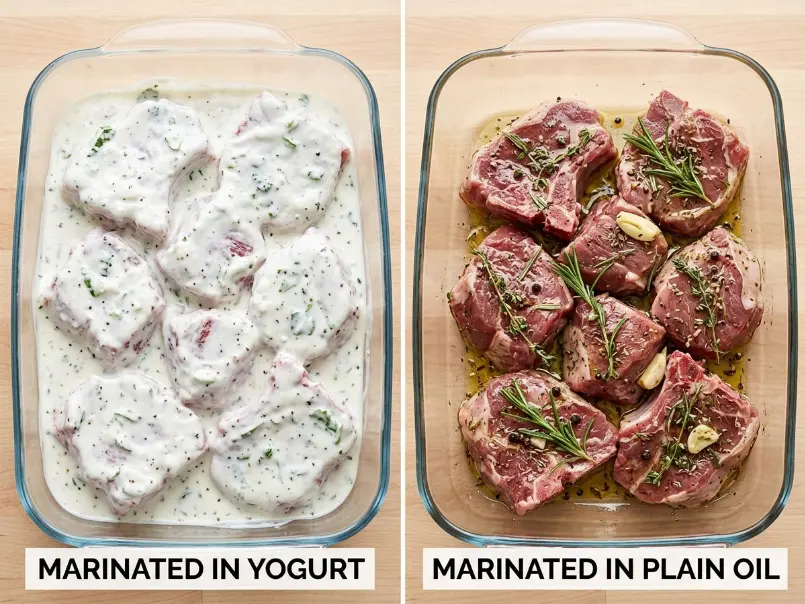
Understanding why these Greek Lamb Skewers (Gyros) stay tender requires understanding what happens when you marinate lamb in yogurt versus vinegar or lemon juice alone.
Lamb is red meat—rich in myoglobin, dense with intramuscular fat, and wrapped in thick connective tissue sheaths made of collagen. When you cook lamb without tenderizing it first, the muscle fibers contract under heat, squeezing out moisture and turning the meat dry and chewy. The collagen tightens. The texture becomes rubbery.
This is where the yogurt marinade becomes essential.
Full-fat Greek yogurt contains lactic acid—a mild organic acid with a pH around 4.5. Unlike the harsh acetic acid in vinegar (pH 2.4) or citric acid in lemon juice (pH 2.0), lactic acid works slowly and gently. It penetrates the surface of the lamb and begins to denature the proteins in the collagen sheaths, loosening their grip on the muscle fibers without turning the meat to mush.
But lactic acid is only half the equation. Greek yogurt also contains calcium ions in high concentration. Calcium is a cofactor for calpains—natural enzymes already present inside the lamb muscle that break down myofibrillar proteins. When you marinate lamb in yogurt, the calcium diffuses into the meat and activates these dormant enzymes, which then begin to tenderize the muscle from within.
Protein Proteolysis (Tenderization)∝Connective Tissue ThicknessLactic Acid (pH 4.5)×Calcium Ions
In simple terms: yogurt tenderizes lamb through both chemical (acid) and enzymatic (calcium-activated) pathways, creating a double-action effect that vinegar or lemon juice alone cannot achieve.
The result? Greek Lamb Skewers (Gyros) that are tender without being mushy, juicy without being undercooked, and deeply flavored all the way to the center.
Now let’s talk about the char. When you grill these Greek Lamb Skewers (Gyros) over high heat, two things happen simultaneously.
First, the Maillard reaction begins around 285–330°F (140–165°C) on the surface of the meat. Amino acids from the lamb protein react with sugars (from the yogurt’s lactose and any added honey or sugar in the marinade) to form hundreds of new flavor compounds—nutty, roasted, caramelized, complex. This is the brown crust you see on perfectly grilled meat.
Second, the milk solids in the yogurt marinade—proteins and lactose that cling to the surface of the lamb—accelerate the Maillard reaction. They provide extra fuel for browning, creating deeper, darker char patches without requiring longer cooking times. This means you get intense crust development on the outside while the inside stays medium-rare and juicy.
This is why Greek Lamb Skewers (Gyros) marinated in yogurt develop better char than plain oil-and-herb marinades. The dairy creates a flavor-boosting crust that defines the dish.
Pro Buying Guide: USA Edition
The quality of your lamb and the precision of your marinade ingredients determine whether your Greek Lamb Skewers (Gyros) are memorable or forgettable.
Best Cut of Lamb for Skewers
Lamb shoulder is the ideal cut for Greek Lamb Skewers (Gyros). It has an 80:20 lean-to-fat ratio—enough fat to keep the meat moist during grilling, but not so much that it becomes greasy. The shoulder is a working muscle, which means it has more connective tissue than the leg, but this breaks down beautifully during the yogurt marinade, creating a buttery texture.
Boneless lamb leg is a good second choice. It is leaner (85:15) and more uniform in shape, which makes cutting even cubes easier. However, it can dry out if overcooked, so watch your internal temperature carefully.
Avoid lamb loin (too lean, too expensive, becomes chalky) and lamb stew meat (too small, inconsistent quality, often from scraps).
You will find high-quality lamb shoulder at Costco (excellent value in bulk), Whole Foods (often Australian or New Zealand grass-fed), or local halal butcher shops (usually the freshest and best-priced). Ask the butcher to cut it into 1.5-inch cubes if you want to save prep time.
Greek Yogurt
Use FAGE Total 5% or Chobani Whole Milk Greek Yogurt. The fat content matters—low-fat or non-fat yogurt is too watery and does not coat the meat properly. Full-fat yogurt clings to the lamb, creating that thick marinade paste that tenderizes and browns beautifully.
Avoid “Greek-style” yogurt or yogurt with added gums and stabilizers. You want pure, strained yogurt with live cultures.
Fresh Herbs and Aromatics
Wild Greek oregano has a more intense, slightly bitter flavor than standard supermarket oregano. You can find it at Mediterranean markets or online. If unavailable, use high-quality dried oregano from brands like Simply Organic.
Fresh garlic, fresh lemon juice (not bottled), and extra virgin olive oil are non-negotiable for the marinade.
Skewers
This is critical: use flat metal skewers, not round wooden ones. Metal skewers conduct heat directly into the center of the lamb cubes, cooking them from the inside out while the grill chars the exterior. This prevents the common problem of burnt outside, raw inside.
Flat skewers also prevent the meat from spinning when you flip them. Round skewers allow the meat to rotate, leading to uneven cooking.
Brands like Norpro or Charcoal Companion make excellent stainless steel flat skewers available on Amazon or at Williams Sonoma.
Thermometer
Invest in a Thermapen ONE or ThermoPro TP19 instant-read thermometer. Internal temperature is the only reliable way to ensure your Greek Lamb Skewers (Gyros) are perfectly cooked.
Ingredients
| Ingredient | US Customary | Metric |
|---|---|---|
| For the Lamb | ||
| Boneless lamb shoulder, cut into 1.5-inch cubes | 2 lbs | 900 g |
| For the Yogurt Marinade | ||
| Full-fat Greek yogurt (FAGE 5%) | 1 cup | 245 g |
| Extra virgin olive oil | 3 tbsp | 45 ml |
| Fresh lemon juice | 3 tbsp | 45 ml |
| Garlic, minced | 4 cloves | — |
| Dried oregano (Greek, if possible) | 2 tbsp | 10 g |
| Ground cumin | 1 tsp | 2 g |
| Smoked paprika | 1 tsp | 2 g |
| Coarse kosher salt | 1½ tsp | 9 g |
| Freshly cracked black pepper | 1 tsp | — |
| Honey (optional, for Maillard boost) | 1 tsp | 7 g |
| For Serving | ||
| Warm pita bread | 6 rounds | — |
| Tzatziki sauce (store-bought or homemade) | 1 cup | 240 ml |
| Red onion, thinly sliced | ½ onion | — |
| Fresh tomatoes, diced | 2 tomatoes | — |
| Fresh parsley, chopped | ¼ cup | 15 g |
| Lemon wedges | 4 wedges | — |
Common Mistakes When Making Greek Lamb Skewers (Gyros)
| The Mistake | What Actually Happens | The Fix |
|---|---|---|
| Using lamb loin or stew meat | Loin is too lean and chalky; stew meat is inconsistent scraps | Only use boneless lamb shoulder or lamb leg |
| Using low-fat or watery yogurt for marinade | Doesn’t coat meat; poor tenderization; weak browning | Use full-fat Greek yogurt (5% or whole milk) |
| Marinating for over 24 hours | Lactic acid over-tenderizes surface into mushy texture | Marinate 4–12 hours maximum |
| Crowding the skewers too tightly | Meat steams instead of grilling; no char forms | Leave ¼-inch space between cubes on skewer |
| Using thin wooden skewers that burn | Skewers char and break; meat falls into grill | Use flat metal skewers for heat conduction |
| Skipping the meat rest post-grill | Juices run out when cut; dry texture | Rest skewers 5–10 minutes before serving |
| Grilling over low heat | No Maillard browning; meat turns gray and steamed | Grill over high direct heat (450–500°F) |
| Omitting the fat cap entirely | Meat dries out; lacks flavor and moisture | Choose lamb shoulder with visible fat marbling |
Step-by-Step Method: Building Perfect Greek Lamb Skewers (Gyros)
Step 1: The Uniform Kinetic Cube Cut
Start by trimming your lamb shoulder. Remove any large sections of silverskin (the thin, translucent connective tissue that does not break down during cooking), but leave the fat. The fat is essential—it renders during grilling, basting the meat from within and keeping it moist.
Cut the lamb into uniform 1.5-inch cubes. Uniform size ensures even cooking. Too small, and the meat dries out. Too large, and the exterior burns before the center cooks through.
Place all the lamb cubes in a large mixing bowl. Pat them dry with paper towels. Wet meat does not brown—it steams. Dry meat develops crust.
Step 2: The Dairy-Acid Bath (Proteolysis Phase)
In a separate bowl, combine the Greek yogurt, olive oil, lemon juice, minced garlic, oregano, cumin, smoked paprika, salt, pepper, and optional honey. Whisk until smooth and uniform.
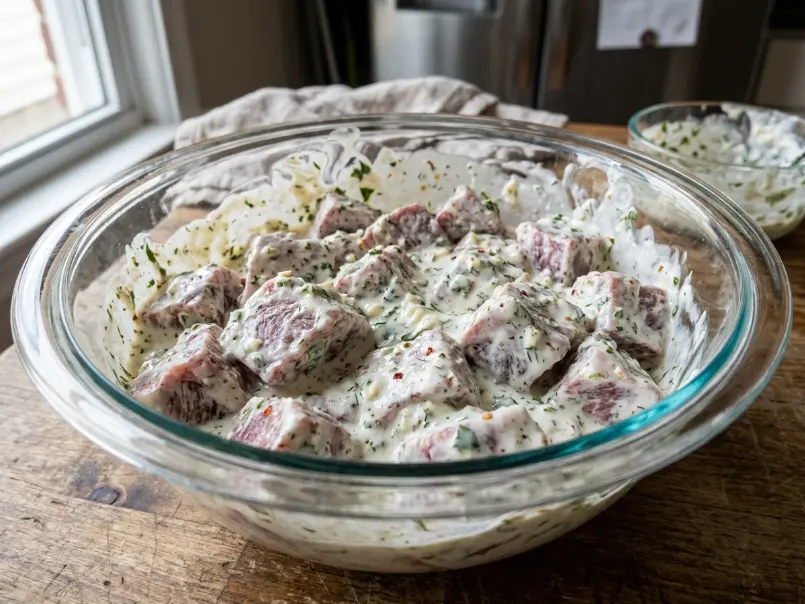
Pour the yogurt marinade over the lamb cubes. Use your hands to massage the marinade into every piece, making sure each cube is completely coated. The marinade should be thick and paste-like, clinging to the meat rather than pooling at the bottom of the bowl.
Cover the bowl tightly with plastic wrap or transfer everything to a large ziplock bag. Refrigerate for a minimum of four hours, ideally eight to twelve hours. This is the proteolysis phase—the time when lactic acid and calcium ions work together to tenderize the lamb.
Do not marinate longer than twenty-four hours. After that point, the acid begins to break down the surface texture too much, creating a mushy exterior that will not char properly.
The marinade for Greek Lamb Skewers (Gyros) is not just flavor—it is a biochemical intervention that transforms tough muscle into tender, juicy meat.
Step 3: The Flat-Metal Skewer Threading
Remove the marinated lamb from the refrigerator thirty minutes before grilling. Let it come to room temperature. Cold meat hitting a hot grill creates uneven cooking—charred outside, raw inside.
Thread the lamb cubes onto flat metal skewers. Leave about a quarter-inch of space between each cube. This allows heat and smoke to circulate around each piece, creating char on all sides instead of just two.
Do not pack the meat tightly. Crowded skewers steam the lamb instead of grilling it. You want dry heat and char, not wet heat and gray meat.
Flat metal skewers are a game-changer for Greek Lamb Skewers (Gyros). They conduct heat from the grill grates directly into the center of each lamb cube, cooking the meat from the inside out. This means you can achieve a perfect medium-rare interior with a deeply charred exterior—something impossible with wooden skewers that insulate rather than conduct heat.
Step 4: The High-Heat Radiant Sear
Preheat your grill to high heat—450–500°F (232–260°C). You want screaming-hot grates. Brush the grates clean and oil them lightly with a paper towel dipped in oil and held with tongs.
Place the skewers directly over the hottest part of the grill. Close the lid. Let them cook undisturbed for three to four minutes. You will hear the fat rendering—sizzling, popping, dripping onto the coals where it ignites in brief flashes.
After three to four minutes, open the lid and flip the skewers ninety degrees. You should see deep brown char marks and a mahogany crust forming. If the meat sticks, give it another thirty seconds—it will release when the crust is fully formed.
Grill for another three to four minutes on the second side. Flip once more if needed to char all four sides of the skewers.
Insert an instant-read thermometer into the thickest part of one lamb cube. Pull the skewers from the grill when the internal temperature reaches 135°F (57°C) for medium-rare or 140°F (60°C) for medium. Do not go beyond 145°F (63°C) or the lamb will be dry and chalky.
Remember: lamb is red meat. It is safe and delicious at medium-rare. Overcooking ruins the texture and flavor of Greek Lamb Skewers (Gyros).
Step 5: The Carryover Heat Resting Window
Transfer the skewers to a clean plate or cutting board. Tent loosely with aluminum foil. Let them rest for five to ten minutes.
During this resting window, carryover cooking will raise the internal temperature by another 5–10°F (3–5°C). The juices, which have been pushed to the center of the meat by heat, will redistribute back through the muscle fibers. When you bite into the lamb, the juice will be evenly distributed instead of running out onto the plate.
This rest is non-negotiable for juicy Greek Lamb Skewers (Gyros). Skip it, and you lose half the moisture.
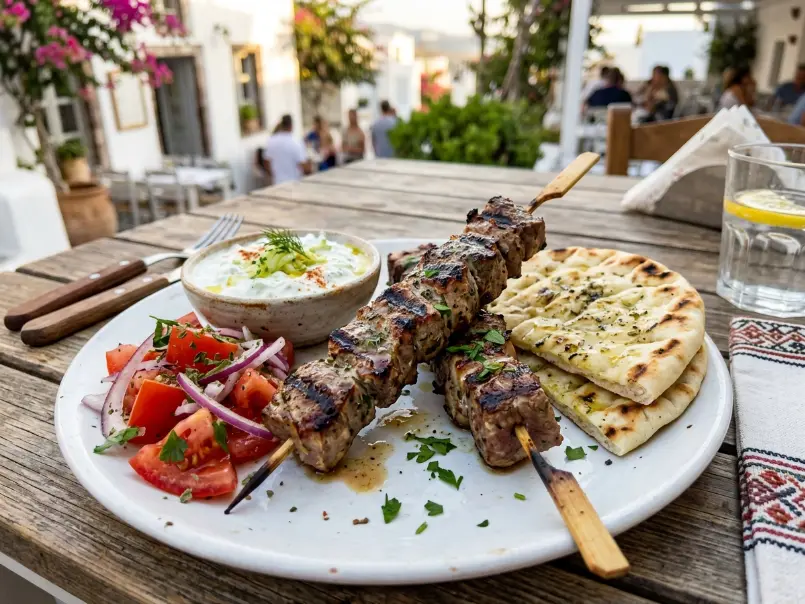
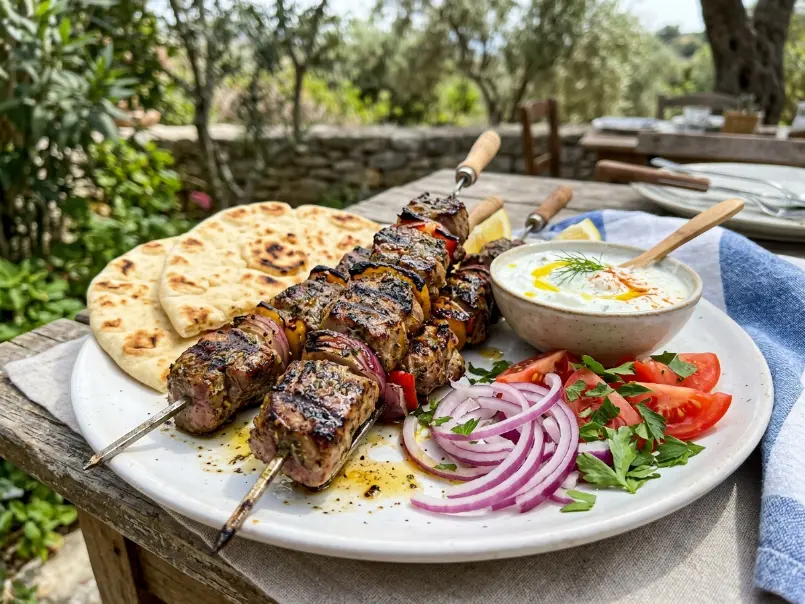
After resting, slide the lamb cubes off the skewers onto a serving platter. Arrange with warm pita bread, tzatziki sauce, sliced red onions, diced tomatoes, and fresh parsley. Squeeze fresh lemon wedges over the top.
Serve immediately. Eat with your hands. This is how Greek Lamb Skewers (Gyros) are meant to be experienced—smoky, tender, dripping with juice, wrapped in soft bread with cool, tangy yogurt sauce.

Greek Lamb Skewers (Gyros)
Ingredients
Equipment
Method
- Trim boneless lamb shoulder, removing large sections of silverskin but leaving visible fat intact. Fat is essential for moisture and flavor.
- Cut lamb into uniform 1.5-inch cubes. Even sizing ensures even cooking.
- Place lamb cubes in a large mixing bowl. Pat dry with paper towels—dry meat browns better than wet meat.
- In a separate bowl, combine Greek yogurt, olive oil, lemon juice, minced garlic, oregano, cumin, smoked paprika, salt, pepper, and optional honey.
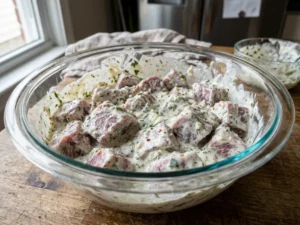
- Whisk until smooth and uniform. The marinade should be thick and paste-like.
- Pour yogurt marinade over lamb cubes.
- Use your hands to massage marinade into every piece until completely coated.
- Cover bowl tightly with plastic wrap or transfer to a large ziplock bag.
- Refrigerate for 4–12 hours. Eight hours overnight is ideal. Do NOT marinate longer than 24 hours or the surface will turn mushy.
- Remove marinated lamb from refrigerator 30 minutes before grilling. Let come to room temperature for even cooking.
- Thread lamb cubes onto flat metal skewers, leaving ¼-inch space between each cube. Do not pack tightly—space allows heat and smoke circulation for better char.
- Preheat grill to high heat: 450–500°F (232–260°C).
- Clean grill grates with a brush and oil lightly using a paper towel dipped in oil, held with tongs.
- Place skewers directly over the hottest part of the grill. Close lid.
- Grill undisturbed for 3–4 minutes. You’ll hear fat rendering and sizzling.
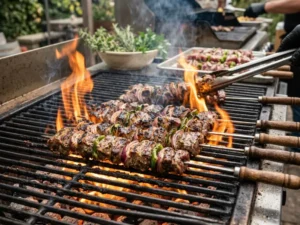
- Flip skewers 90 degrees. Grill another 3–4 minutes until deep brown char marks form.
- Flip once more if needed to char all four sides.
- Insert instant-read thermometer into the thickest lamb cube. Pull skewers when internal temp reaches:
- 135°F (57°C) for medium-rare
- 140°F (60°C) for medium
- Do not cook beyond 145°F or lamb will be dry.
- Transfer skewers to a clean plate. Tent loosely with aluminum foil.
- Rest for 5–10 minutes. Carryover cooking will raise temp by 5–10°F, and juices will redistribute through the meat.
- Slide lamb cubes off skewers onto a serving platter.
- Serve immediately with warm pita bread, tzatziki sauce, sliced red onions, diced tomatoes, fresh parsley, and lemon wedges.
Notes
Chef Mansoor’s Insight
The classic gyro’s transformation from a vertical spit-roast into backyard-friendly skewers preserves the ancient Greek democratic spirit of sharing fire-cooked meats. In the tavernas of Athens, the gyro spit turns slowly, layer upon layer of lamb basting itself in its own rendered fat. But these Greek Lamb Skewers (Gyros) bring that same alchemy to your grill—the yogurt marinade replaces the slow rotation, the metal skewers replace the vertical spit, and the high heat recreates the caramelized crust. What remains unchanged is the ritual: fire, meat, friends, and the understanding that the best meals are the ones eaten standing up, with juice running down your wrists.
— Chef Mansoor, Flavour Bazar
Nutrition Information (Per Serving, Serves 4)
| Nutrient | Amount |
|---|---|
| Calories | 380 kcal |
| Protein | 32 g |
| Carbohydrates | 6 g |
| Dietary Fiber | 0.5 g |
| Sugars | 4 g |
| Total Fat | 25 g |
| Saturated Fat | 9 g |
| Monounsaturated Fat | 11 g |
| Sodium | 480 mg |
| Cholesterol | 105 mg |
| Iron | 25% DV |
| Vitamin B12 | 40% DV |
| Zinc | 35% DV |
High-Protein, Low-Carb, Keto-Friendly: Greek Lamb Skewers (Gyros) are naturally high in protein (32g per serving) and low in carbohydrates (6g), making them ideal for keto, paleo, and low-carb diets. Lamb is rich in iron, zinc, and vitamin B12—essential for energy and immune function.
Note: Nutrition values are estimates and do not include pita bread or tzatziki. Values will vary based on lamb cut and trimming.
Food Safety & Internal Temperature Guide
| Food Safety Element | Temperature / Guideline |
|---|---|
| Minimum safe internal temp (USDA) | 145°F / 63°C + 3 min rest |
| Recommended pull temp (medium-rare) | 135°F / 57°C |
| Recommended pull temp (medium) | 140°F / 60°C |
| Carryover cooking rise | +5–10°F / +3–5°C during rest |
| Danger zone (avoid) | 40–140°F / 4–60°C |
| Maximum marinade time | 24 hours (acid over-tenderizes after) |
| Grill surface temperature | 450–500°F / 232–260°C |
Reheating Leftover Greek Lamb Skewers (Gyros):
Lamb fat oxidizes quickly when reheated, creating a “warmed-over” off-flavor. To minimize this:
- Reheat gently in a covered skillet with a splash of broth or water over medium-low heat
- Do not microwave—it makes the meat rubbery
- Serve reheated lamb wrapped in warm pita with fresh tzatziki to mask any oxidation flavors
Store leftover lamb in an airtight container in the refrigerator for up to 3 days.
Storage & Serving Guide
| Storage Method | Duration | Best Practices |
|---|---|---|
| Refrigerator (raw marinated) | 24 hours max | Do not over-marinate; acid breaks down texture |
| Refrigerator (cooked) | 3 days | Store in airtight container; reheat gently |
| Freezer (raw marinated) | Not recommended | Yogurt separates upon thawing; texture suffers |
| Freezer (cooked) | 2 months | Wrap tightly; thaw in fridge overnight |
| Best serving temperature | 130–140°F / 54–60°C | Serve warm immediately after resting |
FAQ: Greek Lamb Skewers (Gyros)
What is the best cut of lamb for skewers?
Boneless lamb shoulder is the best choice. It has an 80:20 lean-to-fat ratio, which keeps the meat moist during grilling. Boneless lamb leg is a good second option but is leaner and can dry out if overcooked. Avoid lamb loin (too lean) and stew meat (inconsistent quality).
Why use yogurt in a meat marinade?
Yogurt contains lactic acid (pH 4.5), which gently breaks down collagen in lamb without making it mushy. It also contains calcium ions that activate natural meat enzymes (calpains) to tenderize from within. The milk solids in yogurt accelerate Maillard browning for better char and flavor.
How long should I marinate lamb in yogurt?
Four to twelve hours is ideal. Less than four hours and the acid has not had time to tenderize. More than twenty-four hours and the surface begins to turn mushy. Eight hours overnight in the refrigerator is perfect for Greek Lamb Skewers (Gyros).
Can I use wooden skewers instead of metal?
You can, but metal is far superior. Flat metal skewers conduct heat into the center of the lamb cubes, cooking them from the inside out. Wooden skewers insulate the meat and often burn on the grill. If you must use wooden skewers, soak them in water for 30 minutes first.
What internal temperature should I cook lamb to?
Pull the skewers at 135°F (57°C) for medium-rare or 140°F (60°C) for medium. Carryover cooking during the 5–10 minute rest will raise the temperature another 5–10°F. Do not cook beyond 145°F or the lamb will be dry.
How do I make juicy lamb gyros?
Three keys: (1) Use lamb shoulder with visible fat. (2) Marinate in full-fat Greek yogurt. (3) Grill over high heat (450–500°F) and pull at 135–140°F internal temp. Always rest the meat for 5–10 minutes before serving.
What is the best homemade tzatziki sauce pairing?
Combine 1 cup Greek yogurt, ½ cup grated cucumber (squeezed dry), 2 cloves minced garlic, 1 tbsp lemon juice, 1 tbsp olive oil, 1 tbsp fresh dill, salt, and pepper. Refrigerate for 1 hour before serving. The cool, tangy sauce balances the smoky, fatty lamb perfectly.
You Might Also Love These Flavour Bazar Recipes
Burrata Heirloom Tomato Salad
A luxurious summer salad pairing for Greek Lamb Skewers (Gyros)
Garlic Herb Grilled Potatoes
Perfect Mediterranean side dish
Cucumber Kimchi Salad
A cool, crunchy contrast to rich grilled lamb
Sparkling Raspberry Lemonade
A refreshing, non-alcoholic beverage for outdoor dining
For More Healthy Recipes Visit: flavourbazar.com