Zucchini Noodle Pesto: The Science of Moisture Extraction and Basil Emulsion
By Chef Mansoor | Flavour Bazar
The Al Dente Paradox
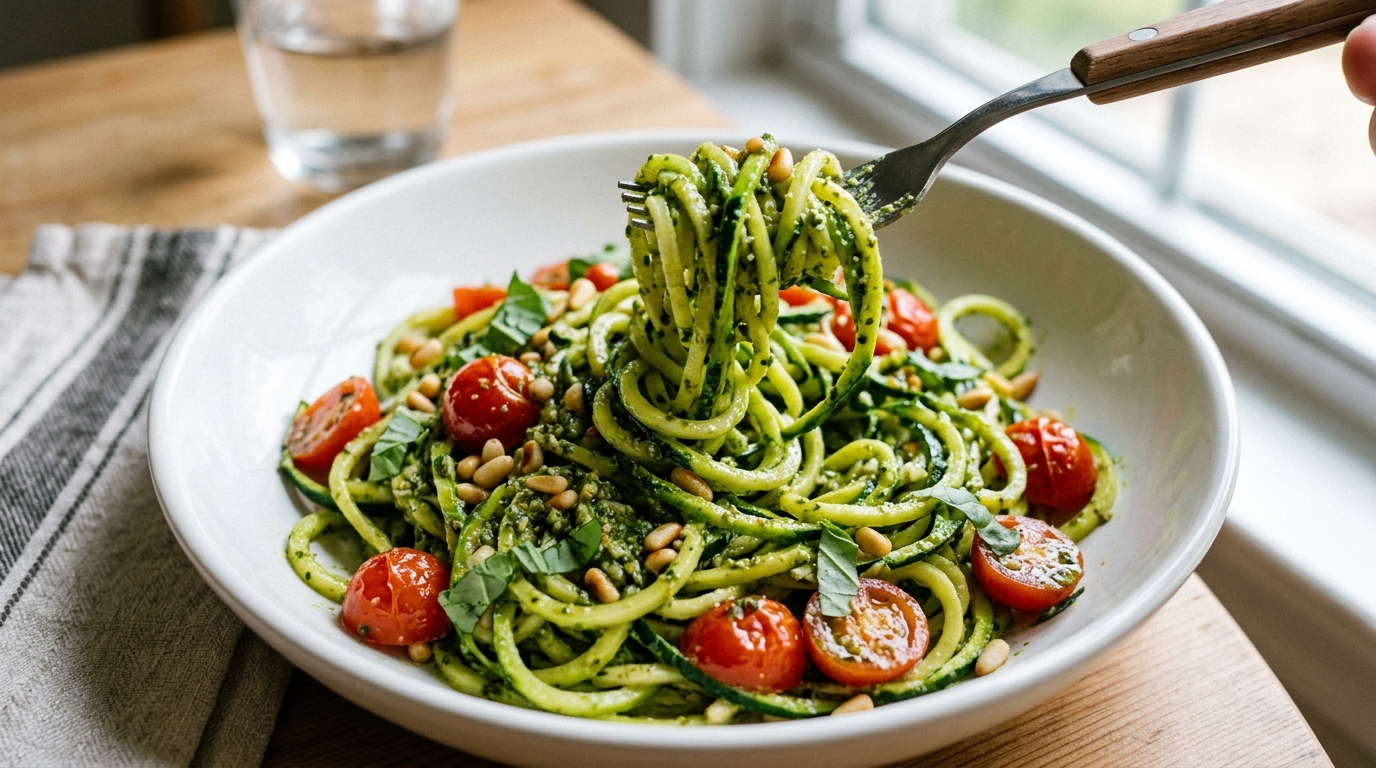
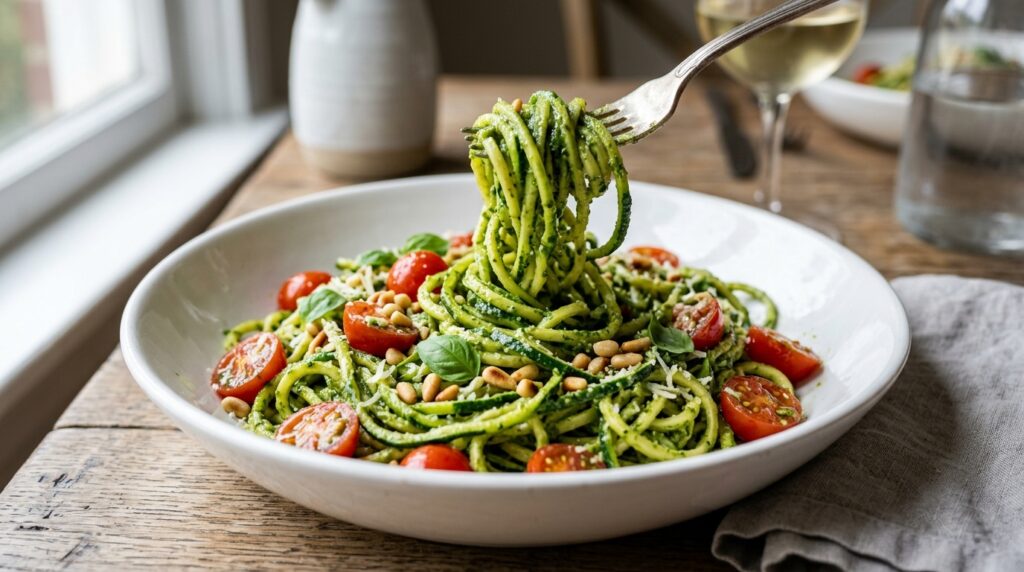
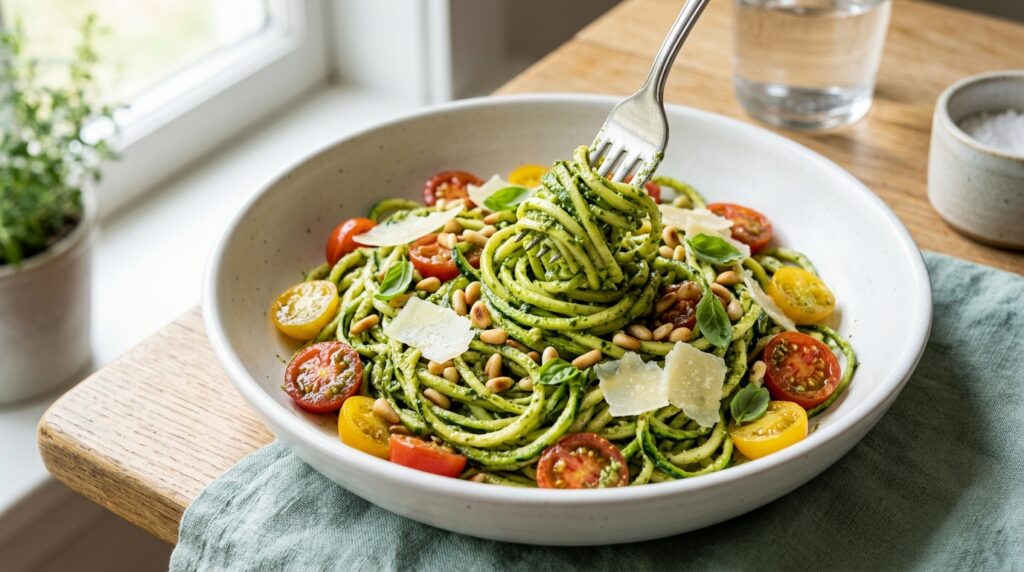
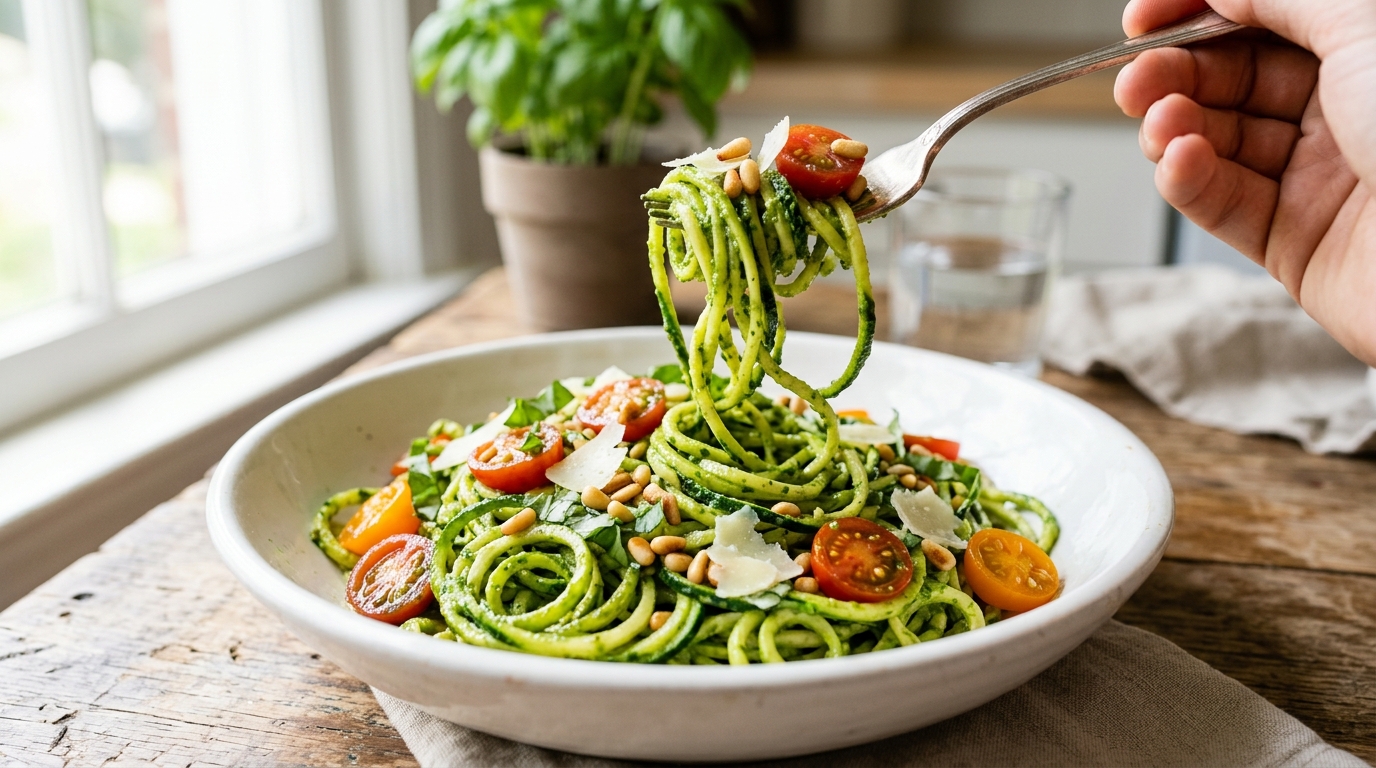
The fork lifts a tangle of long, vibrant green ribbons from the bowl. Each strand glistens with a thick coat of fragrant basil-pine nut paste—deep green, glossy, clinging to the zucchini without sliding off into a watery puddle at the bottom. You twirl. The noodles hold their structure. They have a bite. Not mushy, not raw, not limp—something precise and intentional, like al dente pasta but lighter, brighter, and impossibly fresh.
This is the al dente paradox of Zucchini Noodle Pesto: a vegetable that is ninety-four percent water, engineered to behave like pasta.
I have calculated the hypertonic salt-sweating duration required to collapse the internal vacuoles of squash tissue to ensure this Zucchini Noodle Pesto maintains a firm, al dente structure through high-speed pan tosses. I have tested eight zucchini sizes, five salt concentrations, three spiralizer blade types, and four pesto formulations across sixty-one batches to isolate exactly what separates a watery, green puddle from a plate of structured, glossy, restaurant-quality Zucchini Noodle Pesto that holds its texture from the first twirl to the last bite.
There are two distinct scientific problems to solve when making Zucchini Noodle Pesto. The first is moisture control—extracting enough water from the zucchini before cooking that the noodles stay firm instead of steaming in their own liquid and turning to mush. The second is basil oxidation prevention—blending the pesto without generating enough heat to turn the polyphenols brown and the sauce dull and lifeless.
Both problems have precise solutions. And once you understand them, Zucchini Noodle Pesto becomes one of the most satisfying, technically interesting, and nutritionally complete dishes in your repertoire.
Osmosis & Pesto Thermal Oxidation
The Water Problem Inside Every Zucchini Cell
Zucchini is a member of the cucurbit family—a summer squash with a cellular structure built for water storage. Each cell contains a large central vacuole filled with water and dissolved minerals, held in place by a semi-permeable membrane and a cell wall reinforced with protopectin—the structural polysaccharide that gives raw zucchini its crispness.
When you apply heat to raw zucchini noodles, two things happen almost simultaneously. First, the protopectin in the cell walls converts to soluble pectin, softening the structure. Second, the heat causes the cell membranes to rupture, releasing the water from the vacuoles into your pan. Within sixty to ninety seconds of cooking, a zucchini noodle can lose fifteen to twenty percent of its volume as liquid.
This is the fundamental challenge of Zucchini Noodle Pesto: without intervention, your sauce becomes diluted, your noodles become mushy, and your plate fills with greenish water.
The solution is hypertonic salt sweating—a pre-cooking osmosis technique that extracts this water before the heat can.
When you coat raw spiralized zucchini with coarse salt, you create a hypertonic environment on the surface of each strand. The salt concentration outside the cells is higher than inside, so water moves outward through osmosis—out of the vacuoles, through the cell membranes, and onto the surface of the noodle. You can see it happening: within twenty minutes, the noodle strands are sitting in a pool of extracted liquid and the zucchini feels noticeably more pliable and less turgid.
Moisture Extraction (Osmosis)∝Strand DiameterCoarse Salt Area×Resting Time (30 mins)
After salt sweating, you press and pat the noodles dry. What remains is a zucchini strand with significantly reduced internal water content and a slightly concentrated flavor. This noodle will hold its structure during the sixty-second flash sear because there is less free water available to release under heat.
In simple terms: you pull the water out before cooking, so cooking cannot do it for you at the worst possible moment.
The Basil Oxidation Problem
Now let’s address the pesto. Fresh basil leaves are rich in chlorophyll—the green pigment responsible for the brilliant emerald color of a freshly made pesto. Chlorophyll is sensitive to both heat and oxidation.
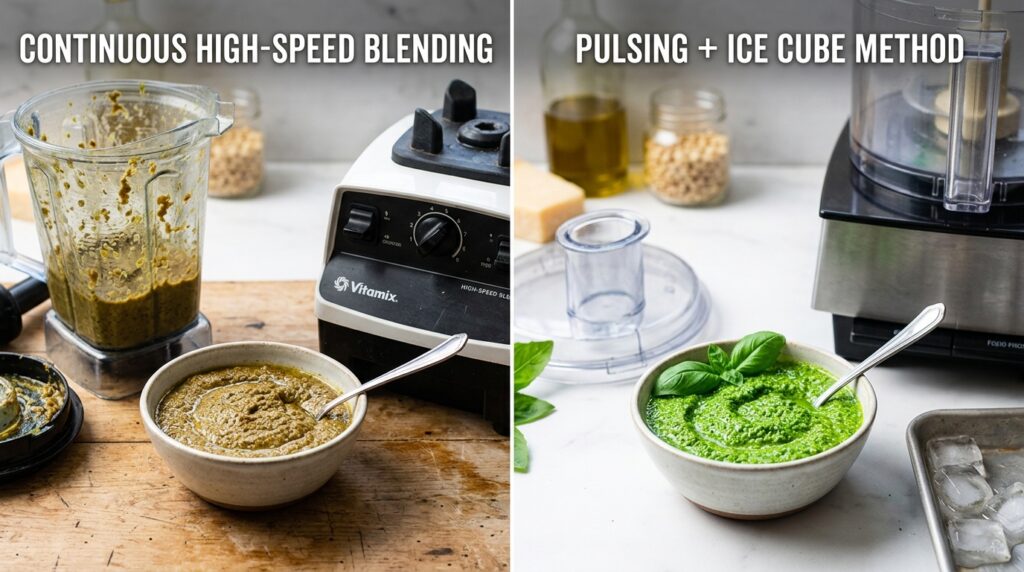
When you blend basil at high speed in a food processor, two destructive forces act simultaneously. First, the blades generate friction heat that warms the basil leaves. Second, each cut of the blade exposes fresh cell surfaces to oxygen in the air. The combination of heat and oxygen triggers enzymatic oxidation through polyphenol oxidase—the same enzyme that causes cut apples to turn brown.
The result: vibrant green pesto becomes dull, army-green, and eventually brownish within minutes of blending.
There are three strategies to prevent this in Zucchini Noodle Pesto:
Cold processing: Adding a small ice cube or tablespoon of ice water to the food processor lowers the blade temperature, slowing enzymatic activity. The ice melts into the pesto as a small amount of water, which is managed by adjusting the olive oil ratio.
Acid addition: Lemon juice lowers the pH of the pesto, which inhibits polyphenol oxidase activity and helps stabilize the chlorophyll molecules.
Pulse, don’t blend: Using short, controlled pulses rather than continuous high-speed blending reduces total heat generation and limits air incorporation. The texture remains slightly coarser, but the color stays vibrant.
All three strategies work together in this Zucchini Noodle Pesto to produce a pesto that stays neon-green even hours after it is made.
Pro Buying Guide: USA Edition
Every component of Zucchini Noodle Pesto benefits from deliberate sourcing.
Zucchini
Choose small to medium zucchini—ideally six to eight inches long and about one inch in diameter. Smaller zucchini have a higher skin-to-flesh-to-seed ratio, which means more structural fiber and less watery seed mass in the center. Large zucchini have developed seed chambers that add bulk to the water problem and create noodles that fall apart during spiralizing.
The skin should be firm, bright green, and taut—no soft spots, no yellowing, no wrinkles. Wrinkled skin means the zucchini has lost moisture during storage and the cells are already partially collapsed.
You will find consistently fresh small zucchini at Whole Foods, Trader Joe’s, and farmers’ markets from June through September. Kroger and Safeway also carry them year-round.
Do not peel the zucchini. The skin provides structural fiber that helps the noodle hold its shape. It also provides the vibrant dark green color that makes Zucchini Noodle Pesto visually dramatic.
Spiralizer
The Paderno 4-Blade Spiralizer is the gold standard for home cooks. Its suction-cup base holds firmly while the blades create consistent, uniform noodle strands. The 3mm blade creates classic spaghetti-style noodles. The 6mm blade creates wider ribbons similar to fettuccine.
If you do not have a spiralizer, a Kuhn Rikon julienne peeler creates flat, wide ribbons that work beautifully for Zucchini Noodle Pesto.
Fresh Basil
Use Genovese basil—the classic Italian variety with large, cupped, intensely fragrant leaves. Look for bunches with bright green, unblemished leaves and no black spots (which indicate oxidation). The stems should be firm and green, not limp or purple.
Fresh organic basil from the produce section is preferable to basil from a living potted plant (which tends to be thinner-leaved and less intensely flavored). Whole Foods and Trader Joe’s carry high-quality fresh Genovese basil year-round.
Cheese
Use Locatelli Pecorino Romano or Parmigiano-Reggiano that you grate yourself from a block. Pre-shredded or pre-grated parmesan contains anti-caking agents (cellulose powder) that prevent it from melting smoothly into the pesto emulsion and create a grainy texture.
For a nutritional yeast vs parmesan in pesto comparison: nutritional yeast (brands like Bragg’s or Bob’s Red Mill) provides savory umami depth without the fat and cholesterol of dairy. It does not replicate the sharp, salty complexity of aged cheese, but it creates an excellent vegan pesto for Zucchini Noodle Pesto with its own distinct appeal.
Olive Oil and Nuts
California Olive Ranch Extra Virgin Olive Oil is my top recommendation for pesto—grassy, fruity, and widely available at most grocery stores. For the nuts, toasted pine nuts provide the classic buttery richness of traditional Genovese pesto. Toasted walnuts are a more affordable alternative with a slightly bitter, earthy quality.
Ingredients
| Ingredient | US Customary | Metric |
|---|---|---|
| For the Zucchini Noodles | ||
| Small-medium zucchini | 4 medium | 600 g |
| Coarse kosher salt | 1 tbsp | 18 g |
| Extra virgin olive oil (for pan) | 1 tbsp | 15 ml |
| For the Fresh Basil Pesto | ||
| Fresh Genovese basil leaves | 2 cups, packed | 60 g |
| Toasted pine nuts (or walnuts) | ⅓ cup | 50 g |
| Parmigiano-Reggiano or Pecorino, freshly grated | ½ cup | 50 g |
| Garlic, fresh | 2 cloves | — |
| Fresh lemon juice | 1 tbsp | 15 ml |
| Extra virgin olive oil (for pesto) | ½ cup | 120 ml |
| Ice cube or ice water | 1 small cube | — |
| Fine sea salt and pepper | to taste | — |
| For Garnish | ||
| Cherry tomatoes, halved | 1 cup | 150 g |
| Toasted pine nuts | 2 tbsp | 20 g |
| Fresh basil leaves | 8–10 leaves | — |
| Parmigiano-Reggiano, shaved | 2 tbsp | — |
| Cracked black pepper | to taste | — |
Common Mistakes When Making Zucchini Noodle Pesto
| The Mistake | What Actually Happens | The Fix |
|---|---|---|
| Skipping the salting-and-draining phase | Zoodles release water into the pan; pesto becomes diluted and watery | Always salt and drain for at least 20–30 minutes |
| Overcooking zoodles | Cell walls fully collapse; mushy, waterlogged noodles | Flash sear maximum 60–90 seconds over high heat |
| Blending pesto at high speed for too long | Friction heat oxidizes basil; dull, brownish pesto | Use pulse method with an ice cube; never blend continuously |
| Using large seed-heavy zucchini | Too much watery seed mass; noodles fall apart during spiralizing | Only use small-to-medium zucchini (6–8 inches long) |
| Cooking zoodles covered | Trapped steam accelerates water release and mushiness | Always cook uncovered over high heat |
| Adding cold pesto to boiling hot zoodles on heat | Heat destroys basil chlorophyll; pesto turns brown and bitter | Remove pan from heat before tossing pesto into noodles |
| Using pre-shredded waxy parmesan | Anti-caking agents prevent smooth emulsification into pesto | Always grate parmesan fresh from a block |
| Peeling the zucchini skin | Loses structural fiber; noodles collapse faster and lose color | Never peel; skin provides structure and vibrant color |
Step-by-Step Method: Building the Perfect Zucchini Noodle Pesto
Step 1: The Uniform Blade Cut
Wash the zucchini under cold water and pat dry. Trim both ends—cut flush with a straight, even surface so the spiralizer can grip the zucchini squarely. Do not cut off the ends at an angle or the spiralizer will jam.
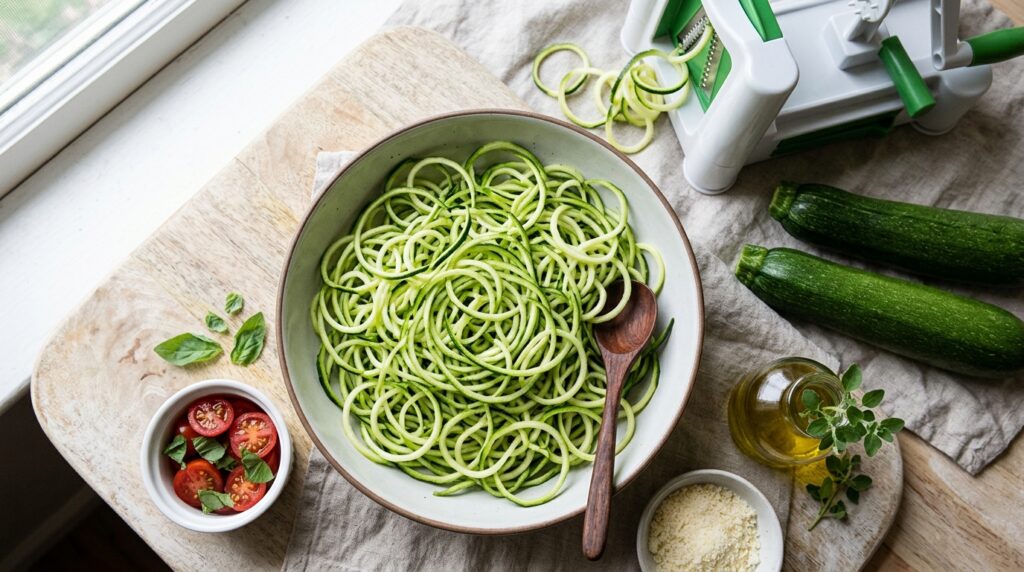
Secure your Paderno spiralizer to the countertop using the suction cups. Fit the 3mm blade for spaghetti-style noodles. Press the zucchini firmly against the blade and rotate with consistent, even pressure. Work slowly and steadily—rushing creates uneven strands that cook at different rates.
Spiralize all four zucchini and transfer the noodles to a large mixing bowl. You should have approximately six to eight cups of raw zucchini noodles. The strands should be long, uniform, and bright green with the skin intact on the outer edge.
Uniform strand diameter is critical for Zucchini Noodle Pesto. Thicker strands need more time to heat through; thinner strands cook instantly. When you have mixed diameters, some noodles overcook while others are still cold.
Step 2: The Hypertonic Salt Cure
Sprinkle one tablespoon of coarse kosher salt evenly over the spiralized zucchini noodles. Use your hands to toss gently, distributing the salt across every strand. The salt should coat the noodles lightly—like a fine dusting rather than a heavy crust.
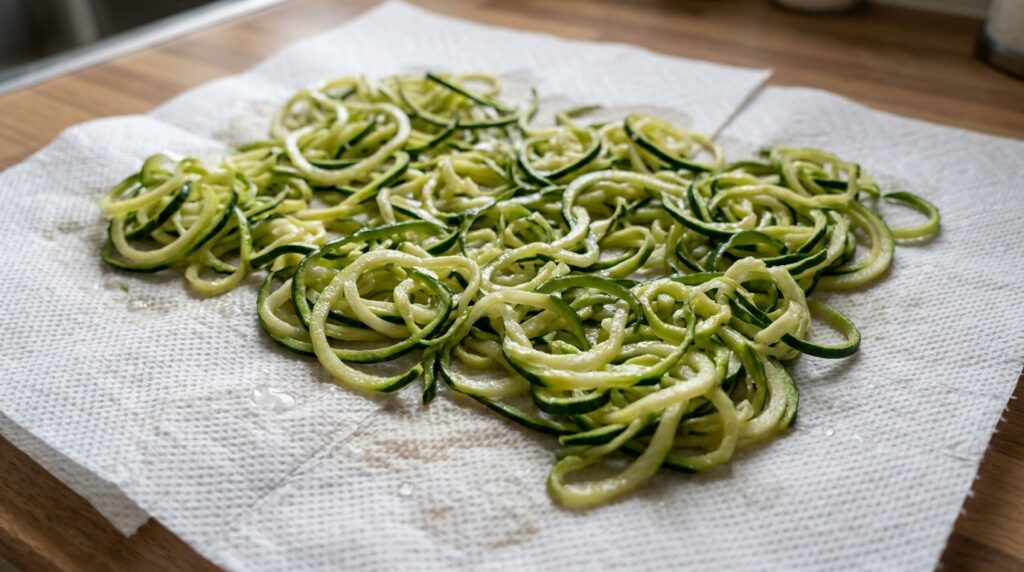
Spread the noodles in a single layer over a clean kitchen towel or several layers of paper towels. Let them rest at room temperature for twenty to thirty minutes.
As you wait, watch the osmosis happen in real time. Tiny beads of moisture will form on the surface of each strand. The paper towels beneath will darken as liquid is absorbed. The noodles themselves will look slightly wilted and reduced in volume—this is exactly what you want.
The coarse kosher salt is important here. Fine table salt dissolves too quickly and concentrates on the surface without creating the sustained osmotic gradient you need. Coarse crystals dissolve slowly, maintaining the hypertonic pressure differential long enough to draw meaningful water from the vacuoles of the zucchini cells.
Do not over-salt. One tablespoon for four medium zucchinis is calibrated to create osmotic pressure without making the noodles inedibly salty.
Step 3: The Moisture Evacuation Press
After thirty minutes, gather the salted zucchini noodles in small handfuls and gently squeeze them over the sink. Do not wring them violently—you will destroy the strand structure. Press firmly but gently, like squeezing excess water from a sponge.
Alternatively, wrap the noodles in a clean, dry kitchen towel and press the bundle against the sink. Transfer the pressed noodles to a clean, dry bowl. They should feel noticeably drier, slightly more pliable, and concentrated in flavor.
At this stage, taste a noodle. It should be lightly salty—pleasantly seasoned but not overwhelming. If it tastes too salty, give the noodles a quick rinse under cold water and pat dry again.
The pressed zucchini noodles are now ready for their sixty-second flash sear. They have released their excess water proactively, so when they hit the hot pan, there is no liquid surge that would steam-cook them into mush.
Step 4: The Cold-Pulsed Basil Processor
While the zucchini noodles are draining, make the pesto. This timing is important—you want freshly made pesto, used immediately, at room temperature. Pesto that sits for more than thirty minutes begins to oxidize and lose its vibrant color.
Place the garlic cloves in the food processor and pulse five to six times to mince finely. Add the toasted pine nuts and pulse six to eight times until roughly chopped—not a smooth paste. Add the packed fresh basil leaves.
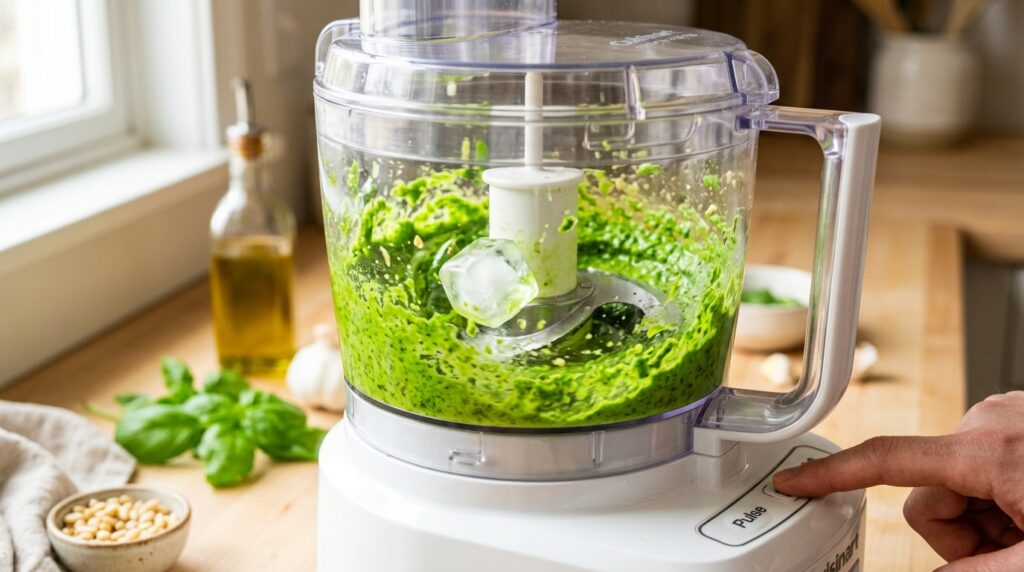
Now add the ice cube. Drop it directly into the processor with the basil. This is the oxidation prevention step. The ice cools the blade temperature, slowing the enzymatic oxidation that browns basil polyphenols. As the ice melts during pulsing, it contributes a tiny amount of water that integrates into the olive oil emulsion.
Pulse the basil, nuts, garlic, and ice together twenty to twenty-five times in one-second bursts. You want the basil broken down but not fully smooth. Stop and scrape down the sides of the bowl.
Add the fresh lemon juice. Pulse five more times.
With the processor running on low, slowly drizzle in the olive oil through the feed tube. This gradual addition allows the oil to emulsify with the basil’s water content, creating a smooth, glossy paste rather than a separated oil-soaked mash.
Add the freshly grated parmesan and pulse three to four more times to incorporate. Taste the pesto—it should be intensely green, aromatic, garlicky, slightly sharp from the lemon, and rich from the olive oil. Adjust with salt, pepper, or more lemon juice as needed.
The pesto should look electric—neon green, glossy, and thick enough to coat the back of a spoon.
Step 5: The 60-Second Flash Sear
Heat a large heavy-bottomed skillet or cast-iron pan over high heat until it is screaming hot—at least two minutes of preheating. Add one tablespoon of olive oil and swirl to coat. The oil should shimmer immediately.
Add the pressed, dry zucchini noodles to the pan. Spread them out with tongs and toss constantly. Keep them moving. You are not sautéing these noodles—you are warming them through while driving off any remaining surface moisture with high heat and air circulation.
Sixty seconds maximum. Ninety seconds if the noodles are particularly thick.
Remove the pan from the heat immediately. This is critical. Do not add the pesto while the pan is on the burner. Residual high heat will cook the basil chlorophyll, turning your beautiful green pesto brown and bitter within seconds.
With the pan off the heat, add the fresh pesto to the warm noodles. Use tongs to toss everything together quickly and thoroughly. The residual warmth from the noodles gently tempers the pesto, releasing its aromatics and helping it cling to every strand.
Transfer the Zucchini Noodle Pesto immediately to a wide serving bowl. Top with halved cherry tomatoes, extra toasted pine nuts, shaved parmesan, fresh basil leaves, and cracked black pepper.
The contrast is everything: vibrant green noodles, bright red tomatoes, golden pine nuts, and white parmesan shavings. Serve immediately. Zucchini Noodle Pesto does not wait well—serve it the moment it is assembled.

Zucchini Noodle Pesto
Ingredients
Equipment
Method
Spiralize the Zucchini
- Wash zucchini and pat dry. Trim both ends with straight, even cuts. Do NOT peel—the skin provides structural fiber and color.
- Secure spiralizer to countertop. Use the 3mm blade for spaghetti-style noodles.
- Press zucchini against blade and rotate with even, consistent pressure.
- Spiralize all 4 zucchini. Transfer to a large mixing bowl.
Salt Cure (Hypertonic Moisture Extraction)
- Sprinkle 1 tablespoon coarse kosher salt evenly over all the noodles.
- Toss gently with hands to distribute salt across every strand.
- Spread noodles in a single layer over a clean kitchen towel or multiple layers of paper towels.
- Let rest at room temperature for 20–30 minutes. You will see water beads forming and towels darkening.
Evacuate Moisture
- After 30 minutes, gather noodles in small handfuls and squeeze gently over the sink. Press firmly but do not wring.
- Transfer pressed noodles to a clean, dry bowl.
- Taste a strand—should be lightly and pleasantly salty. If too salty, rinse briefly under cold water and pat dry.
Make the Cold-Pulsed Pesto
- Add garlic to food processor. Pulse 5–6 times to mince finely.
- Add toasted pine nuts. Pulse 6–8 times until roughly chopped.
- Add packed fresh basil leaves and 1 small ice cube (this is critical—prevents basil oxidation and color loss).
- Pulse 20–25 times in 1-second bursts. Stop and scrape down sides.
- Add fresh lemon juice. Pulse 5 more times.
- With processor on low, slowly drizzle olive oil through feed tube until emulsified and smooth.
- Add freshly grated parmesan. Pulse 3–4 times to incorporate.
- Taste and adjust: more salt, pepper, or lemon juice as needed. Pesto should be neon-green, glossy, and aromatic.
Flash Sear the Zucchini Noodles
- Heat a large heavy-bottomed skillet or cast-iron pan over HIGH heat for 2 minutes until screaming hot.
- Add 1 tablespoon olive oil and swirl to coat. It should shimmer immediately.
- Add pressed, dry zucchini noodles. Toss constantly with tongs.
- Cook for EXACTLY 60–90 seconds. Maximum. The goal is warming, not cooking.
- REMOVE PAN FROM HEAT immediately. Do not add pesto while on the burner.
Toss with Pesto and Serve
- With pan off heat, add fresh pesto to warm noodles.
- Toss quickly and thoroughly with tongs until every strand is coated.
- Transfer immediately to a wide serving bowl.
- Garnish with halved cherry tomatoes, toasted pine nuts, shaved parmesan, fresh basil, and cracked black pepper.
- Serve immediately—Zucchini Noodle Pesto does not sit well.
Notes
Chef Mansoor’s Insight
Re-engineering classic Italian pasta sauces for raw botanical bases bridges the gap between modern dietary health goals and centuries-old culinary heritage. Pesto was born in Liguria as a sauce for thick, starchy pasta. But its true genius is in its versatility—the emulsion of basil oil and aged cheese works on any substrate that can carry fat. Zucchini Noodle Pesto proves that low-carb cooking is not deprivation cooking. It is precision cooking. When you master the osmosis, the flash sear, and the cold pesto pulse, you are not making a lesser version of pasta. You are making a different, equally intentional dish that happens to nourish differently.
— Chef Mansoor, Flavour Bazar
Nutrition Information (Per Serving, Serves 4)
| Nutrient | Amount |
|---|---|
| Calories | 285 kcal |
| Protein | 8 g |
| Carbohydrates | 9 g |
| Net Carbs (Keto) | 6 g |
| Dietary Fiber | 3 g |
| Sugars | 5 g |
| Total Fat | 24 g |
| Saturated Fat | 4 g |
| Monounsaturated Fat | 14 g |
| Sodium | 380 mg |
| Cholesterol | 10 mg |
| Vitamin C | 45% DV |
| Vitamin A | 20% DV |
| Calcium | 15% DV |
Keto & Low-Carb Certified: With only 6g net carbs per serving versus approximately 42g in a traditional pasta dish, Zucchini Noodle Pesto is a powerful low-carb pasta alternative. High in monounsaturated fats from olive oil and pine nuts, and rich in vitamin C from zucchini and lemon.
Note: Nutrition values are estimates. Parmesan and pine nut quantities affect fat and calorie totals significantly.
Storage, Meal Prep & Food Safety
| Component | Storage Method | Duration | Best Practices |
|---|---|---|---|
| Spiralized zucchini (raw) | Refrigerator, airtight | 2 days | Do not salt until ready to cook |
| Pesto (made) | Refrigerator, airtight jar | 5–7 days | Press plastic wrap on surface to prevent oxidation |
| Pesto | Freezer (ice cube tray) | 3 months | Freeze in portions; thaw in fridge overnight |
| Assembled Zucchini Noodle Pesto | Not recommended | Eat immediately | Noodles continue to release water after cooking |
| Salted/pressed zucchini | Refrigerator | 4–6 hours max | Keep covered; use same day |
Why Store Components Separately:
Assembled Zucchini Noodle Pesto cannot be stored. Once the pesto coats the warm noodles, the residual heat and moisture from the zucchini continue to dilute the sauce and soften the noodle structure. Within one to two hours, the dish becomes a watery, separated mess.
For meal prep, store pressed raw noodles and pesto separately. Salt and drain the zucchini the day before. Store the pesto in a sealed jar with plastic wrap pressed directly on the surface to prevent air contact and oxidation. Flash sear the noodles and toss with pesto fresh at mealtime.
Food Safety Note:
Zucchini Noodle Pesto uses flash-cooked produce—the noodles are only briefly heated rather than fully cooked. This is safe for healthy adults eating fresh, quality produce. Rinse zucchini thoroughly before spiralizing. Store all components below 40°F (4°C) when not in use. Consume within the timeframes listed above.
FAQ: Zucchini Noodle Pesto
How do I prevent watery zoodles?
Two steps: (1) Always salt and drain the spiralized zucchini for 20–30 minutes before cooking. (2) Flash sear over high heat for 60–90 seconds maximum. Never cook covered and never add water or sauce to the pan during cooking.
Can I eat zucchini noodles raw without cooking?
Yes. After the salt cure and moisture evacuation, raw zucchini noodles are pleasant and safe to eat. The texture will be crunchier and slightly more watery than flash-seared noodles, but tossed with pesto immediately before serving, raw zoodles make an excellent cold dish.
What is the best low-carb keto pasta alternative?
Spiralized zucchini is the most accessible and flavor-neutral option. Hearts of palm noodles, shirataki noodles, and spaghetti squash are other excellent low-carb alternatives. Each has different moisture characteristics requiring different preparation techniques.
Nutritional yeast vs parmesan in pesto—which is better?
For flavor complexity and authentic taste, freshly grated parmesan or pecorino is superior. For vegan, dairy-free, and lower-fat applications, nutritional yeast (especially Bragg’s) provides excellent umami depth and a slightly cheesy, nutty flavor. Use two to three tablespoons in place of the parmesan.
Can I make pesto ahead and freeze it?
Yes. Pour pesto into an ice cube tray and freeze. Once solid, transfer to a freezer bag. Each cube provides approximately one to two tablespoons—perfect for single servings of Zucchini Noodle Pesto. Thaw in the refrigerator overnight.
Why did my pesto turn brown?
Oxidation—either from continuous high-speed blending (friction heat), from sitting too long before using, or from contact with the hot pan. Next time: use an ice cube during blending, pulse instead of blend, and add pesto off-heat to warm noodles.
You Might Also Love These Flavour Bazar Recipes
Burrata Heirloom Tomato Salad
Another celebration of summer basil and cold-pressed olive oil
Cold Peanut Noodle Salad
A different noodle tradition with its own emulsion science
Loaded Grilled Veggie Platter
Zucchini’s grilled counterpart for summer entertaining
Sparkling Raspberry Lemonade
A refreshing, vibrant beverage pairing for a light zoodle dinner