Peach Melba Pavlova: The Physics of the Perfect Meringue
By Chef Mansoor | Flavour Bazar
The Summer Showstopper
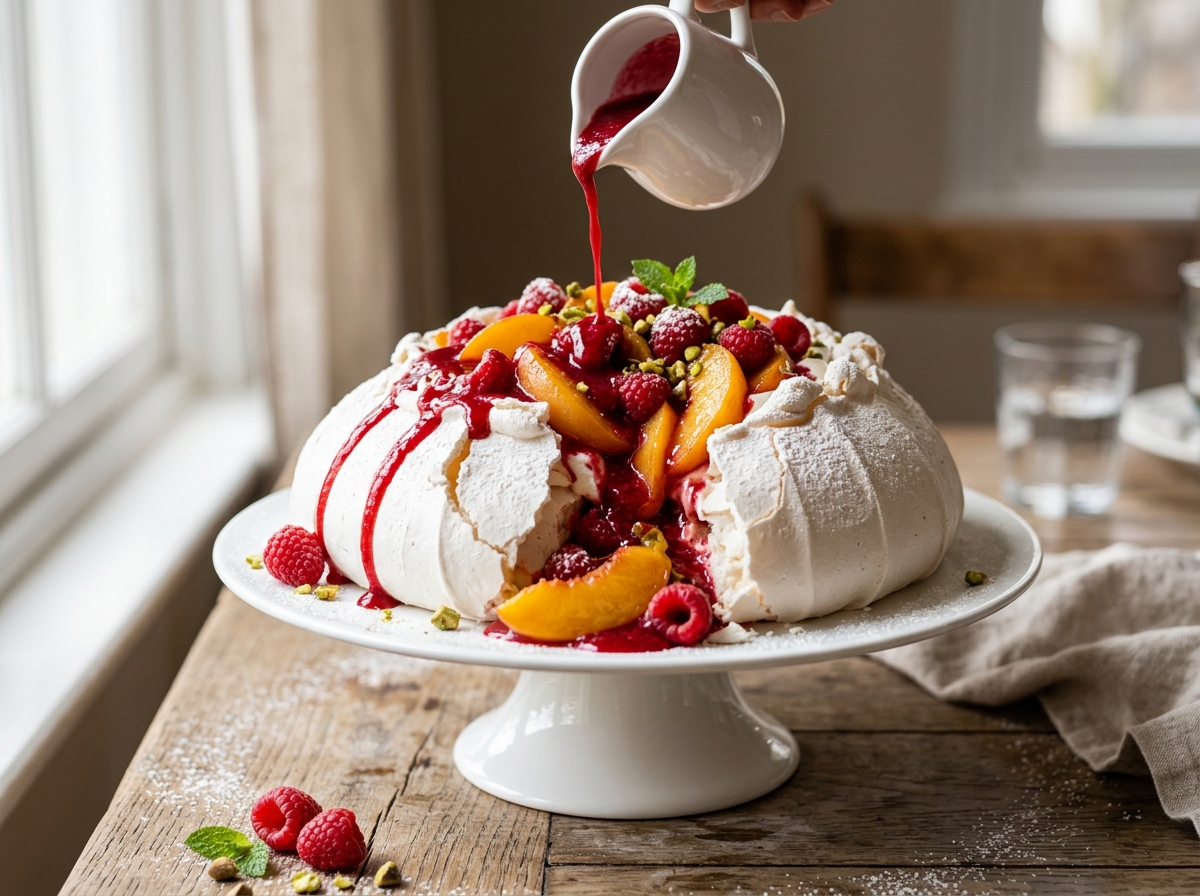
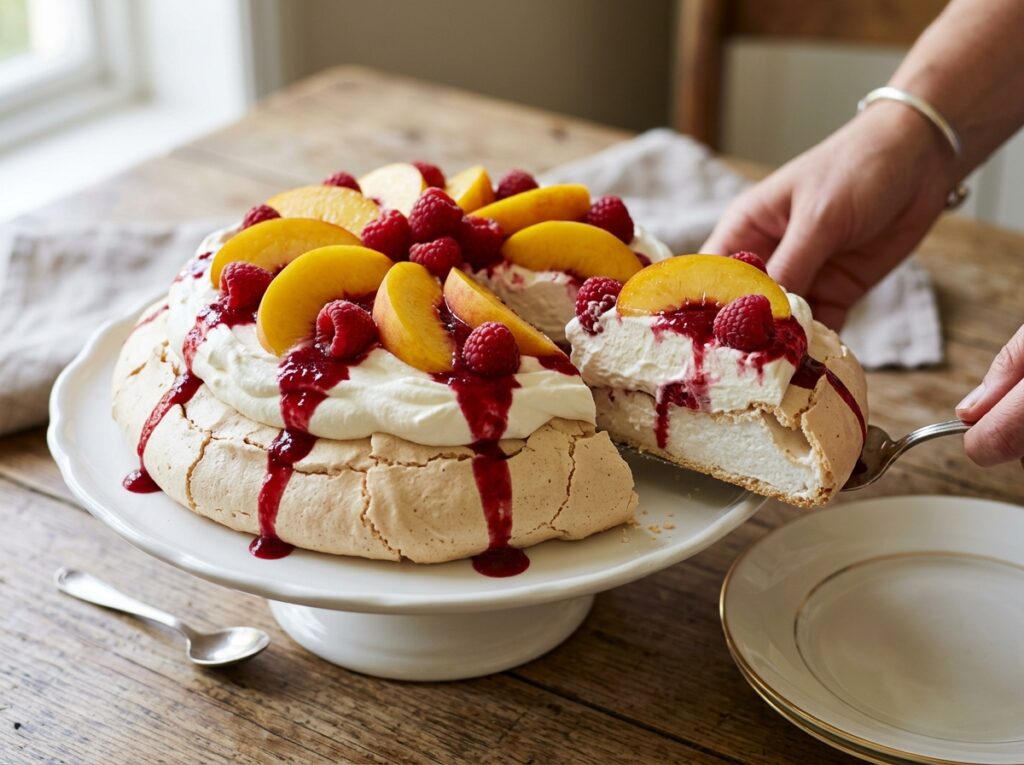
There is a moment when you present a perfect Peach Melba Pavlova that silences the table. The meringue, stark white and sculpted like a cloud, shatters with an audible crackle as you press a serving spoon into its surface, revealing an impossibly soft, marshmallow-like center. Piled high with golden, syrup-poached peaches, vibrant raspberries, and a drizzle of ruby-red raspberry coulis, it is more than a dessert—it is an event. A declaration that summer has arrived.
I have calculated the exact humidity-to-sugar ratio to ensure this Peach Melba Pavlova stays structurally sound in the peak of summer heat, a feat most home bakers think is impossible. What I discovered through years of testing is that the legendary pavlova is not temperamental or fussy—it is simply a matter of physics. When you understand how acid stabilizes egg white proteins, why cornstarch creates that signature marshmallowy interior, how osmosis keeps poached peaches firm, and why slow cooling prevents catastrophic cracking, you can create a Peach Melba Pavlova that is both a work of art and a masterpiece of food science.
This is not just another meringue. The Peach Melba Pavlova is a dessert with history, named for the great Australian opera singer Nellie Melba. It demands precision, but rewards you with a textural experience unlike anything else: crisp, airy, chewy, creamy, tart, and sweet, all in a single, glorious bite.
The Science: Meringue Structure and Osmosis in Fruit
The Physics of a Perfect Meringue: An Acid-Sugar Stabilizer
A pavlova meringue is a delicate balance of air, water, and protein, and its signature texture—crisp on the outside, soft and marshmallowy on the inside—is achieved through a scientific trio: egg whites, sugar, and an acid-sugar stabilizer.
Egg whites are primarily water and proteins (like ovotransferrin and ovalbumin). When you whip them, the mechanical action denatures (unfolds) these proteins, which rearrange themselves around air bubbles to create a stable foam. Sugar is then added to fortify this foam, but the real secret to the marshmallowy interior of a Peach Melba Pavlova lies in two key ingredients: vinegar and cornstarch.
Vinegar (Acidification): Adding a small amount of acid, like white vinegar, to the meringue lowers its pH. This slight acidification makes the egg white proteins more elastic and prevents them from over-coagulating (tightening too much) during the long, slow bake. The proteins form a more flexible network that can stretch without breaking, resulting in a meringue that is less likely to crack in the oven and has a softer, chewier interior.
Cornstarch (Moisture Control): Cornstarch is a hydrophilic (water-loving) starch. When folded into the meringue, it absorbs excess free moisture from the egg whites. During baking, this trapped moisture gelatinizes, creating the soft, sticky, marshmallow-like center that defines a pavlova. Without cornstarch, the meringue would dry out completely into a crisp, hollow shell like a meringue cookie.
Stable Foam∝Whipping SpeedSugar Concentration+Acid (pH)
In simple terms: sugar provides the primary structure, vinegar makes that structure flexible, and cornstarch creates the soft, chewy, marshmallow center. This combination is what makes a Peach Melba Pavlova a pavlova, not just a giant meringue.
Osmosis in Poaching: Why Poached Peaches Stay Firm
When you place fruit in plain water, water rushes into the fruit cells via osmosis (moving from a low-solute environment to a high-solute one), causing them to swell, burst, and turn to mush. This is why boiling peaches in water results in a sloppy mess.
The solution for a perfect Peach Melba Pavlova is to poach the peaches in a sugar syrup. The sugar syrup creates a high-solute environment outside the fruit. This equalizes the osmotic pressure, preventing excess water from rushing into the peach cells. The peaches cook gently, becoming tender and infused with flavor from the syrup, but they maintain their structural integrity and shape. You get perfectly soft, golden peach slices that hold their form on top of your Peach Melba Pavlova instead of turning into a watery puddle.
🛒 Pro Buying Guide: Ingredients for a Flawless Peach Melba Pavlova (USA)
Egg Whites: Fresh, Room Temperature, High Protein
The quality of your egg whites directly impacts the stability of your meringue. Eggland’s Best eggs (available everywhere) are a good choice because they have slightly higher protein content and stronger yolks, making them easier to separate without contamination. Use large eggs and bring them to room temperature for at least 30-45 minutes before whipping—room-temperature egg whites whip to a greater volume.
Crucial tip: Separate your eggs one at a time into a small bowl before adding them to the main mixing bowl. This prevents one broken yolk from contaminating the entire batch of whites. Even a tiny speck of fat (from the yolk) will prevent the meringue from reaching stiff peaks.
Sugar: Superfine for Faster Dissolution
C&H Superfine Sugar (also called caster sugar) is ideal for making meringue. It is granulated sugar that has been ground into smaller crystals, so it dissolves faster into the egg whites. If you add sugar too quickly or if it does not dissolve fully, the meringue can “weep” (leak sugary syrup) during baking. If you cannot find superfine sugar, you can pulse regular granulated sugar in a food processor for 10–15 seconds to make your own.
Peaches: Fresh, Ripe Freestones
For the best Peach Melba Pavlova, use fresh freestone peaches (peaches where the flesh does not cling to the pit) during peak summer season (June–August in the USA).
Look for peaches at farmers’ markets or Whole Foods that are fragrant, have a creamy yellow or golden background color, and yield slightly to gentle pressure. Avoid peaches that are rock-hard or have green spots near the stem.
Raspberries: Driscoll’s for Coulis and Garnish
Driscoll’s Raspberries (available year-round at most supermarkets like Kroger, Safeway, Target) are consistently sweet and high-quality. You will need both fresh raspberries for garnish and either fresh or frozen raspberries for the coulis (sauce).
Essential Tools
- KitchenAid Stand Mixer: A stand mixer is highly recommended for meringue. It provides the consistent, powerful whipping needed to achieve stable stiff peaks. A hand mixer can work, but it takes much longer and can be difficult to manage.
- Parchment Paper: Use parchment paper (not wax paper—wax will melt in the oven). Draw a 9-inch circle on the back as a guide for shaping your Peach Melba Pavlova.
- Digital Kitchen Scale: Meringue is a science. Weighing your egg whites and sugar in grams is far more accurate than using measuring cups and is the secret to consistent success with French Buttercream Macarons and this Peach Melba Pavlova.
- Stainless Steel or Glass Bowl: Never use a plastic bowl for meringue. Plastic retains a thin film of oil, and even a trace of fat will prevent your egg whites from whipping properly.
📊 Ingredients Table (US Customary + Metric)
For the Pavlova Meringue
| Ingredient | US Customary | Metric |
|---|---|---|
| Large egg whites, room temperature | 6 whites (from large eggs) | 180g |
| Superfine sugar (caster sugar) | 1 1/2 cups | 300g |
| Cornstarch | 1 tablespoon | 8g |
| White vinegar or lemon juice | 1 teaspoon | 5ml |
| Vanilla extract | 1 teaspoon | 5ml |
For the Poached Peaches
| Ingredient | US Customary | Metric |
|---|---|---|
| Ripe but firm peaches | 4 large peaches | 4 peaches |
| Water | 4 cups | 960ml |
| Granulated sugar | 1 cup | 200g |
| Vanilla bean, split (optional) | 1 | 1 |
For the Raspberry Coulis
| Ingredient | US Customary | Metric |
|---|---|---|
| Fresh or frozen raspberries | 12 oz | 340g |
| Granulated sugar | 1/4 cup | 50g |
| Lemon juice | 1 tablespoon | 15ml |
For Assembly
| Ingredient | US Customary | Metric |
|---|---|---|
| Heavy whipping cream | 1 1/2 cups | 360ml |
| Powdered sugar | 2 tablespoons | 15g |
| Fresh raspberries (for garnish) | 1/2 cup | 75g |
Yield: 8-10 servings
Prep Time: 45 minutes
Bake & Cool Time: 2 hours 30 minutes
Total Time: 3 hours 15 minutes
⚠️ Common Mistakes Table (8 Mistakes That Ruin a Peach Melba Pavlova)
| The Mistake | What Actually Happens | The Fix |
|---|---|---|
| Using a plastic bowl for meringue | Plastic retains a film of oil; fat prevents egg whites from whipping | Use a clean, dry stainless steel or glass bowl wiped with vinegar |
| Adding sugar too fast or all at once | Meringue deflates; sugar doesn’t dissolve; pavlova “weeps” sticky syrup | Add sugar 1 tbsp at a time while mixer is running; wait 30 sec between additions |
| Over-poaching the peaches | Peaches turn to mushy, watery pulp; lose their shape | Poach 2-3 min per side until just tender; they should still hold their form |
| Opening the oven door during baking | Drastic temperature drop causes pavlova to crack and collapse | Keep oven door closed for the entire bake time; use oven light to check |
| Not letting the meringue cool in the oven | Thermal shock (rapid cooling) causes severe cracking and collapse | Turn off oven; prop door open with wooden spoon; let cool completely inside |
| Making pavlova on a humid day | Meringue absorbs moisture from air; becomes sticky and weeps; won’t crisp | Bake on a dry, low-humidity day (<50% humidity); avoid rainy days |
| Contaminating egg whites with yolk | Even a tiny speck of fat (yolk) will prevent meringue from whipping | Separate eggs one at a time into a small bowl before adding to main bowl |
| Over-whipping the meringue | Meringue looks dry, grainy, and separated; loses its glossy shine | Stop whipping at stiff, glossy peaks—when whisk is lifted, peak should curl slightly at tip |
🔪 Step-by-Step Method: Building the Perfect Peach Melba Pavlova
Step 1: The Grease-Free Wipe and Meringue Prep
Preheat your oven to 250°F (120°C). This low, slow temperature is crucial for drying out the meringue shell without browning it. Line a large baking sheet with parchment paper and draw a 9-inch circle on the back as a guide.
Wipe the inside of your stand mixer bowl and the whisk attachment with a paper towel dampened with white vinegar. This removes any residual grease or oil, which is the enemy of stable meringue.
Make sure the bowl is completely dry. Add 180g (about 6 large) room-temperature egg whites to the bowl.
Step 2: The Slow Sugar Rain (Building a Stable Foam Matrix)
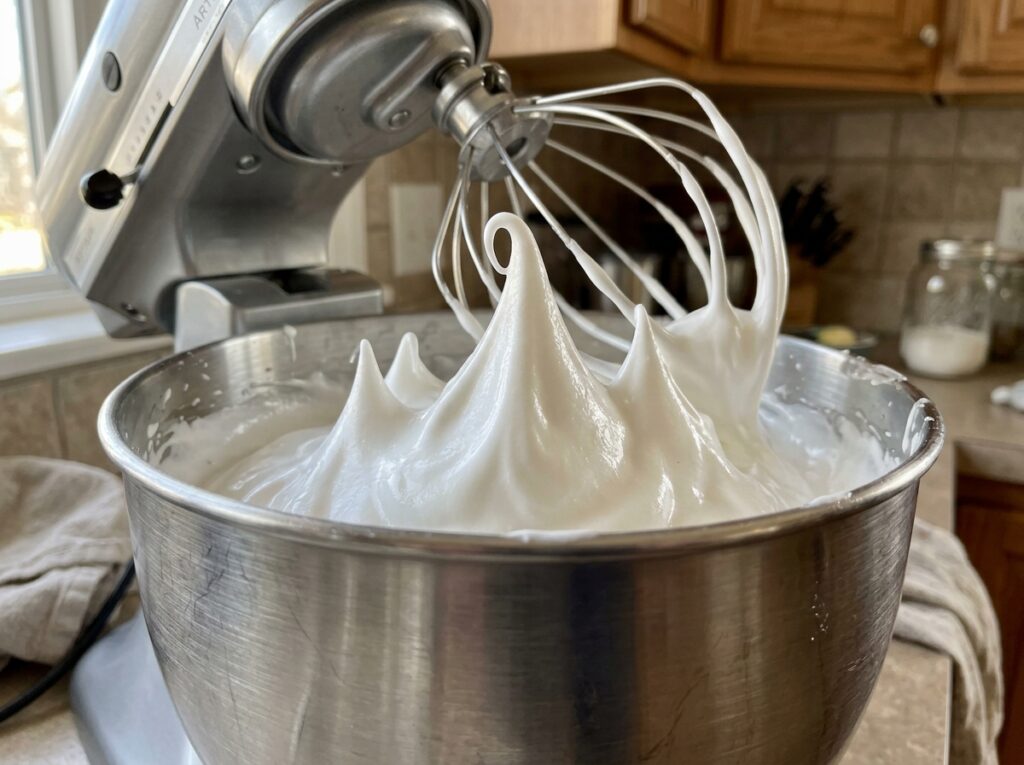
Start whipping the egg whites on medium speed until they become frothy and opaque (soft peaks), about 2–3 minutes. Once at soft peaks, begin adding the superfine sugar one tablespoon at a time while the mixer is running.
This slow addition is critical—it allows the sugar to dissolve fully into the meringue, creating a strong, stable foam. If you add sugar too fast, the meringue can deflate and will weep sugary syrup during baking. Wait about 30 seconds between each addition.
Once all the sugar is added, increase the mixer speed to medium-high and whip for another 5–7 minutes until the meringue is very thick, glossy, and holds stiff peaks. To test, stop the mixer and lift the whisk—the peak should stand straight up with only a slight curl at the tip.
The meringue should be so thick that you can rub a small amount between your fingers and feel no sugar granules—it should be completely smooth. This indicates the sugar is fully dissolved, which is the key to a stable Peach Melba Pavlova.
Step 3: The Cornstarch Fold (Creating the Marshmallowy Center)
Sift one tablespoon of cornstarch over the stiff meringue. Add one teaspoon of white vinegar and one teaspoon of vanilla extract. Using a large spatula, gently fold these ingredients into the meringue with just 8–10 careful strokes.
The vinegar makes the meringue more elastic and prevents cracking, while the cornstarch absorbs moisture and creates the soft, marshmallow-like interior.
Do not overmix—just fold until barely combined. The goal is to incorporate these stabilizers without deflating the meringue you worked so hard to build.
Step 4: Shaping and the Low-Heat Bake
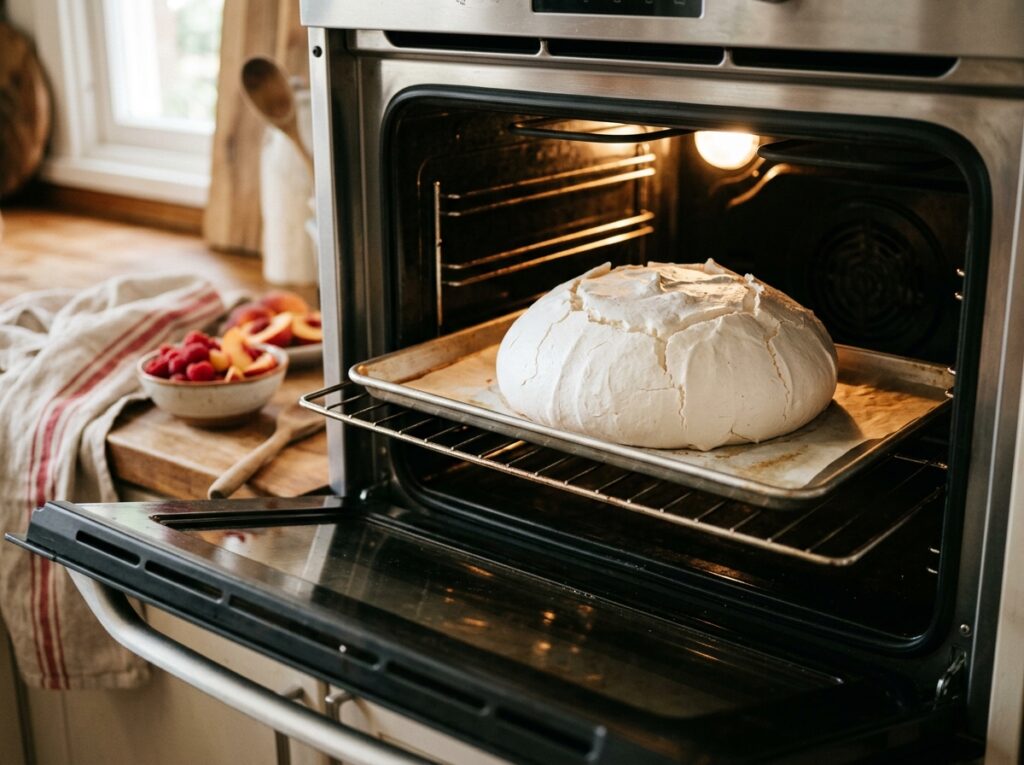
Spoon the thick, glossy meringue onto the parchment paper-lined baking sheet, using the 9-inch circle as a guide. With a spatula, shape the meringue into a thick disc, creating a slight crater in the center to hold the fruit and cream later.
Make decorative swirls or peaks around the edges. Place the Peach Melba Pavlova in the preheated 250°F (120°C) oven on the center rack. Immediately reduce the oven temperature to 225°F (110°C). Bake for 1 hour and 30 minutes.
Do NOT open the oven door during this time. When the baking time is up, turn the oven off completely. Prop the oven door open slightly with a wooden spoon and let the Peach Melba
Pavlova cool completely inside the oven for at least another hour, preferably until the oven is cool to the touch. This slow cooling process prevents thermal shock and minimizes cracking.
Step 5: The Poached Peaches (Osmosis in Action)
While the pavlova bakes and cools, prepare the peaches. In a large saucepan, combine four cups of water and one cup of sugar. If using, add a split vanilla bean. Bring to a gentle simmer over medium heat, stirring to dissolve the sugar.
Score an “X” on the bottom of each peach and blanch them in boiling water for 30 seconds, then transfer to an ice bath. The skins should peel off easily. Slice the peeled peaches into thick wedges (about 8 per peach).
Gently lower the peach slices into the simmering sugar syrup. Poach for 2–3 minutes per side until just tender but still holding their shape. Do not overcook—they should be soft but not mushy.
Remove peaches with a slotted spoon and let cool. The sugar syrup prevents the peaches from turning to pulp through osmosis.
Step 6: The Raspberry Coulis Strain (Silky Smooth Sauce)
In a small saucepan, combine 12 ounces of fresh or frozen raspberries, 1/4 cup sugar, and one tablespoon of lemon juice. Cook over medium heat, stirring occasionally, for 8–10 minutes until the raspberries break down and the sauce thickens slightly.
For a silky-smooth coulis, press the mixture through a fine-mesh sieve to remove the seeds. Let the raspberry coulis cool completely. This sauce will provide the bright, acidic punch that cuts through the sweetness of the Peach Melba Pavlova.
Step 7: Assembly (The Grand Finale)
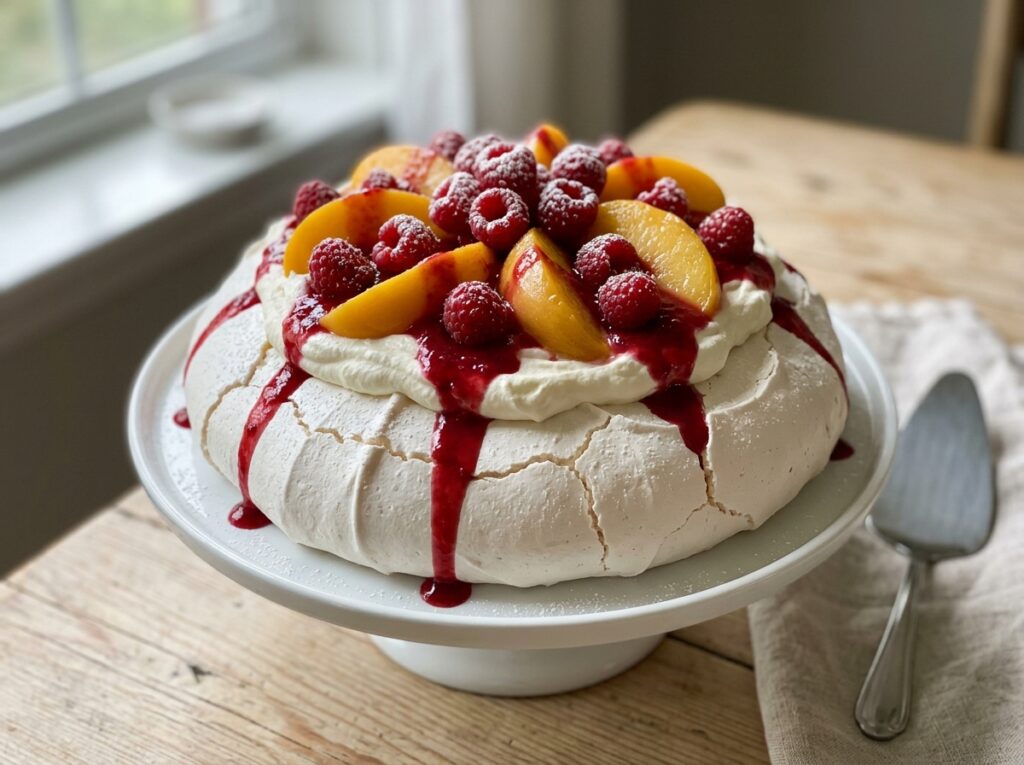
The Peach Melba Pavlova should be assembled just before serving. In a chilled bowl, whip the cold heavy cream with two tablespoons of powdered sugar until soft peaks form. Carefully transfer the cooled meringue shell to a serving platter.
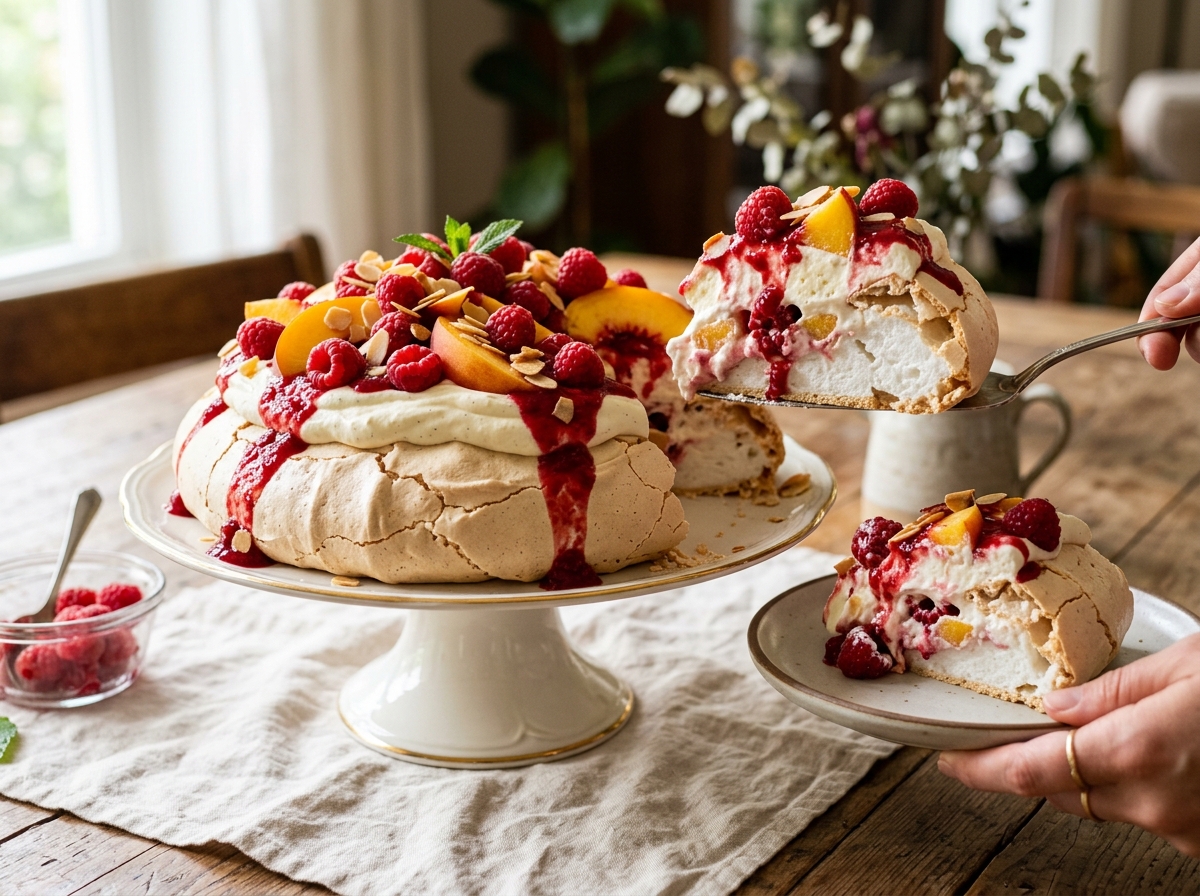
Fill the crater in the center with the whipped cream. Arrange the cooled poached peach slices and fresh raspberries over the cream.
Finally, drizzle the raspberry coulis generously over the fruit and down the sides of the meringue. Serve immediately and listen for the satisfying crackle as you slice into your masterpiece.

Peach Melba Pavlova
Ingredients
Equipment
Method
- Preheat your oven to 250°F (120°C). Line a large baking sheet with parchment paper and draw a 9-inch circle on the back as a guide. Wipe the inside of a stand mixer bowl and whisk attachment with a paper towel dampened with white vinegar to remove any grease—plastic or oil residue will prevent the meringue from whipping properly. Add 180g (6 large) room-temperature egg whites to the clean bowl.
- Using a stand mixer fitted with the whisk attachment, whip egg whites on medium speed until frothy and opaque with soft peaks (2-3 minutes). Begin adding the superfine sugar one tablespoon at a time while the mixer continues running. Wait about 30 seconds between each addition to allow the sugar to dissolve fully. This slow addition prevents weeping (syrup leaking) during baking. Once all sugar is added, increase speed to medium-high and whip for 5-7 minutes until the meringue is very thick, glossy, and holds stiff peaks. Test by lifting the whisk—the peak should stand straight up with only a slight curl at the tip. The meringue should feel completely smooth between your fingers (no sugar granules).
- Sift 1 tablespoon cornstarch over the stiff meringue. Add 1 teaspoon white vinegar and 1 teaspoon vanilla extract. Using a large spatula, gently fold these ingredients into the meringue with only 8-10 strokes. The vinegar makes the proteins more elastic (preventing cracks), while the cornstarch absorbs moisture to create the marshmallowy center. Do not overmix—fold just until combined.
- Spoon the meringue onto the parchment-lined baking sheet, using the 9-inch circle as a guide. Shape into a thick disc with a slight crater in the center (for holding fruit and cream later). Create decorative swirls or peaks around the edges. Place in the preheated oven on the center rack and immediately reduce temperature to 225°F (110°C). Bake for 1 hour 30 minutes. Do NOT open the oven door during baking.
- When baking time is complete, turn off the oven. Prop the oven door open slightly with a wooden spoon and let the Peach Melba Pavlova cool completely inside the oven for at least 1 hour (or until the oven is cool to the touch). This slow cooling prevents thermal shock and minimizes cracking.
- While the pavlova bakes and cools, prepare the peaches. Bring 4 cups water and 1 cup sugar to a gentle simmer in a large saucepan (add vanilla bean if using). Score an “X” on the bottom of each peach and blanch in boiling water for 30 seconds, then transfer to an ice bath to loosen skins. Peel and slice peaches into thick wedges. Gently lower slices into the simmering sugar syrup. Poach for 2-3 minutes per side until just tender but still holding shape. Remove with a slotted spoon and let cool. The sugar syrup prevents mushiness through osmosis.
- In a small saucepan, combine 12 oz raspberries, 1/4 cup sugar, and 1 tbsp lemon juice. Cook over medium heat for 8-10 minutes until raspberries break down and sauce thickens slightly. Press mixture through a fine-mesh sieve to remove seeds for a silky coulis. Let cool completely.
- In a chilled bowl, whip 1 1/2 cups cold heavy cream with 2 tbsp powdered sugar until soft peaks form. Carefully transfer the cooled meringue shell to a serving platter. Fill the crater with whipped cream. Arrange poached peach slices and fresh raspberries over the cream. Drizzle raspberry coulis generously over the fruit and down the sides. Serve immediately.
Notes
🧘♂️ Chef Mansoor’s Insight
The Peach Melba Pavlova is a tribute to two different kinds of artistry. It was created in the 1890s by the legendary French chef Auguste Escoffier to honor the Australian opera singer Nellie Melba, whose voice was said to be as pure and ethereal as the dessert itself.
Every time I make this pavlova, I think of that connection. The meringue shell is the architecture—the technical skill, the precise physics, the hours of practice. But the fruit, the cream, the coulis—that is the artistry.
That is the soprano’s voice, soaring over the structure, bringing life and emotion and beauty to the whole performance. This dessert teaches us that the best creations are a marriage of science and soul. It is not enough to be technically perfect. You must also make it sing.
📊 Nutrition Table (Per Serving, 10 Servings)
| Nutrient | Amount |
|---|---|
| Calories | 350 kcal |
| Total Carbohydrates | 58g |
| Total Sugars | 55g |
| Protein | 4g |
| Total Fat | 12g |
| Saturated Fat | 7g |
| Cholesterol | 50mg |
| Sodium | 45mg |
| Vitamin C | 20% DV |
| Dietary Fiber | 3g |
Estimates based on USDA data. Values vary with serving size and topping amounts.
🌡️ Food Safety Guide
Safe minimum internal temperature for egg whites (baked meringue): 160°F (71°C) — fully cooked and safe
Oven temperature for baking Peach Melba Pavlova: 225°F (110°C) for 1.5 hours
Danger zone (do not hold): 40°F–140°F (4°C–60°C)
Assembled pavlova: Due to whipped cream and fresh fruit, assemble just before serving and do not leave at room temperature for more than 2 hours.
🧊 Storage & Leftover Tips
| Component | Storage | Duration | Notes |
|---|---|---|---|
| Unfilled Meringue Shell | Room temp (airtight) | 2-3 days | Meringue is hygroscopic and will get sticky in humidity |
| Assembled Peach Melba Pavlova | Refrigerator | 1 day | The shell will soften and weep; best eaten immediately |
| Poached Peaches | Refrigerator | 5 days | Store in their poaching syrup in an airtight container |
| Raspberry Coulis | Refrigerator | 1 week | Store in an airtight jar or bottle |
| Whipped Cream | Refrigerator | 24 hours | Re-whip briefly if it deflates |
Pro Tip: Meringue hates humidity. Never store your Peach Melba Pavlova in a humid environment. If it is a rainy day, your pavlova will likely be sticky. Bake on dry days for the best results.
❓ Frequently Asked Questions
Can I make Peach Melba Pavlova without a stand mixer?
You can use a hand mixer, but it will take much longer (15–20 minutes) to reach stiff peaks, and your arm will get very tired. It is much more difficult to achieve a stable meringue with a hand mixer, but it is possible with patience.
Why did my pavlova crack?
Some cracking is normal and even desirable, giving the Peach Melba Pavlova a rustic look. Severe cracking is usually caused by (1) opening the oven door during baking, (2) baking at too high a temperature, or (3) cooling the pavlova too quickly (thermal shock). Always cool it slowly inside the turned-off oven.
Can I use a different fruit for this pavlova?
Absolutely. Pavlova is a versatile base. Classic pairings include mixed berries, passion fruit with kiwi, or tropical fruits like mango and pineapple. The “Peach Melba” version specifically requires peaches and raspberries.
Why did my meringue “weep” sticky syrup?
This happens when the sugar is not fully dissolved into the egg whites. Use superfine sugar and add it very slowly (1 tablespoon at a time) while the mixer is running. Test by rubbing a small amount of meringue between your fingers—if it feels gritty, the sugar is not dissolved.
What is the difference between a pavlova and a meringue?
A pavlova has a crisp outer shell and a soft, marshmallow-like interior, achieved by adding cornstarch and vinegar. A standard meringue is crisp and dry all the way through, like a meringue cookie.
Can I make the meringue shell ahead of time?
Yes. You can bake the meringue shell up to two days in advance. Let it cool completely, then store it in an airtight container at room temperature in a dry, non-humid place. Assemble the Peach Melba Pavlova just before serving.
Why is my pavlova brown instead of white?
Your oven temperature was too high. The goal of a Peach Melba Pavlova is to dry it out at a low temperature, not to bake or brown it. Use an oven thermometer to verify your oven is at the correct low temperature (225°F / 110°C).
🔗 More from Flavour Bazar
If the Peach Melba Pavlova inspired your inner pastry scientist, explore these other technical bakes:
French Buttercream Macarons: The Physics of the Perfect Foot
Deep dive into egg white meringue and emulsification
The Perfect Chocolate Chip Cookie: The Science of Chewy vs. Crispy
Master Maillard reaction and sugar ratios
Blueberry Buttermilk Pancakes: The Science of the Fluff
Learn acid-base leavening chemistry
Buttermilk Biscuits: The Science of Flaky Layers
Cold fat lamination and gluten control
Strawberry Shortcake: The Science of the Perfect Crumb
Fat-gluten interaction in tender baking
Outbound Link (Authority Building):
The Historical Origin of the Peach Melba (Food & Wine)
Learn the story behind Auguste Escoffier’s tribute to Nellie Melba
For More Healthy Recipes Visit: flavourbazar.com