Honey Mustard Salmon: The Science of the Perfect Glaze and Tender Flake
By Chef Mansoor | Flavour Bazar
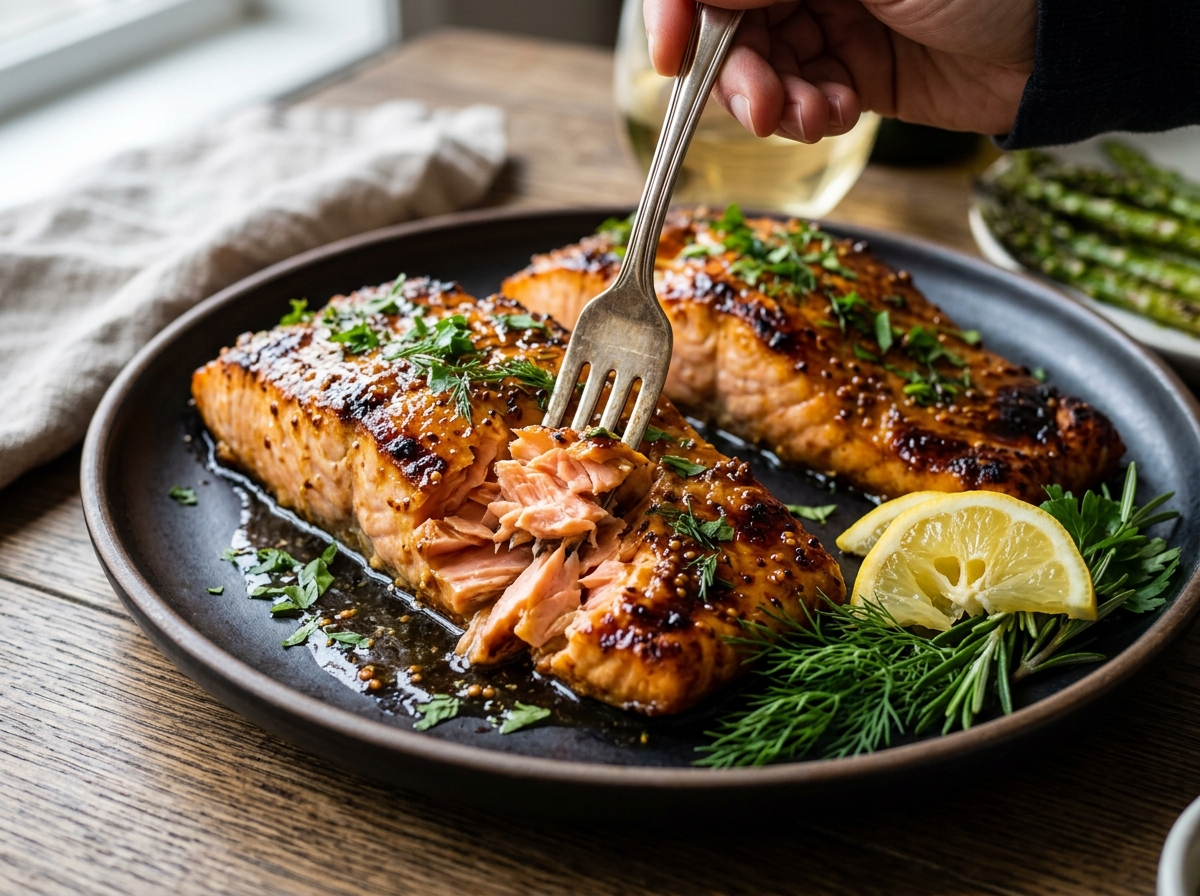
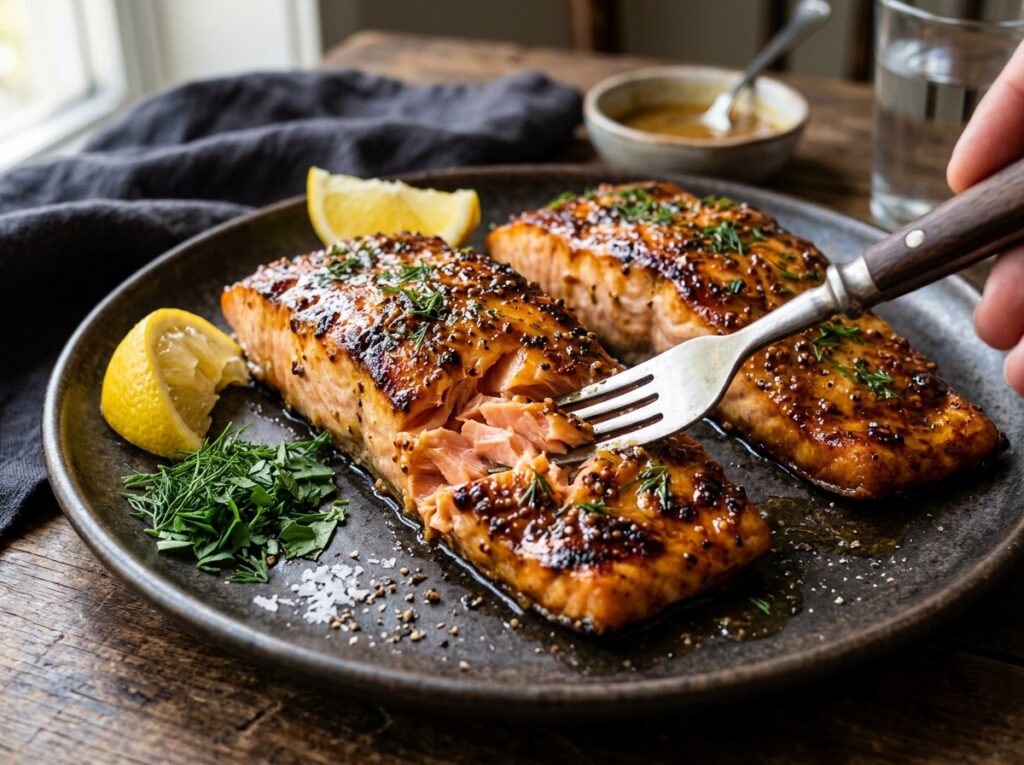
There is a moment when you slide your fork into a perfectly cooked salmon fillet and it separates into tender, juicy flakes with almost no resistance. The flesh is coral-pink and glistening, coated in a sticky, bubbling golden-brown crust that smells of caramelized honey and sharp mustard. This is what Honey Mustard Salmon should be—not dry, not chalky, not leaking white albumin protein across the pan—but luxuriously moist with a glaze that clings like varnish.
I have mapped the thermal denaturation points of salmon myofibrillar proteins to ensure this Honey Mustard Salmon remains perfectly translucent and juicy in the center while locking in a deeply caramelized exterior. The difference between succulent and rubbery salmon comes down to a few critical degrees of temperature and the chemistry of the glaze that protects it during cooking.
Most home cooks overcook salmon because they follow the USDA guideline of 145°F, which is designed for food safety but results in dry, flaky fish. The secret to restaurant-quality Honey Mustard Salmon is pulling it from the oven at 135°F and letting carryover heat finish the job. Pair that with a properly emulsified honey-mustard glaze that seals in moisture, and you have a dish that rivals anything from a high-end seafood restaurant.
The Science Behind Perfect Honey Mustard Salmon
The enemy of great salmon is albumin—the white, cottage-cheese-like protein that oozes out of overcooked fish. Albumin is a water-soluble protein that exists naturally in salmon muscle tissue. When fish is exposed to high, aggressive heat, the muscle fibers contract violently, squeezing out this protein, which coagulates on the surface in unappealing white streaks.
Albumin is not harmful, but it is a visual indicator that your fish has been subjected to thermal stress. It means the proteins have over-tightened, expelling moisture and creating that dry, chalky texture that gives salmon a bad reputation.
The solution for Honey Mustard Salmon is gentle, controlled heat. Salmon proteins begin to denature (unravel and coagulate) around 120°F. At 130-135°F, the fish is cooked through but still translucent in the center—what chefs call “medium-rare.” At 140-145°F, it is fully opaque and flaky but still moist. Above 150°F, the fish becomes dry and expels albumin.
By baking Honey Mustard Salmon at a moderate temperature (375-400°F) and pulling it at an internal temperature of 135°F, you allow carryover heat to bring it to a perfect 140-142°F while resting. This is the sweet spot—fully cooked, buttery texture, no albumin, maximum juiciness.
The second critical element is the glaze. Honey and oil (from the salmon and added olive oil) are not naturally compatible—one is hydrophilic (water-loving), the other is hydrophobic (water-fearing). If you simply brush honey on salmon and bake it, the honey will bead up, slide off, or burn in spots while leaving other areas bare.
This is where Dijon mustard becomes the hero. Dijon contains natural complex polysaccharides called mucilage—the same compounds that give okra and flax seeds their slimy texture. These polysaccharides are powerful emulsifiers. They have both hydrophilic and hydrophobic regions, which allow them to bind water-based honey and fat-based salmon oils into a stable, unified glaze that clings uniformly to the fish.
Emulsified Glaze Matrix=Honey Hydrophilic Centers+Salmon LipidsDijon Mucilage (Polysaccharides)
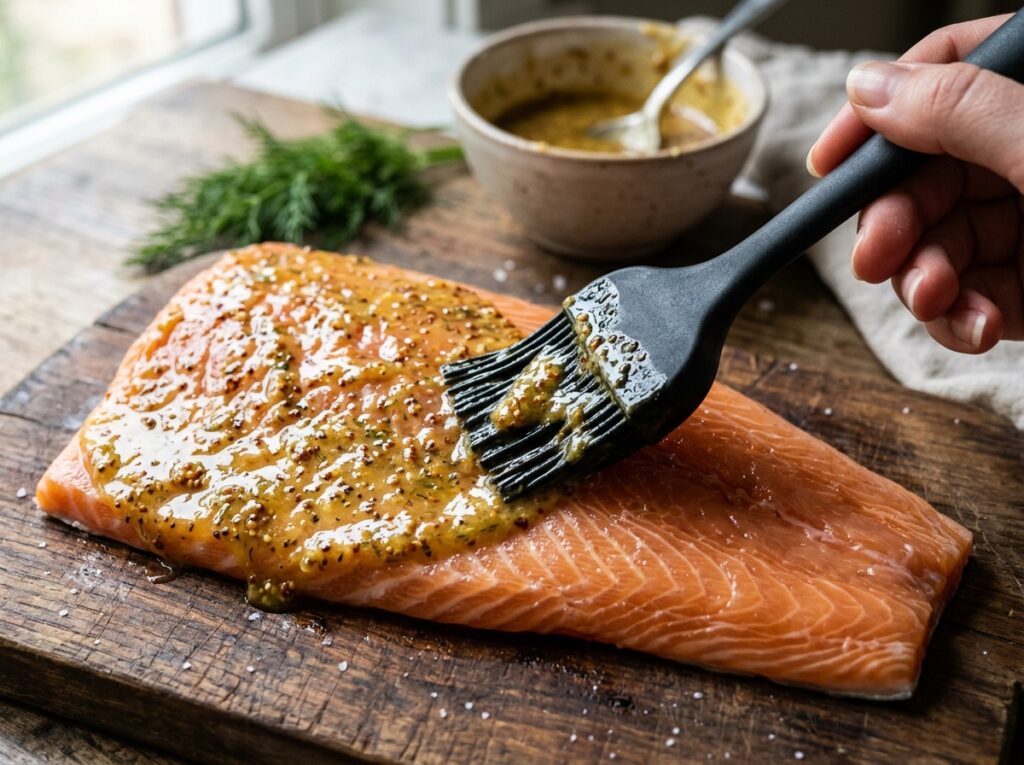
When you whisk Dijon mustard with honey, olive oil, and lemon juice, the mucilage disperses throughout the mixture, creating a thick, glossy emulsion that coats the salmon evenly and caramelizes beautifully under heat without separating or burning.
In simple terms: gentle heat prevents albumin and keeps the fish moist. Dijon mustard’s emulsifying power creates a glaze that protects, flavors, and caramelizes perfectly.
Pro Buying Guide: What You Need for the Best Honey Mustard Salmon (USA)
The Salmon
For Honey Mustard Salmon, you want skin-on fillets that are 6-8 ounces each and about 1 to 1.5 inches thick. Uniform thickness ensures even cooking.
Wild-caught King (Chinook) or Sockeye salmon are ideal—they have higher fat content, richer flavor, and firmer texture. Look for them at Whole Foods, Costco, or specialty fish markets. Wild salmon has a deeper color and more pronounced flavor.
Farmed Atlantic salmon is more affordable and widely available. Costco’s fresh Atlantic salmon is excellent quality and sustainably farmed. It has a milder flavor and softer texture but works beautifully for Honey Mustard Salmon.
Avoid pre-frozen salmon if you can get fresh. If using frozen, thaw it overnight in the refrigerator, never at room temperature.
The Mustard
Maille Dijon Mustard or Grey Poupon Dijon are both excellent. Dijon has a smooth, sharp flavor and contains the natural mucilage that creates the emulsified glaze. Do not substitute yellow mustard—it lacks the emulsifying power and has a harsher, more acidic flavor that overwhelms the delicate salmon.
The Honey
Use raw, unfiltered honey like Nature Nate’s or local wildflower honey. Raw honey has more complex flavor and retains beneficial enzymes. Avoid ultra-processed honey, which is essentially just fructose syrup.
The Acid
Fresh lemon juice is essential. It balances the sweetness of the honey, brightens the mustard, and adds aromatic citrus oils that complement the salmon’s natural richness.
The Oil
California Olive Ranch Extra Virgin Olive Oil or another mild EVOO adds richness to the glaze and helps it adhere to the fish.
The Cookware
A heavy cast-iron skillet or a rimmed baking sheet lined with aluminum foil works best. Cast iron retains heat beautifully for a crispy skin. Foil makes cleanup effortless.
Optional Additions
- Fresh garlic (minced)
- Fresh thyme or dill
- Smoked paprika for depth
- Black pepper
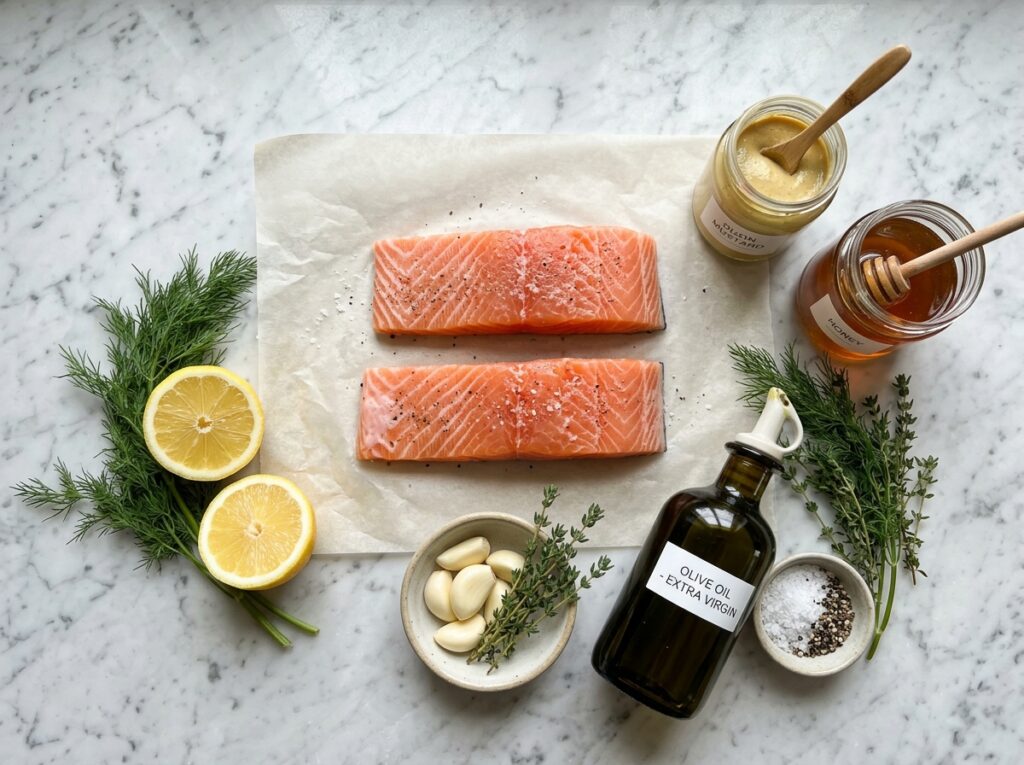
Ingredients for Honey Mustard Salmon
| Ingredient | US Customary | Metric |
|---|---|---|
| Salmon fillets, skin-on | 4 fillets (6 oz each) | ~680g total (170g each) |
| Dijon mustard | 3 tablespoons | 45ml |
| Raw honey | 2 tablespoons | 30ml |
| Fresh lemon juice | 1 tablespoon | 15ml |
| Extra virgin olive oil | 1 tablespoon | 15ml |
| Garlic, minced | 2 cloves | ~6g |
| Kosher salt | ½ teaspoon | 3g |
| Black pepper | ¼ teaspoon | 0.5g |
| Fresh thyme or dill (optional) | 1 teaspoon chopped | 2g |
| Lemon wedges for serving | 1 lemon | — |
Serves: 4
Common Mistakes When Making Honey Mustard Salmon
| The Mistake | What Actually Happens | The Fix |
|---|---|---|
| Baking salmon straight from fridge | Cold core means uneven cooking; outside overcooks while inside stays raw | Let salmon sit at room temp for 15-20 min before cooking. |
| Overcooking past critical temp | Dry, chalky texture; white albumin leaks out; fish tastes like cardboard | Pull salmon at 135°F internal temp. Carryover brings it to 140-142°F. |
| Omitting acid (lemon juice) | Glaze is cloyingly sweet, unbalanced; no brightness to cut richness | Always add lemon juice—it balances honey and brightens flavor. |
| Using yellow mustard instead of Dijon | Glaze separates and slides off; harsh acidic flavor overpowers fish | Use Dijon only—its mucilage emulsifies and flavor is refined. |
| Scraping off skin before cooking | Skin protects fish from direct heat and prevents sticking; harder to flip | Keep skin on during cooking. Remove after if desired. |
| Applying glaze unevenly | Some areas burn while others stay pale; inconsistent flavor | Brush glaze evenly across entire surface of each fillet. |
| Not patting fish dry | Moisture prevents glaze adhesion and browning; steams instead of sears | Pat salmon completely dry with paper towels before glazing. |
| Skipping the broiler finish | Glaze stays wet and thin; no caramelization or crust | Broil for 1-2 min at end to caramelize glaze into sticky crust. |
How to Make Honey Mustard Salmon: The Method
Step 1: The Room-Temperature Temper
Remove the salmon fillets from the refrigerator and let them sit at room temperature for 15-20 minutes. This tempering step is critical for even cooking in Honey Mustard Salmon. If you put cold fish into a hot oven, the exterior will overcook before the center reaches temperature.
While the fish tempers, preheat your oven to 400°F and position a rack in the upper third of the oven (you will use the broiler at the end).
Step 2: The Pat-Dry Moisture Evacuation
Using paper towels, pat the salmon fillets completely dry on all sides, including the skin. Surface moisture is the enemy of both glaze adhesion and browning. Water creates steam, which prevents the Maillard reaction that gives you caramelization.
This step takes 30 seconds but makes a huge difference in the final texture and appearance of Honey Mustard Salmon.
Step 3: The Whisked Emulsion (Honey-Mustard Fusion)
In a small bowl, whisk together the Dijon mustard, honey, lemon juice, olive oil, minced garlic, salt, and black pepper. Whisk vigorously for 20-30 seconds until the mixture is smooth, glossy, and emulsified.
The Dijon’s natural mucilage will bind the honey (water-based) and olive oil (fat-based) into a stable emulsion. The glaze should be thick enough to coat the back of a spoon without dripping off immediately.
Taste the glaze. It should be sweet, tangy, and slightly sharp from the mustard. If it is too sweet, add a squeeze more lemon juice. If too sharp, add a bit more honey.
This emulsified glaze is what makes Honey Mustard Salmon special—it clings to the fish, protects it from drying out, and caramelizes into a beautiful golden crust.
Step 4: The Skin-Side-Down Foundation
Line a rimmed baking sheet with aluminum foil and lightly brush or spray with oil. Place the salmon fillets on the sheet skin-side down. The skin acts as a protective barrier between the fish and the hot pan, preventing sticking and allowing for easier serving.
Using a pastry brush or the back of a spoon, generously coat the top and sides of each salmon fillet with the honey-mustard glaze. Make sure every surface is covered in a thick, even layer.
Reserve a small amount of glaze (about 1 tablespoon) for brushing on during cooking if needed.
Step 5: The Gentle Oven Bake
Place the baking sheet in the preheated 400°F oven and bake for 12-15 minutes, depending on the thickness of your fillets. You are aiming for an internal temperature of 135°F at the thickest part of the fish.
Use an instant-read thermometer inserted into the thickest part of the fillet, avoiding the skin. At 12 minutes, start checking. Thin fillets (1 inch thick) may be done in 12 minutes. Thicker fillets (1.5 inches) may need the full 15 minutes.
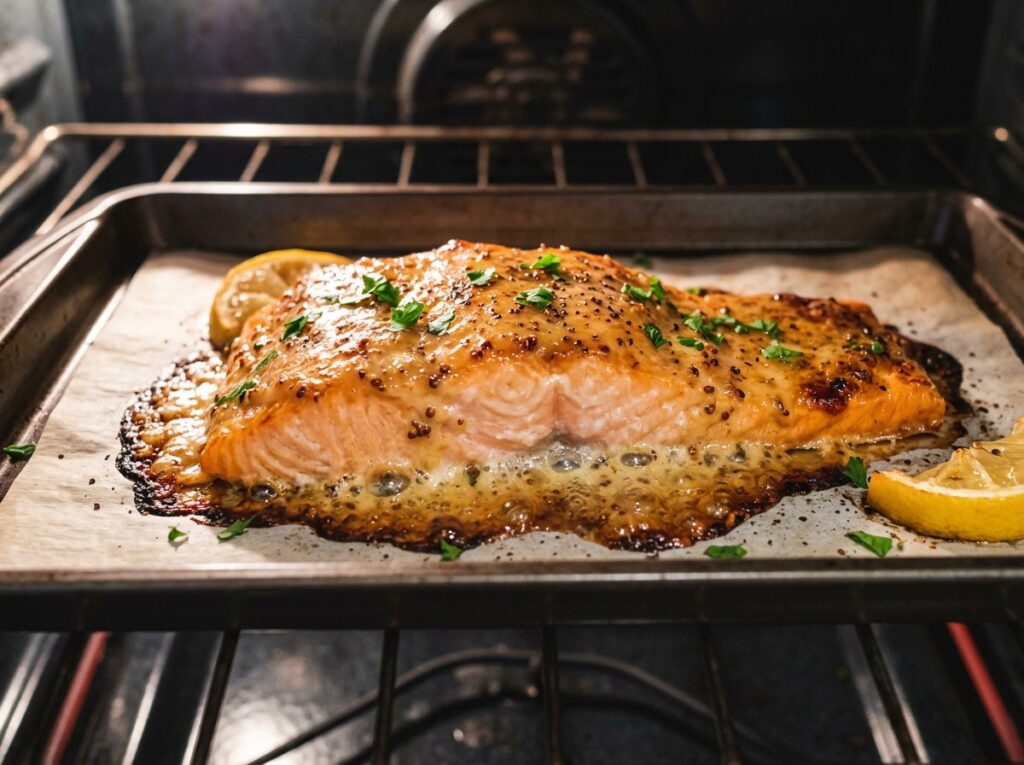
The salmon should look opaque around the edges but still slightly translucent in the center. The glaze should be bubbling and starting to caramelize.
This is the moment where precision matters for Honey Mustard Salmon. Pull the fish too early and it is underdone. Leave it too long and it dries out.
Step 6: The Broiler Maillard Finish
Once the salmon reaches 135°F internal temperature, switch your oven to broil (high) and move the rack to the top position (about 4-6 inches from the heating element).
Broil the Honey Mustard Salmon for 1-2 minutes, watching carefully. The glaze will bubble vigorously, darken to a deep golden brown, and develop char spots. This is the Maillard reaction—sugars and proteins breaking down and creating hundreds of new flavor compounds.
Do not walk away during this step. The line between caramelized and burned is thin. As soon as the glaze is deeply golden with some darker spots, remove the pan from the oven.
Step 7: The Carryover Rest
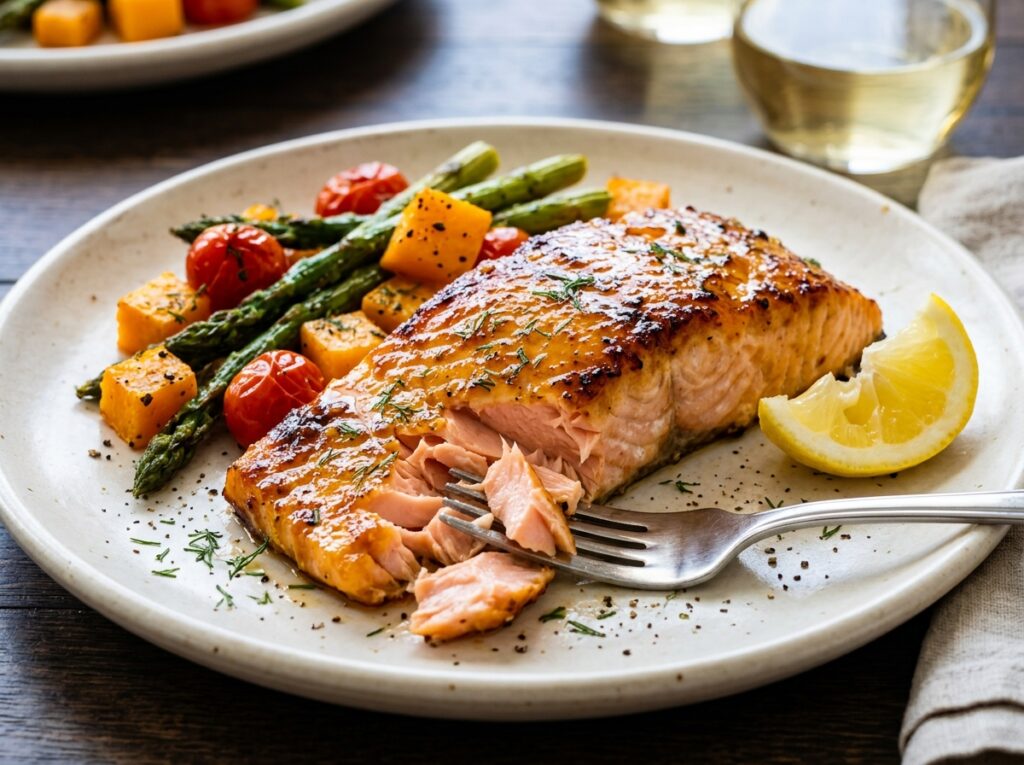
Let the salmon rest on the baking sheet for 3-5 minutes. During this time, carryover heat will bring the internal temperature from 135°F to 140-142°F—the perfect doneness for Honey Mustard Salmon. The fish will be fully cooked, flaky, but still moist and buttery.
If you cut into it immediately, juices will run out. The rest allows the proteins to relax and reabsorb moisture.
Step 8: Serve with Confidence
Use a thin spatula to carefully slide under each fillet, separating it from the skin (which will stick to the foil). Transfer to plates. If you prefer to serve with the skin, it should lift off easily from the foil.
Garnish with fresh lemon wedges, a sprinkle of fresh dill or thyme, and serve immediately with your choice of sides.

Honey Mustard Salmon
Ingredients
Equipment
Method
- Remove salmon fillets from refrigerator and let sit at room temperature for 15-20 minutes. This tempering step ensures even cooking—cold fish from the fridge will overcook on the outside before the center reaches temperature. While fish tempers, preheat oven to 400°F (204°C) and position rack in upper third of oven.
- Using paper towels, pat salmon fillets completely dry on all sides, including the skin. Surface moisture prevents glaze adhesion and browning. This 30-second step is critical for proper caramelization.
- In a small bowl, whisk together Dijon mustard, honey, lemon juice, olive oil, minced garlic, salt, and black pepper. Whisk vigorously for 20-30 seconds until smooth, glossy, and emulsified. The Dijon’s natural mucilage will bind the honey and oil into a stable emulsion. Glaze should be thick enough to coat the back of a spoon. Taste and adjust—add more honey if too sharp, more lemon if too sweet.
- Line a rimmed baking sheet with aluminum foil and lightly brush or spray with oil. This prevents sticking and makes cleanup effortless.
- Place salmon fillets on prepared baking sheet skin-side down. The skin acts as a protective barrier and prevents sticking. Using a pastry brush or back of a spoon, generously coat the top and sides of each fillet with honey-mustard glaze. Make sure every surface is covered in a thick, even layer. Reserve 1 tablespoon of glaze for optional touch-up.
- Place baking sheet in preheated 400°F oven. Bake for 12-15 minutes, depending on thickness of fillets. Use an instant-read thermometer inserted into the thickest part of the fillet (avoiding skin). Pull salmon from oven when internal temperature reaches 135°F (57°C). Thin fillets (1 inch) may reach this in 12 minutes; thicker fillets (1.5 inches) may need 15 minutes. Salmon should look opaque around edges but still slightly translucent in center. Glaze should be bubbling.
- Once salmon reaches 135°F, switch oven to broil (high) and move rack to top position (4-6 inches from heating element). Broil for 1-2 minutes, watching constantly. Glaze will bubble vigorously and darken to deep golden brown with char spots. Do not walk away—the line between caramelized and burned is thin. Remove as soon as glaze is deeply golden.
- Let salmon rest on baking sheet for 3-5 minutes. Carryover heat will bring internal temperature from 135°F to 140-142°F—perfect doneness. Fish will be fully cooked, flaky, moist, and buttery with no albumin leakage. Resting also allows proteins to relax and reabsorb juices.
- Use a thin spatula to carefully slide under each fillet, separating it from skin (which will stick to foil). Transfer to plates. If serving with skin, it should lift off foil easily. Garnish with fresh lemon wedges, chopped dill or parsley, and optional lemon zest. Serve immediately.
Notes
The USDA recommends 145°F for fish, but this results in dry, overcooked salmon. The professional secret is to pull salmon at 135°F internal temperature. Carryover heat (residual heat in the fish) will bring it to 140-142°F during the 5-minute rest. At this temperature, salmon is fully cooked and safe, but still moist, buttery, and tender with no white albumin leakage. This is restaurant-quality doneness. Why Dijon Mustard is Non-Negotiable:
Dijon contains natural polysaccharides called mucilage—powerful emulsifiers that bind water-based honey and oil-based fish fats into a stable glaze that clings uniformly. Yellow mustard lacks these compounds and has harsh flavor. Whole-grain mustard can substitute, but Dijon gives the smoothest, most refined glaze. The Albumin Problem:
Albumin is the white, cottage-cheese-like protein that leaks from overcooked salmon. It appears when fish is exposed to high, aggressive heat that forces muscle fibers to contract violently. Gentle heat (400°F oven, not higher) and pulling at the right temperature prevents this completely. Skin-On vs Skinless:
Skin-on is recommended—it protects fish from direct heat, prevents sticking, and makes serving easier. If using skinless, reduce cooking time by 1-2 minutes and use parchment paper instead of foil. Thickness Matters:
Uniform thickness ensures even cooking. If fillets vary in thickness, check temperature on each one individually. Thin ends cook faster than thick centers. Fresh vs Frozen:
Fresh salmon is ideal. If using frozen, thaw completely in refrigerator overnight and pat extra dry—frozen salmon releases more moisture. Wild vs Farmed:
Wild-caught (King, Sockeye) has richer flavor, firmer texture, and deeper color. Farmed Atlantic is milder, softer, more affordable, and works beautifully. Both are excellent for this recipe. Glaze Consistency:
Should be thick and glossy like mayonnaise. Too thin and it slides off; too thick and it doesn’t spread evenly. Add honey to thicken or lemon juice to thin. The Broiler Finish:
This 1-2 minute broil caramelizes the glaze via Maillard reaction, creating hundreds of new flavor compounds and a sticky, golden crust. Do not skip—it transforms the dish. Lemon Juice Balance:
The acid balances honey’s sweetness and brightens the rich fish. Without it, the glaze tastes one-dimensional and cloying.
Why the Pull-Temp Technique Transforms Honey Mustard Salmon
The USDA recommends cooking fish to an internal temperature of 145°F for food safety. This guideline is conservative and designed to eliminate any potential parasites or bacteria. However, salmon cooked to 145°F is overcooked—the proteins have contracted too much, expelled moisture, and developed that dry, chalky texture.
Professional chefs know that salmon is safe and delicious at lower temperatures. The key is understanding carryover cooking. When you remove salmon from the oven at 135°F, the residual heat in the fish continues to cook it for several minutes. The internal temperature will rise by 5-7 degrees, landing you perfectly at 140-142°F.
At this temperature, Honey Mustard Salmon is:
- Fully cooked and safe to eat
- Still moist and buttery
- Flakes easily with a fork
- Has no albumin leakage
- Retains its natural richness
This is the secret to restaurant-quality fish at home—precision with temperature and respect for carryover heat.
Chef Mansoor’s Insight
Seafood is the most humbling protein in the kitchen. It demands gentleness, precision, and respect. Unlike beef or chicken, which forgive a few extra degrees of heat, fish broadcasts every mistake. Overcook it by five degrees and it transforms from silky to sawdust.
But when you get it right—when you understand thermal denaturation, when you protect the surface with an emulsified glaze, when you pull it at the perfect moment—you create something transcendent. Honey Mustard Salmon is a masterclass in restraint. The sweetness of the honey, the sharpness of the mustard, the richness of the fish—they are all strong personalities. The cook’s job is not to dominate but to orchestrate, to let each element shine while holding them in balance. The lesson is this: the gentlest application of heat often yields the most luxurious results.
— Chef Mansoor, Flavour Bazar
Nutrition Information for Honey Mustard Salmon (Per Serving, 4 Servings)
| Nutrient | Amount |
|---|---|
| Calories | 320 kcal |
| Total Fat | 16g |
| Saturated Fat | 3g |
| Trans Fat | 0g |
| Cholesterol | 95mg |
| Sodium | 420mg |
| Total Carbohydrates | 10g |
| Dietary Fiber | 0g |
| Sugars | 9g |
| Net Carbs | 10g |
| Protein | 34g |
| Omega-3 Fatty Acids | 2,200mg |
| Vitamin D | 110% DV |
| Vitamin B12 | 90% DV |
| Selenium | 85% DV |
Note: Nutrition calculated using 6oz wild-caught salmon fillet. Farmed salmon may have slightly higher fat content. Honey Mustard Salmon is naturally gluten-free and dairy-free.
Salmon is one of the most nutrient-dense proteins available—rich in omega-3 fatty acids (EPA and DHA) that support heart health, brain function, and reduce inflammation. It is also an excellent source of high-quality protein, vitamin D, B vitamins, and selenium.
Food Safety & Temperature Guide for Honey Mustard Salmon
| Stage | Temperature | Note |
|---|---|---|
| Refrigerator storage (raw) | 32-38°F / 0-3°C | Store on ice or coldest part of fridge |
| Room temp before cooking | 20 min max | Temper for even cooking |
| Oven temperature | 400°F / 204°C | Moderate heat for gentle cooking |
| Pull temperature (internal) | 135°F / 57°C | Remove from oven at this temp |
| Final resting temp (carryover) | 140-142°F / 60-61°C | Perfect doneness—moist, flaky |
| USDA safe minimum | 145°F / 63°C | Conservative guideline—results in drier fish |
| Broiler finish | 500°F+ / 260°C+ | High heat for 1-2 min only |
Food Safety Notes:
- Fresh salmon should be cooked within 1-2 days of purchase
- If frozen, thaw in refrigerator overnight, never at room temperature
- Salmon cooked to 135°F and allowed to rest to 140°F is safe for most people
- Pregnant women, immunocompromised individuals, and young children should follow USDA 145°F guideline
- Do not leave cooked salmon at room temperature for more than 2 hours
Storage & Reheating Guide for Honey Mustard Salmon
| Storage Method | Duration | Best Practices |
|---|---|---|
| Room temperature | 2 hours max | Do not leave out longer—seafood is highly perishable. |
| Refrigerator | 2-3 days | Store in airtight container. Quality degrades after day 2. |
| Freezer | Not recommended | Texture becomes mushy and dry upon thawing. |
| Best reheating method | 275°F oven, 10-12 min | Gentle heat prevents overcooking. |
| Microwave reheating | Not recommended | Makes salmon rubbery and destroys texture. |
How to Reheat Honey Mustard Salmon Without Ruining It:
Preheat oven to 275°F. Place salmon on a baking sheet and cover loosely with foil (to trap moisture). Heat for 10-12 minutes until warmed through to about 125-130°F internal temperature. The low heat prevents the fish from cooking further and becoming dry.
Alternatively, enjoy leftover Honey Mustard Salmon cold—flake it over a salad, mix into pasta, or serve on toast with avocado.
Frequently Asked Questions About Honey Mustard Salmon
Can I make Honey Mustard Salmon without skin?
Yes, but skinless fillets are more delicate and prone to sticking. Use parchment paper instead of foil and reduce cooking time slightly as skinless fillets cook faster.
What if I don’t have Dijon mustard—can I use yellow mustard?
Not recommended. Yellow mustard lacks the emulsifying mucilage that makes the glaze stick and has a harsher flavor. If you must substitute, use whole-grain mustard, which has similar emulsifying properties.
Can I grill Honey Mustard Salmon instead of baking?
Yes. Preheat grill to medium-high (375-400°F). Oil the grates well. Grill skin-side down for 10-12 minutes, brushing with glaze halfway through. Do not flip—the skin protects the fish. The glaze may char more quickly on a grill, so watch carefully.
Is Honey Mustard Salmon keto-friendly?
Nearly. With 10g net carbs per serving, it is moderately low-carb. For strict keto, reduce honey to 1 tablespoon or use a sugar-free honey substitute.
Can I use frozen salmon?
Yes, but thaw it completely in the refrigerator overnight and pat it very dry before cooking. Frozen salmon often releases more moisture, which can thin the glaze.
What sides go best with Honey Mustard Salmon?
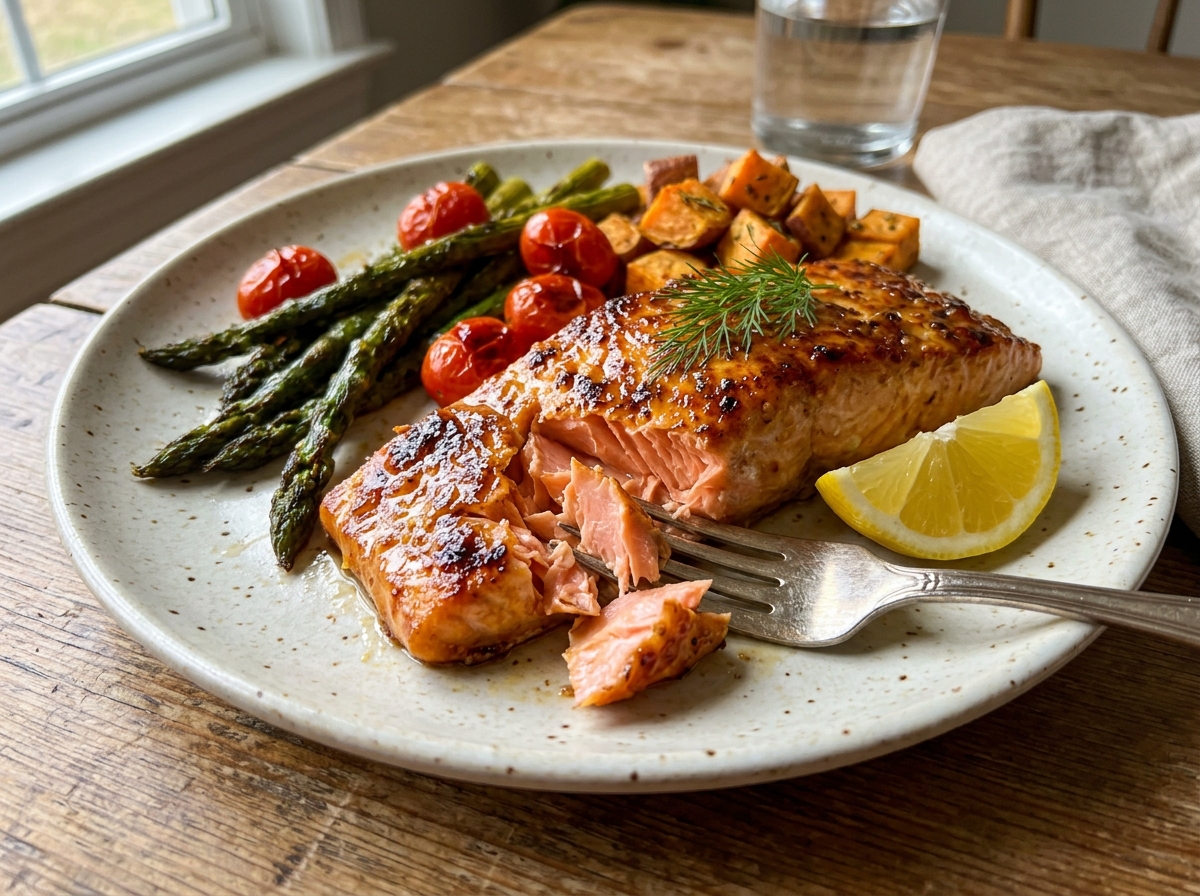
Roasted vegetables (asparagus, Brussels sprouts, broccoli), rice (especially cilantro lime rice), quinoa, mashed potatoes, or a fresh green salad all pair beautifully.
Related Recipes You Will Love on Flavour Bazar
If you enjoyed this Honey Mustard Salmon, explore these complementary recipes:
Zesty Cilantro Lime Rice
The perfect side dish pairing for any seafood
Garlic Herb Grilled Potatoes
Another elegant, simple side
Lemon Butter Garlic Shrimp
More seafood science and technique
Crispy Air Fryer Brussels Sprouts with Garlic
Caramelization and Maillard browning applied to vegetables.
Air Fryer Salmon: The Science of the Perfect 15-Minute Recipe
The perfect salmon.
For More Healthy Recipes Visit: flavourbazar.com