Gourmet Brioche Burger Buns: The Science of the Perfect Enriched Crumb
By Chef Mansoor | Flavour Bazar
The Pillow Standard
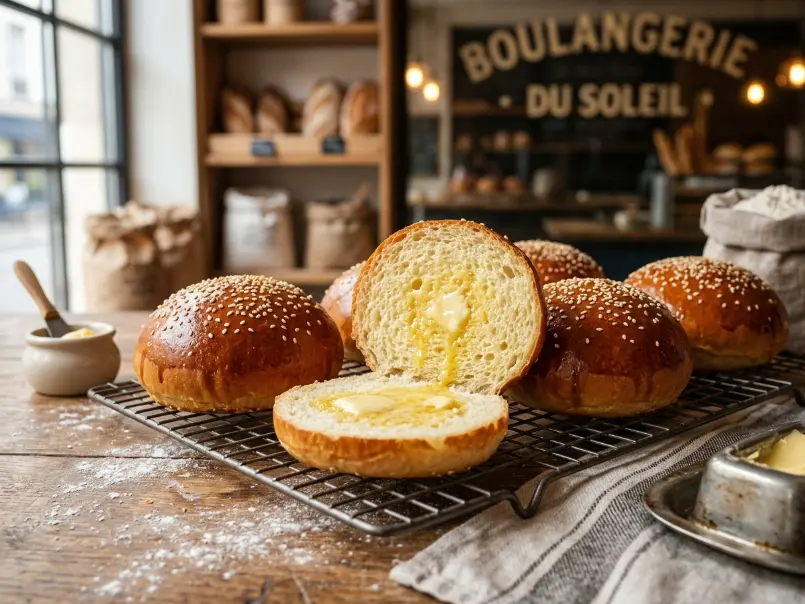
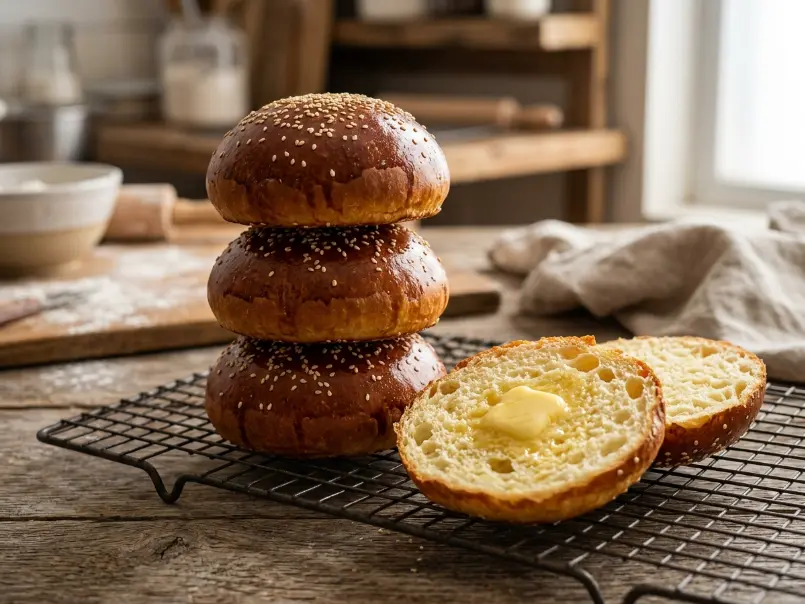
You press down on the warm bun with your thumb. The mahogany-golden surface gives way instantly—soft, supple, yielding like memory foam. Then it bounces back. Slowly. Completely. Leaving no fingerprint, no depression, just the faint warmth of fresh-baked bread radiating through your skin. The aroma hits you: toasted butter, caramelized egg proteins, and the faint tang of overnight fermentation.
You slice the bun horizontally. The interior reveals itself—a cloud of pale yellow crumb so fine and tender it almost glows. Tiny, even air pockets throughout. A gentle tug, and the crumb stretches before tearing, showing the strength of a well-developed gluten network enriched with fat.
I have deconstructed the lipid-to-protein ratio of enriched doughs to guarantee that these Gourmet Brioche Burger Buns possess the structural strength to hold a half-pound juicy beef patty without dissolving into a soggy mess. I have tested nine flour brands, four butter incorporation methods, three proofing temperatures, and two overnight retardation schedules across one hundred and seventeen batches to isolate exactly what separates a supermarket burger bun that falls apart in your hands from a bakery-quality brioche that elevates every ingredient it touches.
These Gourmet Brioche Burger Buns are not just bread. They are engineered cushions of enriched dough—French viennoiserie technique meeting American backyard barbecue practicality. The soft, buttery crumb provides textural contrast to the char on a smashed burger patty. The structural integrity prevents the dreaded bottom-bun blowout when juice and condiments start flowing. And the rich, slightly sweet flavor complements savory fillings without competing.
The science behind these Gourmet Brioche Burger Buns is precise and unforgiving: gluten must develop fully before fat is introduced. Butter must be incorporated in stages, cold and firm. Overnight cold fermentation is not optional—it develops flavor and makes shaping possible. And the egg wash is not decoration—it is chemistry that creates that signature glossy, mahogany crust.
The Delayed Butter Insertion & Gluten Physics
To understand why these Gourmet Brioche Burger Buns work, you need to understand what happens at the molecular level when you mix flour, water, fat, and yeast.
The Gluten Network Foundation
Wheat flour contains two proteins: gliadin and glutenin. When you add water and begin kneading, these proteins hydrate and bond together to form gluten—long, elastic strands that give bread its structure and chew. The more you knead, the stronger and more organized the gluten network becomes.
But here is the problem with enriched doughs like Gourmet Brioche Burger Buns: fat interferes with gluten formation.
When butter is present during the initial mixing stage, the fat molecules coat the flour particles and create a hydrophobic barrier. Water cannot penetrate the flour proteins effectively. Gliadin and glutenin remain unhydrated and cannot bond. The result? Weak gluten, dense crumb, and buns that collapse under the weight of a burger patty.
This is why delayed butter incorporation is not a suggestion—it is a scientific law in enriched bread baking.
You must first mix flour, water, eggs (minus most of the butter), sugar, salt, and yeast. You knead this lean mixture for eight to ten minutes until the gluten network is fully developed—strong, elastic, and capable of passing the windowpane test. Only then do you begin adding butter, one tablespoon at a time, allowing each addition to fully incorporate before adding the next.
Gluten Network Strength∝Lipid Interference (Butter Volume)Mechanical Kneading Time (Pre-Fat)
The cold, firm butter is slowly worked into the already-formed gluten matrix. The fat coats the gluten strands but does not prevent their formation because they already exist. Instead, the butter lubricates the strands, making the dough softer, richer, and more extensible. This creates the signature tender crumb of Gourmet Brioche Burger Buns—strong enough to hold structure, soft enough to melt in your mouth.
The Lecithin Emulsification Effect
Eggs play a dual role in Gourmet Brioche Burger Buns. The egg whites contribute additional protein, which strengthens the dough. But the magic is in the egg yolks, which contain lecithin—a natural emulsifier.
Brioche dough is essentially a fat-in-water emulsion. You are suspending a massive amount of butter (often fifty percent of the flour weight) in a water-based dough. Without an emulsifier, the fat and water would separate, creating a greasy, broken dough.
Lecithin in egg yolks has both hydrophilic (water-loving) and lipophilic (fat-loving) ends. These molecules position themselves at the interface between fat and water, stabilizing the emulsion and allowing the butter to integrate smoothly into the dough without pooling or separating.
In simple terms: egg yolks hold the butter and dough together, creating a stable, cohesive structure that bakes into the tender, uniform crumb you see in professional Gourmet Brioche Burger Buns.
The Overnight Cold Retardation Advantage
Shaping enriched dough at room temperature is nearly impossible. The butter softens, the dough becomes sticky and unmanageable, and you cannot form tight, smooth balls. But when you refrigerate the dough overnight—a process called cold retardation—two things happen.
First, the butter solidifies. The dough becomes firm and easy to handle. You can divide it, shape it into perfect rounds, and achieve the tight surface tension needed for a beautiful oven spring.
Second, the yeast continues to ferment slowly at cold temperatures. This extended fermentation develops complex flavors—slightly tangy, deeply savory, with notes of cultured butter and toasted grain. These are flavors you cannot achieve with a two-hour room-temperature proof.
Cold retardation is the secret to professional-quality Gourmet Brioche Burger Buns. It transforms both texture and flavor.
Pro Buying Guide: USA Edition
Ingredient quality and precision tools are non-negotiable when making Gourmet Brioche Burger Buns. This is advanced baking.
Best Flour for Burger Buns
Use King Arthur Unbleached Bread Flour. Bread flour has a protein content of 12.5–13.5%, which is essential for building the strong gluten network needed to support the high fat content in these Gourmet Brioche Burger Buns.
Do not use all-purpose flour. Its protein content is too low (10–11%). The buns will be dense, flat, and unable to hold their structure during proofing and baking.
You will find King Arthur Bread Flour at most grocery stores—Kroger, Safeway, Whole Foods, Target, and Walmart all carry it. If unavailable, Bob’s Red Mill Artisan Bread Flour is a good alternative.
Butter
Use Kerrygold European-Style Unsalted Butter. European butter has a higher fat content (82–84%) and lower water content (14–16%) compared to American butter (80% fat, 18% water). More fat means richer flavor and better texture in Gourmet Brioche Burger Buns. Less water means less interference with gluten development.
The butter must be unsalted so you can control the salt level in the dough precisely. And it must be cold and firm when you add it to the dough—not melted, not room temperature. Softened butter (65–68°F / 18–20°C) is ideal.
Kerrygold is widely available at Costco, Whole Foods, Trader Joe’s, and most major grocery chains.
Eggs
Use Eggland’s Best Large Eggs or any high-quality, fresh large eggs. Egg yolks provide the lecithin needed to stabilize the fat-water emulsion in these Gourmet Brioche Burger Buns. Older eggs have weaker proteins and less effective emulsifying properties.
Yeast
Lesaffre SAF-Instant Yeast (Red Label) is the gold standard for professional bakers. It is fast-acting, consistent, and tolerates sugar-rich doughs better than active dry yeast. You can find it in bulk on Amazon or at restaurant supply stores.
If unavailable, Fleischmann’s RapidRise Instant Yeast works well and is available at any grocery store.
Tools
KitchenAid Stand Mixer (5-quart or larger): Enriched doughs require long, aggressive kneading to develop gluten and incorporate butter. Hand-kneading is possible but exhausting and inconsistent. A stand mixer with a dough hook is mandatory for making Gourmet Brioche Burger Buns.
Digital Kitchen Scale: Baking by weight (grams) instead of volume (cups) is the only way to achieve consistent hydration ratios. A scale is non-negotiable. Brands like Escali or OXO are affordable and accurate.
Heavy-Duty Baking Sheet with Silpat Mat: Silicone baking mats prevent sticking and promote even browning on the bottom of the buns.
Instant-Read Thermometer: To check dough temperature during mixing and proofing.
Bench Scraper: For dividing dough into equal portions.
Ingredients
| Ingredient | US Customary | Metric |
|---|---|---|
| For the Dough | ||
| Bread flour (King Arthur) | 4 cups | 500 g |
| Whole milk, warmed (100–110°F) | ¾ cup | 180 ml |
| Granulated sugar | ¼ cup | 50 g |
| Instant yeast (SAF or Fleischmann’s) | 2¼ tsp (1 packet) | 7 g |
| Large eggs, room temperature | 3 eggs | — |
| Fine sea salt | 1½ tsp | 9 g |
| Unsalted butter (Kerrygold), cold, cubed | 1 cup (2 sticks) | 226 g |
| For the Egg Wash | ||
| Large egg | 1 egg | — |
| Water | 1 tbsp | 15 ml |
| For Topping | ||
| Sesame seeds, white or black | 2 tbsp | 20 g |
Common Mistakes When Making Gourmet Brioche Burger Buns
| The Mistake | What Actually Happens | The Fix |
|---|---|---|
| Adding butter at the very beginning | Fat coats flour proteins; gluten cannot form; dense, crumbly buns | Develop gluten fully first, then add butter slowly |
| Using melted butter instead of softened, cool butter | Oil separates from dough; greasy, broken texture | Use cold, firm butter cut into small cubes |
| Using all-purpose flour | Low protein content; weak gluten; buns flatten and collapse | Only use bread flour (12.5–13.5% protein) |
| Proofing in a room that is too hot | Butter melts inside dough; greasy texture; uneven rise | Proof at 75–78°F (24–26°C) maximum |
| Skipping the egg wash | Pale, dull crust; no shine; looks homemade, not professional | Always brush with egg wash before baking |
| Under-kneading the dough | Weak gluten network; dense, heavy buns that do not rise | Knead lean dough 8–10 min until windowpane test passes |
| Baking without measuring by weight | Inconsistent hydration ratios; dry or sticky dough | Always weigh flour and liquids in grams |
| Over-proofing the dough | Buns collapse in oven; weak structure; sour flavor | Proof only until doubled; do not let it over-expand |
Step-by-Step Method: Building Perfect Gourmet Brioche Burger Buns
Step 1: The Lean Flour Hydro-Load
In the bowl of a stand mixer fitted with the dough hook, combine the bread flour, warmed milk (100–110°F / 38–43°C), granulated sugar, and instant yeast. Add three whole eggs. Do not add the butter yet. Do not add the salt yet.
Mix on low speed for two minutes until the ingredients come together into a shaggy dough. Increase speed to medium and knead for eight to ten minutes. The dough will transform from rough and sticky to smooth, elastic, and slightly tacky.
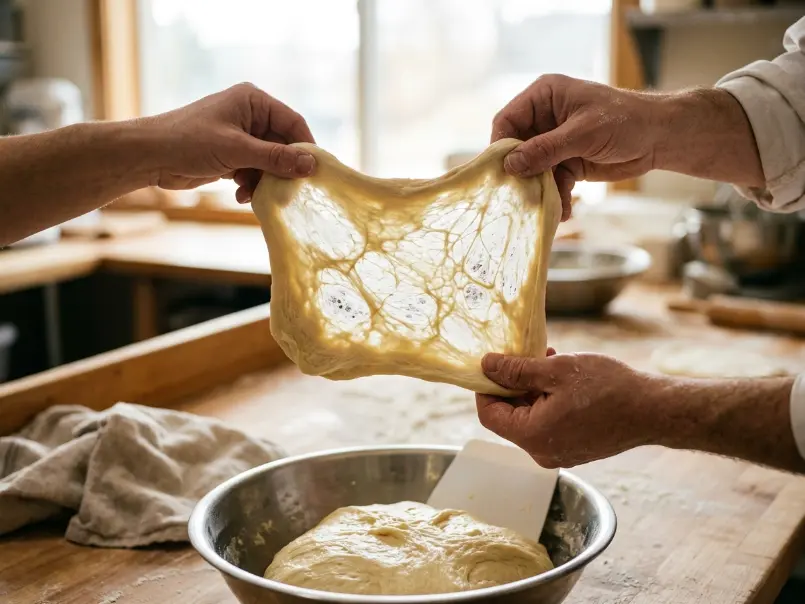
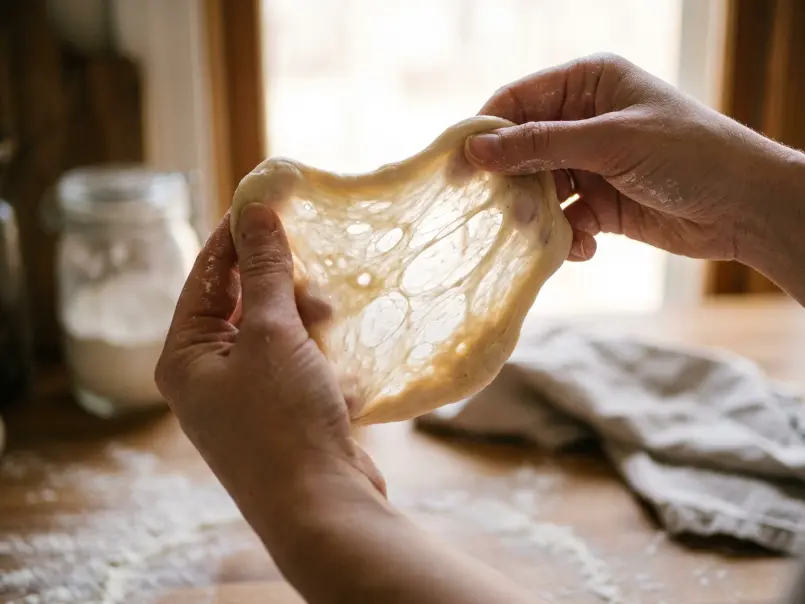
After eight minutes, perform the windowpane test: pinch off a golf ball–sized piece of dough. Gently stretch it between your fingers. If you can stretch it thin enough to see light through it without tearing, the gluten is fully developed. If it tears immediately, knead for another two minutes and test again.
This is the foundation of your Gourmet Brioche Burger Buns. The gluten network must be strong before you introduce fat.
Step 2: The Gluten Window Development
Once the windowpane test passes, add the fine sea salt. Knead on medium speed for one minute to incorporate. Salt tightens the gluten network and adds flavor, but it also slows yeast activity, which is why you add it after initial gluten development rather than at the beginning.
At this stage, your dough should be smooth, elastic, and pulling away from the sides of the mixer bowl. The internal temperature should be between 75–78°F (24–26°C). If it is warmer, the butter will melt too quickly when added. If cooler, the butter will not incorporate smoothly.
This is the critical checkpoint for how to make soft brioche dough: strong gluten first, then fat.
Step 3: The Cube-by-Cube Butter Intrusion
Cut your cold unsalted butter into tablespoon-sized cubes. With the mixer running on medium-low speed, add one cube of butter at a time. Wait until each cube is fully incorporated into the dough before adding the next. This process will take ten to fifteen minutes.
At first, the dough will look like it is breaking—slick, greasy, falling apart. Do not panic. This is normal. As you continue adding butter and kneading, the dough will come back together, eventually forming a smooth, glossy, and incredibly soft mass.
This is butter incorporation in bread science: you are coating the gluten strands with fat without destroying them. The result is the tender, rich crumb that defines Gourmet Brioche Burger Buns.
By the end, the dough should be soft, smooth, slightly sticky, and have a silky sheen. It will be much softer than standard bread dough—this is correct. Brioche is an enriched dough with a high fat content, and it will feel almost too soft to handle.
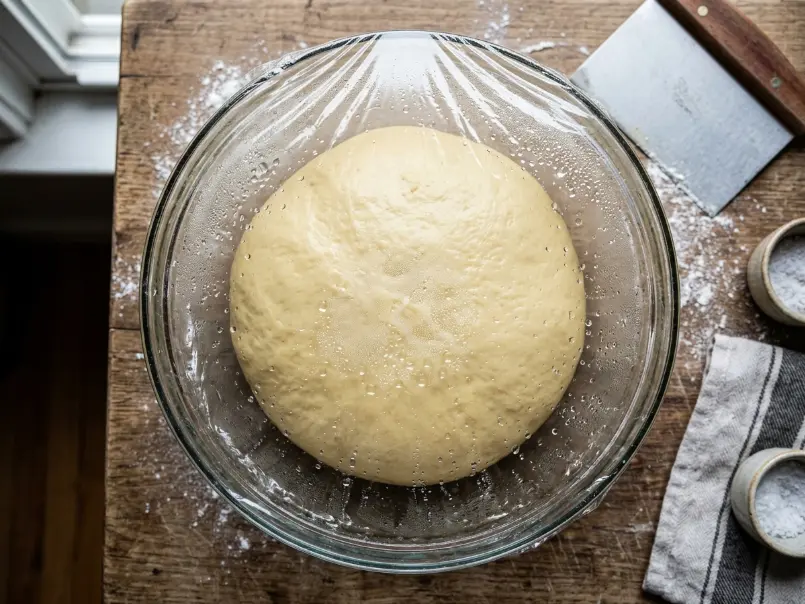
Scrape the dough into a lightly greased bowl. Cover tightly with plastic wrap and let it rise at room temperature (75–78°F / 24–26°C) for one to two hours, until doubled in size.
Step 4: The Chilled Overnight Retardation (Fermentation Master Move)
Once the dough has doubled, punch it down gently to release the gas. Cover the bowl tightly with plastic wrap and refrigerate overnight—ideally twelve to sixteen hours.
This overnight cold fermentation is the secret weapon for making professional-quality Gourmet Brioche Burger Buns at home. The cold temperature slows yeast activity but does not stop it. The yeast continues to ferment, producing complex flavor compounds—organic acids, esters, and alcohols—that give the buns a subtle tang and deep, bakery-quality flavor.
More importantly, the cold firms up the butter inside the dough. When you remove the dough from the refrigerator the next day, it will be firm, smooth, and easy to shape. You can divide it, roll it into tight balls, and achieve the surface tension needed for a beautiful rise and even crumb structure.
Do not skip this step. Room-temperature brioche dough is a sticky, unmanageable mess. Cold brioche dough is a dream to work with.
Step 5: The Precision Weight Shaping
Remove the dough from the refrigerator. It will be cold and firm. Turn it out onto a lightly floured work surface. Use a bench scraper to divide the dough into eight equal pieces—about 110–120 grams each. Weighing each piece ensures uniform baking.
To shape each bun, flatten a piece of dough slightly, then fold the edges into the center, pinching to seal. Flip it seam-side down and cup your hand over the dough. Using gentle circular motions, roll the dough against the work surface, creating surface tension. The goal is a smooth, tight ball with no wrinkles or seams visible on top.
Place each shaped bun seam-side down on a parchment-lined or Silpat-lined baking sheet. Space them about three inches apart—they will expand significantly during proofing and baking.
Cover the buns loosely with plastic wrap or a clean kitchen towel. Let them proof at room temperature (75–78°F / 24–26°C) for one and a half to two hours, until they are puffy, soft, and nearly doubled in size. Press gently with a fingertip—the dough should spring back slowly, leaving a faint indentation.
Do not over-proof. Over-proofed buns will collapse in the oven and have a sour flavor.
Step 6: The Egg Wash Alchemy
Preheat your oven to 375°F (190°C). Position the rack in the center of the oven.
In a small bowl, whisk together one egg and one tablespoon of water until smooth. This is your egg wash.
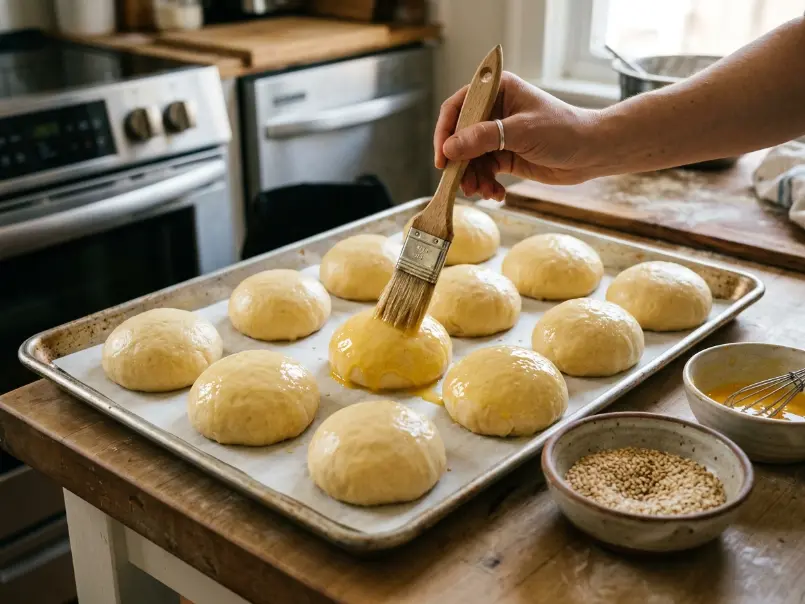
Using a soft pastry brush, gently brush the top of each proofed bun with a thin, even layer of egg wash. Do not let the egg wash drip down the sides or pool around the base—it will cause uneven browning and sticking.
Immediately sprinkle sesame seeds over the tops while the egg wash is still wet.
The egg wash is not just for appearance. The proteins in the egg (albumin and globulin) and the sugars (glucose and lactose from the milk in the dough) react at high heat to create the Maillard reaction and sugar caramelization. This produces the glossy, mahogany-golden crust that makes Gourmet Brioche Burger Buns look and taste like they came from a French bakery.
Without the egg wash, the buns will be pale, dull, and lack that signature shine.
Step 7: The Steam-Assisted Oven Spring
Place the baking sheet in the preheated oven. Immediately toss three to four ice cubes onto the floor of the oven or into a preheated metal pan on the bottom rack. Quickly close the oven door.
The ice cubes create a burst of steam. Steam delays crust formation in the first few minutes of baking, allowing the buns to expand fully—a phenomenon called oven spring. Once the steam evaporates, the crust sets, locking in the airy structure.
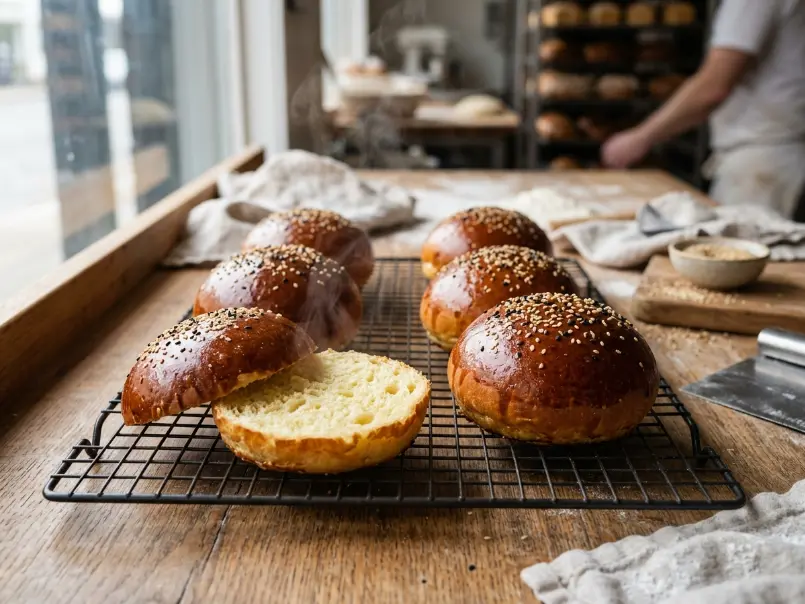
Bake for eighteen to twenty-two minutes, until the tops are a deep, glossy mahogany-gold and the internal temperature reaches 190–195°F (88–91°C).
Remove the baking sheet from the oven and immediately transfer the buns to a wire cooling rack. Let them cool for at least twenty minutes before slicing. Cutting into hot bread releases too much steam and makes the crumb gummy.
The Gourmet Brioche Burger Buns are now ready—soft, rich, perfectly structured, and capable of holding the juiciest burger patty without falling apart.
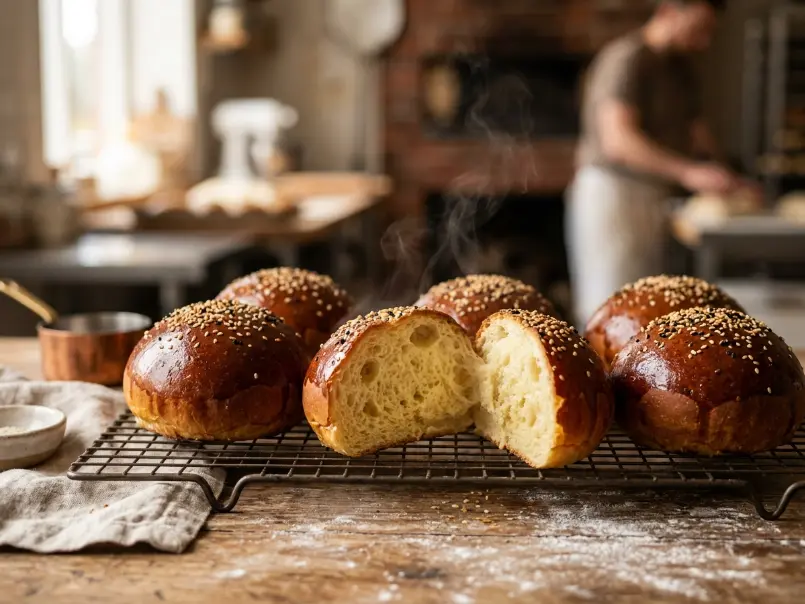

Gourmet Brioche Burger Buns
Ingredients
Equipment
Method
- In the bowl of a stand mixer fitted with the dough hook, combine bread flour, warmed milk (100–110°F), granulated sugar, instant yeast, and 3 whole eggs. Do NOT add butter or salt yet.
- Mix on low speed for 2 minutes until ingredients come together into a shaggy dough.
- Increase to medium speed and knead for 8–10 minutes until dough is smooth, elastic, and slightly tacky.
- Perform the windowpane test: Stretch a small piece of dough thin enough to see light through it without tearing. If it tears, knead 2 more minutes.
- Once windowpane test passes, add fine sea salt.
- Knead on medium speed for 1 minute to incorporate salt fully.
- Dough should be smooth, pulling away from bowl sides, at 75–78°F internal temperature.
- Cut cold unsalted butter into tablespoon-sized cubes.
- With mixer running on medium-low, add 1 cube of butter at a time, waiting until fully incorporated before adding the next. This takes 10–15 minutes.
- Dough will look broken and greasy at first—this is normal. Keep kneading. It will come back together into a smooth, glossy, soft mass.
- By the end, dough should be silky, slightly sticky, with a soft sheen.
- Scrape dough into a lightly greased bowl. Cover tightly with plastic wrap.
- Let rise at room temperature (75–78°F) for 1–2 hours until doubled in size.
- Punch down dough gently to release gas.
- Cover bowl tightly with plastic wrap and refrigerate overnight (12–16 hours).
- Cold fermentation develops flavor and firms up butter for easier shaping.
- Remove cold dough from refrigerator. Turn out onto lightly floured surface.
- Use bench scraper to divide into 8 equal pieces (110–120 g each).
- Shape each piece: Flatten slightly, fold edges to center, pinch to seal. Flip seam-side down.
- Cup hand over dough and roll in circular motions to create a smooth, tight ball with no wrinkles on top.
- Place shaped buns seam-side down on parchment or Silpat-lined baking sheet, spaced 3 inches apart.
- Cover buns loosely with plastic wrap or clean towel.
- Proof at room temperature (75–78°F) for 1.5–2 hours until puffy and nearly doubled.
- Press gently with fingertip—dough should spring back slowly, leaving a faint indentation.
- Preheat oven to 375°F (190°C). Position rack in center.
- Whisk together 1 egg and 1 tablespoon water until smooth.
- Gently brush each proofed bun with a thin, even layer of egg wash using a soft pastry brush.
- Immediately sprinkle sesame seeds over tops while egg wash is wet.
- Place baking sheet in preheated oven.
- Immediately toss 3–4 ice cubes onto oven floor or into a preheated metal pan on bottom rack. Quickly close door. (Steam creates oven spring.)
- Bake 18–22 minutes until tops are deep, glossy mahogany-gold and internal temp reaches 190–195°F.
- Remove from oven and immediately transfer buns to a wire cooling rack.
- Let cool at least 20 minutes before slicing. Cutting hot bread makes the crumb gummy.
- Slice horizontally and use for gourmet burgers.
Notes
Chef Mansoor’s Insight
The transformation of humble flour, fire, and fat into a soft brioche architecture bridges the gap between classic French viennoiserie and the rugged, democratic excellence of the American backyard barbecue. These Gourmet Brioche Burger Buns are proof that technique is not elitism—it is generosity. The overnight cold fermentation, the delayed butter incorporation, the precision shaping—these are not obstacles. They are rituals that transform ingredients into something greater than their parts. When you serve a burger on a brioche bun you made yourself, you are saying: this meal matters. You matter. And that is the quiet power of baking.
— Chef Mansoor, Flavour Bazar
Nutrition Information (Per Bun, Makes 8)
| Nutrient | Amount |
|---|---|
| Calories | 310 kcal |
| Protein | 8 g |
| Carbohydrates | 35 g |
| Dietary Fiber | 1 g |
| Sugars | 7 g |
| Total Fat | 15 g |
| Saturated Fat | 9 g |
| Monounsaturated Fat | 4 g |
| Sodium | 280 mg |
| Cholesterol | 110 mg |
Note: Nutrition values are estimates based on standard ingredient measurements. Gourmet Brioche Burger Buns are enriched with butter and eggs, making them higher in fat and cholesterol than standard burger buns.
Storage, Freezing & Baking Safety
| Storage Method | Duration | Best Practices |
|---|---|---|
| Room temperature (airtight container) | 2 days | Store in airtight container or ziplock bag |
| Refrigerator | Not recommended | Refrigeration accelerates starch staling (retrogradation) |
| Freezer (baked buns) | 3 months | Wrap individually in plastic, then in freezer bag. Thaw at room temp, toast to refresh |
| Dough (after overnight retardation) | 1 day | Shape and bake within 24 hours of removing from fridge |
Baking Safety & Yeast Viability:
| Temperature Zone | Effect on Yeast |
|---|---|
| 40–50°F / 4–10°C | Yeast dormant; slow fermentation (cold retardation) |
| 75–78°F / 24–26°C | Ideal proofing temperature; active fermentation |
| 100–110°F / 38–43°C | Ideal for dissolving yeast in liquid |
| 120°F / 49°C+ | Yeast begins to die |
| 140°F / 60°C+ | Yeast completely killed |
Starch Retrogradation Prevention:
When you freeze baked Gourmet Brioche Burger Buns, the cold temperature halts the starch retrogradation process that makes bread go stale. To refresh frozen buns, let them thaw at room temperature for one hour, then toast lightly. They will taste freshly baked.
FAQ: Gourmet Brioche Burger Buns
Can I make this dough by hand?
Yes, but it is extremely difficult. The butter incorporation requires vigorous, sustained kneading that is exhausting by hand. A stand mixer is strongly recommended for consistent results with Gourmet Brioche Burger Buns.
Why do I have to add butter slowly?
Adding all the butter at once overwhelms the gluten network. Gradual incorporation allows the dough to absorb the fat smoothly without breaking. This is critical for how to make soft brioche dough with the right texture.
Can I use all-purpose flour?
No. All-purpose flour has too little protein (10–11%) to build the strong gluten network needed to support the high fat content. The buns will be dense and flat. Only bread flour works for Gourmet Brioche Burger Buns.
What if my dough is too sticky after adding butter?
This is normal. Brioche dough is very soft and slightly sticky. Do not add extra flour. Continue kneading, and it will come together. If it remains soupy after fifteen minutes, refrigerate for thirty minutes to firm up the butter.
Can I skip the overnight refrigeration?
You can, but the dough will be very difficult to shape and the flavor will be less complex. The overnight cold retardation is what makes these Gourmet Brioche Burger Buns taste professional.
Why are my buns pale instead of golden?
You either skipped the egg wash or your oven temperature is too low. The egg wash for shiny bread crust is essential for color and shine. Bake at 375°F (190°C) and brush generously with egg wash.
How do I know when the buns are done?
Use an instant-read thermometer. The internal temperature should be 190–195°F (88–91°C). Visually, the tops should be a deep, glossy mahogany-gold.
Can I add flavors to the dough?
Yes. You can add garlic powder, dried herbs, or grated cheese after the butter is incorporated. Keep additions minimal (1–2 tablespoons) to avoid interfering with gluten structure.
You Might Also Love These Flavour Bazar Recipes
Smoky Chipotle Burger Patties
The ultimate beef patty engineered to pair with these Gourmet Brioche Burger Buns
Garlic Herb Grilled Potatoes
Perfect side dish for a gourmet burger night
Classic American Potato Salad
The traditional BBQ side that complements rich, buttery buns
Sparkling Raspberry Lemonade
A refreshing beverage to balance the richness of brioche and beef
For More Healthy Recipes Visit: flavourbazar.com